



Overview
- Meta’s 2026 holiday guide argues that shoppers expect trust and convenience at the same time, and the guide shows how to deliver both through Reels, creators, and AI-driven conversion tools.
- Creators are positioned as central to holiday performance as 94% of shoppers look to them for holiday guidance and partnership ads outperform standard ads by a wide margin.
- House of Marketers‘ Insights on how this affects marketers.
Meta has recently released its 34-page 2026 holiday marketing guide titled “Winning Hearts and Boosting Carts”. and it makes one core argument: brands that wait until November to plan their holiday push are already behind.
The guide lays out where holiday shoppers spend their time, why creators have become central to driving purchase decisions, and a quarter-by-quarter timeline for building campaigns months ahead of peak season.
The headline data point is what Meta calls the “dual mandate.” According to Meta-commissioned Kantar research, 82% of consumers need to trust a brand before buying from it, while 79% say convenience is a very important factor in their purchase decision. Meta’s takeaway is that these two things aren’t competing priorities to balance — they’re what every shopper expects at the same time, in the same scroll. The rest of the guide is essentially a playbook for delivering both.
Meta’s framework: Hearts earn the right, Carts close the deal
Meta structures its recommended strategy around two halves working together rather than competing for budget.
Part 1: Winning hearts
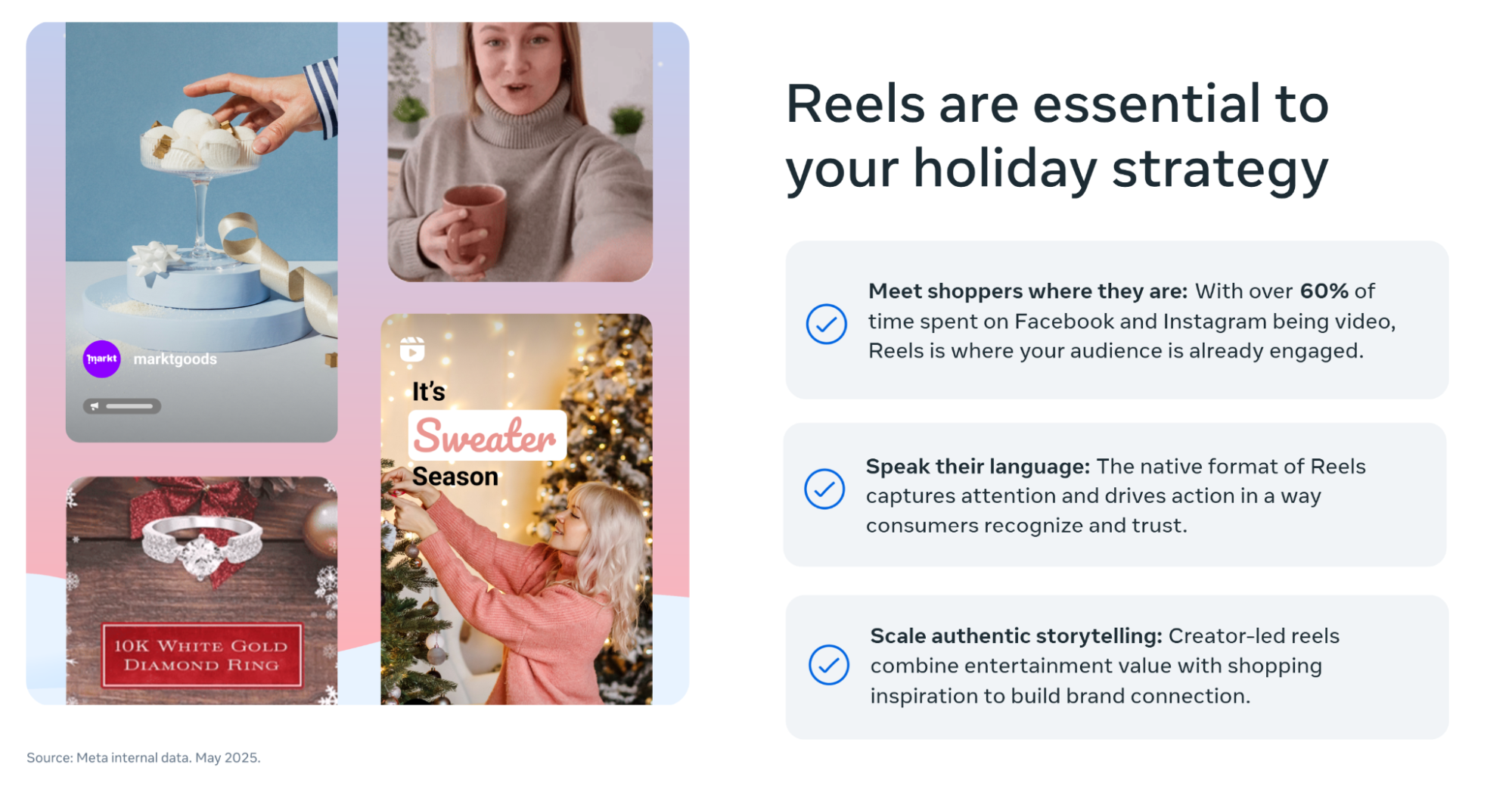
This part covers Reels, creator partnerships, and storytelling aimed at building trust. The guide cites that video content now accounts for more than 60% of time spent on Facebook and Instagram, which is the basis for its recommendation that Reels sit at the centre of awareness campaigns
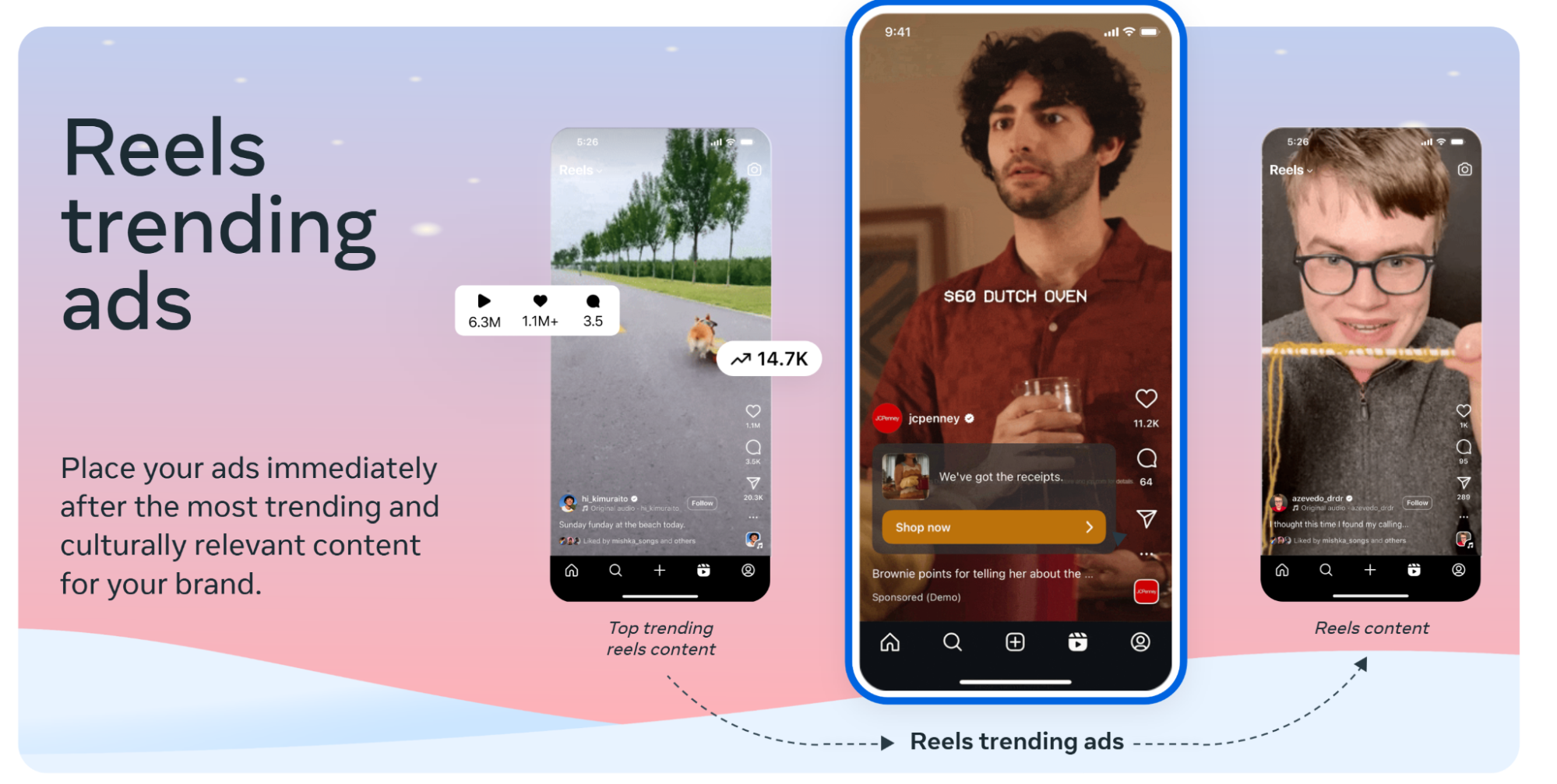
It also highlights a newer ad format, Reels trending ads, which place ads immediately after high-performing, culturally relevant Reels content in categories like beauty, food, sports, and music.
Part 2: Boosting carts
This part covers the AI-driven tools Meta wants advertisers to lean on for conversion: Advantage+ sales campaigns, Advantage+ catalogue ads, and omnichannel optimisation.
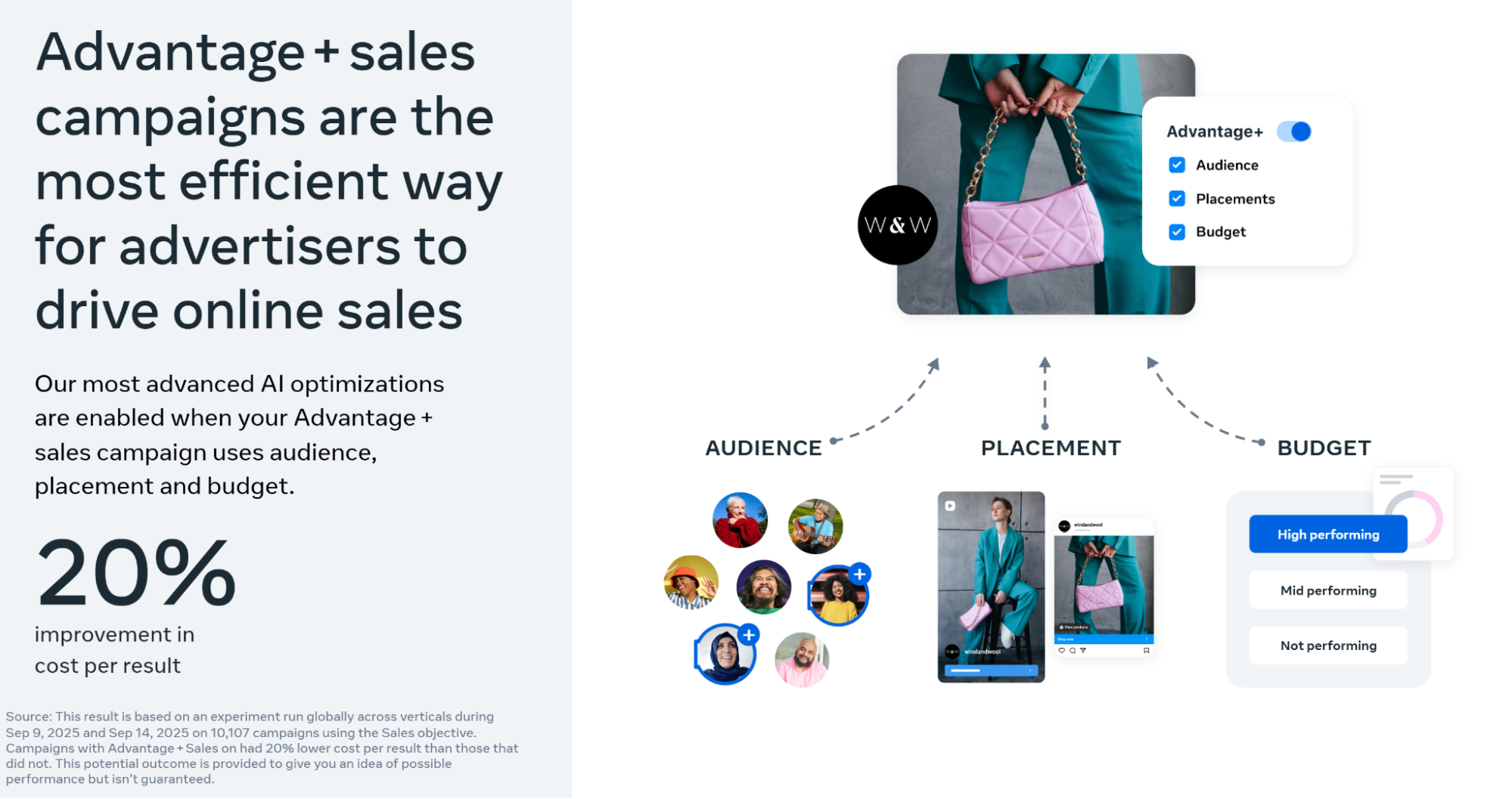
The guide reports a 20% improvement in cost per result when Advantage+ sales campaigns use automated audience, placement, and budget settings together.
Meta’s framing is that these two halves aren’t sequential. A shopper might discover a product through creator content, get a personalised recommendation based on that interest, then complete the purchase wherever is easiest for them, in-app, on a website, or in-store, with each step happening inside the same ecosystem.
Social Search & Creators Are Central to Meta’s Holiday Strategy
For anyone working in influencer marketing, this guide cements the belief that creators aren’t positioned as a nice-to-have add-on to paid media. They’re framed as the mechanism that makes the entire “hearts” half of the strategy work.
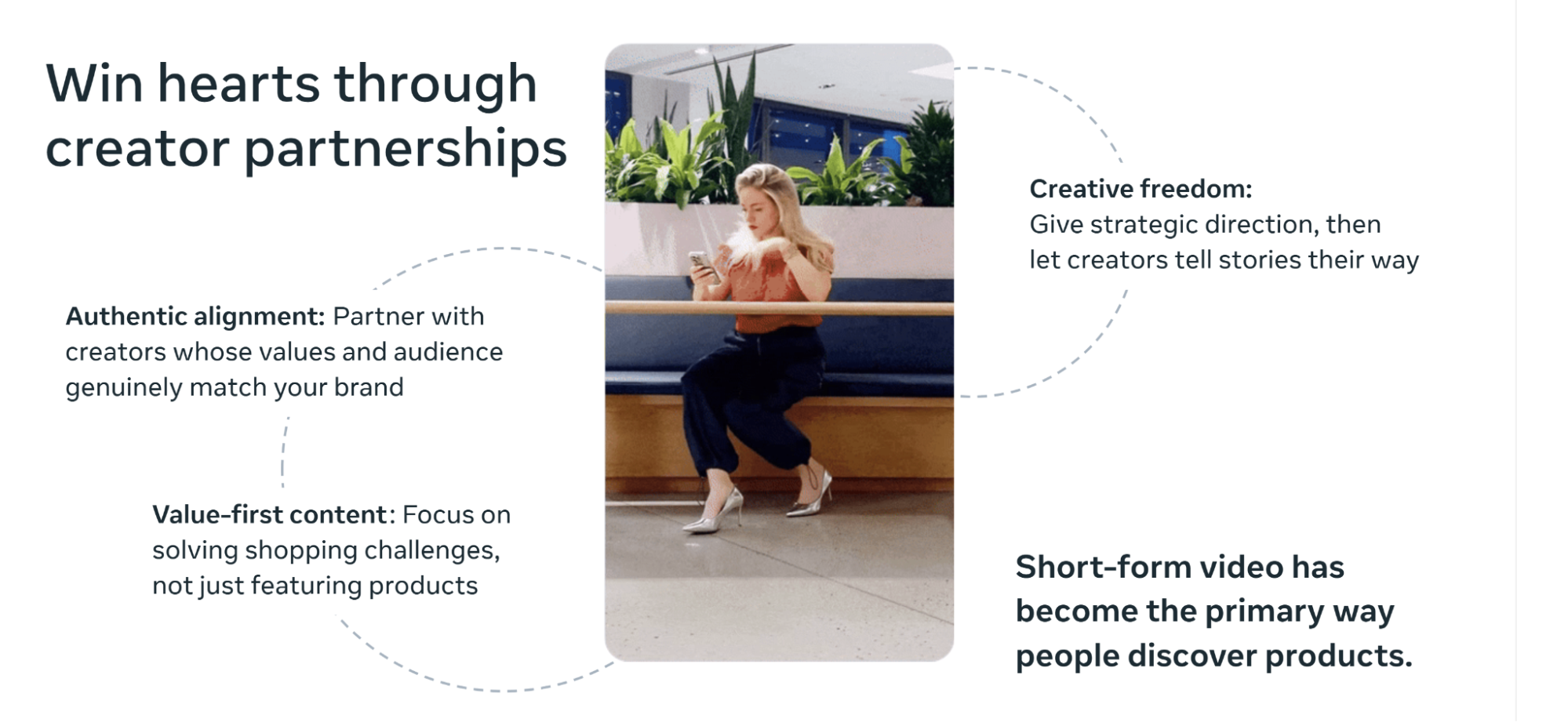
Meta reports that 94% of shoppers look to creators for holiday guidance, and 57% say creators directly influence their purchase decisions. The guide’s language is notably direct about why: a brand telling shoppers a product is good is expected obviously, but when a creator the shopper already trusts does that same thing it carries weight which a brand can’t replicate on its own.
Meta also pushes advertisers toward Partnership ads. These are ads which let brands run paid media through a creator’s handle, are positioned as the most effective way to scale creator relationships.
The guide cites a 50% higher click-through rate and a 99% probability of outperforming business-as-usual ads when partnership ads are layered into an always-on strategy, based on a meta-analysis of a dozen lift studies. It also reports that 71% of consumers make a purchase within a few days of seeing creator content on Meta’s platforms.
3 Creator Content Types That Drive Holiday Conversions
On the practical side, the guide recommends three creator content types mapped to different stages of the shopping journey:
- Gift guides for discovery,
- product reviews for evaluation
- Sales or discount updates for the purchase moment itself.
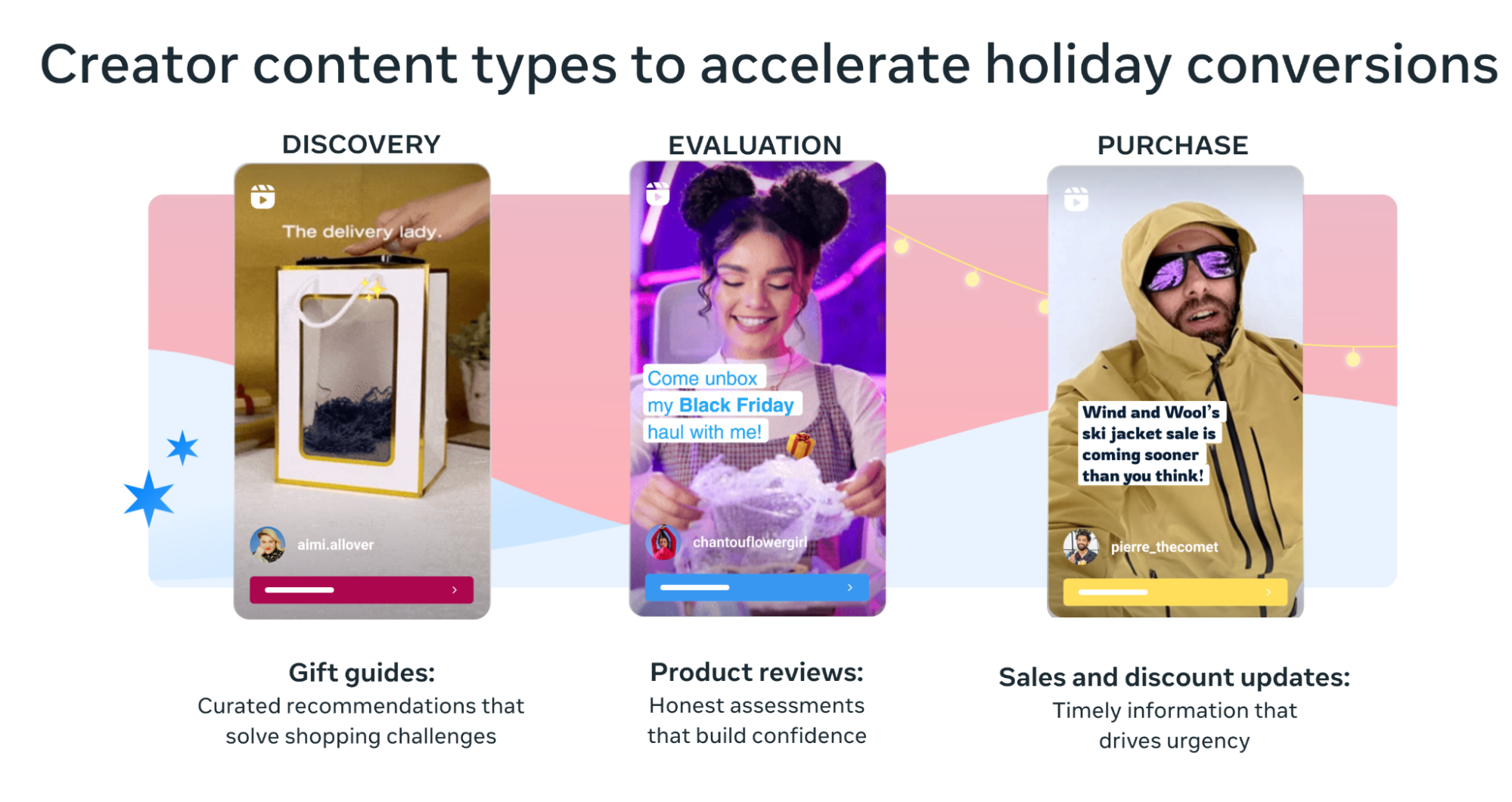
You can use Meta’s Creator Marketplace tool for finding and vetting partners. We suggest that you should give creators strategic direction rather than tightly scripted briefs, on the basis that over-controlling the content undermines the authenticity that makes it effective in the first place.
Read more on how to get started with an influencer marketing campaign that sets you up for success
Meta’s Q2–Q4 Holiday Planning Timeline
Meta’s guide pushes back hard against last-minute holiday planning, laying out a three-quarter build that starts well before peak season.
In Q2, the recommendation is to identify aligned creator partners, develop strategic content briefs, and set up an integrated measurement framework.
Q3 is positioned as the testing phase: launching creator content and partnership ads, trialling Advantage+ sales campaigns, and setting up omnichannel attribution so brands can see what’s actually working before committing serious budget.
By Q4, the idea is to scale what’s already been proven rather than start from scratch, running the full integrated strategy with real-time optimisation across all touchpoints.
As the guide puts it, the gap between brands that front-load this work and those that don’t is “what separates strong holiday performance from expensive guesswork.”
What this means heading into Q4 2026
For marketers, the practical takeaway is less about any single tactic and more about timing and integration. Meta is explicit that the learning phase for its AI optimisation tools takes time, so campaigns that aren’t live until November are starting from a disadvantage against those that have been running and refining since the summer. The guide also flags AI-driven product discovery as a new variable worth testing now: advertisers are encouraged to check whether AI tools recommend their products for relevant searches, and to enrich product catalogues with detailed descriptions, use cases, and customer reviews accordingly.
Whether this guide reflects genuine best practice or simply Meta’s commercial interest in advertisers committing budget earlier and using more of its automated tools is a fair question, and likely both are true at once. Either way, the data points are specific enough, and the creator-economy emphasis is strong enough, that the guide is worth a proper read for anyone setting holiday strategy this year.
At House of Marketers, we work with brands to design influencer marketing strategies built around how shoppers actually discover and buy today. We start by pairing the right creators with content structured for each stage of the journey, then using paid media boosting to scale what’s working ahead of peak season rather than scrambling for it in Q4. If you’re mapping out your 2026 holiday strategy, Contact for Free Campaign Proposal and let’s build it properly, starting now.