Somehow, Zohran Mamdani had the whole internet rooting for him. Even people nowhere near New York were invested in what he had to say. This type of internet virality comes from creator partners that make sense. Zohran used storytelling and visuals designed to snag the doom-scrolling rhythm. And because everything felt human and aligned with his cause, people turned from passive viewers into active supporters. His campaign became a live case study in how influencer marketing works when it’s built for the feed but continues to move people offline
Let’s break down what made it so effective. But to understand the strategy, you need a quick snapshot of who Mamdani is.
Who is Zohran Mamdani, and Why Does His Message Hit Home
Before his campaign lit up every corner of social media, Mamdani was almost unknown outside his district. Born in Uganda to Indian parents, he moved to New York at age seven. By the time he launched his bid for mayor, he was seen as an energetic community-focused leader with a clear theme: New York is too expensive, and people can’t afford to stay.
With this message, he entered the mayoral race polling at one percent. Within months, he’d become a national figure and ultimately win the mayoral race.
His message on affordability resonated widely, but the real breakthrough came from how he packaged and delivered it
The Internet Sweep: How a 1% Candidate Became a Household Name
Every corner of the internet felt like it suddenly knew Zohran. He was gaining support as well as cultural attention.
His campaign understood the city’s language landscape better than most brands try to. Estimates suggest that New York State residents speak over 800 languages. Mamdani didn’t overlook this reality. He approached New Yorkers in the languages they were already speaking at home.
He spoke about affordability concerns in Hindi, Urdu, Bangla, Spanish, and more. These messages didn’t just stay on Instagram; they flowed into text threads, WhatsApp chats, and family group discussions. They moved from platform to platform like sparks carried by the wind.
Soniya Munshi, associate professor in urban studies, told Al Jazeera,
“I saw his Hindi/Urdu video move from Instagram to text chats among second-generation South Asians to WhatsApp family threads to discussions about Zohran’s platform for an affordable NYC,” said Munshi, who herself is a second-generation South Asian New Yorker. “These videos opened up a bigger conversation with friends, families, and communities about our experiences, our conditions, our own hopes for the city we call home, and they also moved voters to come out for Mamdani.”
That’s the kind of resonance marketers often fail to achieve.
The Marketing Architecture Behind Mamdani’s Mayoral Campaign
Mamdani’s campaign strategy stayed grounded in real interactions and clear communication. He treated New Yorkers like neighbours instead of numbers, stepping into their daily routines and cultural spaces with ease.
Influencer Collaborations That Drove Zohran’s Success
Mamdani’s influencer partnerships were never scattershot.
He paired up with creators whose voices were already rooted in the corners of the city he hoped to energise.
His collaboration with SubwayTakes made immediate sense because his stance on free public transit aligned with a creator whose audience spends half their time navigating subway stations. That collaboration felt like two regular riders swapping stories on the subway.
View this post on Instagram
His partnership with Shop Cats carried that same everyday warmth. Bodegas are pockets of the city where people pick up milk, gossip, and maybe pet a cat. Showing up in that world wasn’t a gimmick. It was a small nod to the lives of people trying to stretch every dollar in a place that keeps getting more and more expensive.
View this post on Instagram
And when he joined food influencers exploring the diverse cuisine NYC has to offer, it felt like he was inviting viewers to pull up a chair beside him. Those videos didn’t feel engineered. They looked like the sort of content New Yorkers already consume on quiet evenings when they scroll through recommendations for what to eat next. The message and the messenger were in perfect rhythm, and that’s why audiences leaned in.
View this post on Instagram
Brutal Simplicity in Messaging
Mamdani stayed anchored in one theme: affordability. His statements weren’t packed with political jargon.
This simplicity gave his message room to breathe.
It also made it easier for creators, voters, and communities to repeat it in their own words. That’s the quiet strength of a single, clear idea. It travels. It becomes conversational. It becomes personal.
Marketers are often tempted to stack multiple messages, but Mamdani demonstrated how powerful it is to sit confidently inside one narrative and let it echo through every touchpoint.
Community Building That Thrived Online and Showed Up Offline
The heart of his campaign lived in small moments that found their way online. There is something familiar about seeing him stop to chat with a taxi driver or crouch down to meet a bodega cat. These scenes felt like glimpses into a neighbor’s day, not a politician’s schedule.
Online, these moments took on a life of their own. The warmth of these experiences didn’t vanish when they hit the feed. That’s partly because Mamdani used social media the way creators do. He filmed in first person. He spoke directly. He avoided the polished distance that can make political messaging feel cold.
Creators amplified these interactions even further. Channels like SubwayTakes and Are You Okay? extended his reach and pulled him deeper into communities that saw parts of themselves reflected in his interactions.
The Visual Branding That Made People Stop Scrolling
The visual identity of the campaign carried just as much weight.
There were no muted blues or predictable flag motifs. Instead, they reached for sharp purples and deep golds, colors that felt young, bold, and undeniably New York. The typography echoed bodega store signage, the kind you see taped to windows with thick black markers and fluorescent backgrounds. It felt handmade in the best way.
Memes drawn from South Asian cultural references added another layer of texture, especially for younger voters who move quickly between humor and politics without separating the two.
All of this came from Melted Solids, a Brooklyn-based digital agency that had been shaping Mamdani’s online presence for years. They were behind his first viral video, the one that crossed 3.5 million views on X. Their long history with him meant every piece of content arrived already tuned to his voice.
This design language differentiated him and made people stop scrolling. It told voters, “This campaign understands YOU and the city you live in.”
It’s a reminder of what the right creative partner can do. Agencies like House of Marketers build creator-first strategies for brands, helping campaigns hit the feed with clarity, context, and content people want to engage with.
A Meme-Forward Campaign Strategy That’s Designed for the For-You-Page
His social media content is as gen z as can be. All dolled up with quick cuts, trending sounds, a touch of silliness, and a sense of momentum. Yet beneath the lighthearted packaging, the substance remained clear. He explained political concepts in a friendly tone. He talked about tax policy without draining the color out of it. He broke down tenant rights in a way that made people feel informed instead of overwhelmed. And the whole thing was wrapped in meme-y merch and lighthearted jokes like “Cats for Zohran,” which kept the campaign feeling playful instead of heavy.
Even his request for supporters to stop donating after reaching the campaign cap and to volunteer instead felt like a breath of fresh air. That sort of honesty carries weight, especially in an era where audiences read authenticity quicker than they read captions.
He proved a point marketers have felt for years: if your message isn’t built to move through TikTok, Discord, meme pages, and Reels, it won’t reach the younger audiences who increasingly shape public opinion.
Why Paid Ads Perform Better When the Story Already Resonates
The numbers from the race make the strategy even clearer. Mamdani spent around $240,000 on digital ads during the final stretch. Other candidates spent more than $775,000 across four platforms, with over $300,000 going into Meta alone. Mamdani spent nothing on Meta.
Analysts estimate that Mamdani spent about $19 for every vote he earned. Other candidates spent about $87. Money wasn’t the deciding factor. Storytelling, community & trust were. Mamdani’s campaign invested in the kind of engagement that lingers long after an ad impression fades.
This contrast in digital spend highlights a familiar marketing truth: attention doesn’t come from budget alone. One approach relied on paid reach, while the other leaned heavily on organic content shaped by community participation.
Paid ads still matter, but they only work when they’re paired with content people actually want to engage with.
At House of Marketers, we help brands strike this balance through our Paid Media Boosting services. We take the creator content and paid social ads already working well and amplify them in the right places, so you’re not spending to chase attention, you’re spending to scale it.
What Mamdani’s Campaign Teaches Us About Modern Audiences
Instead of relying on traditional outreach methods, Mamdani built something closer to a content ecosystem. His videos looked like what people already watched on their phones at lunch. They featured real New Yorkers and real conversations instead of carefully staged speeches. The humor felt natural. The cultural references felt familiar.
He didn’t wait for voters to find him. He met them where they already were, on TikTok, in Instagram Reels, on creator pages, and in shared WhatsApp threads. He offered content that aligned with the rhythm of their daily lives. That’s why trust formed so quickly.
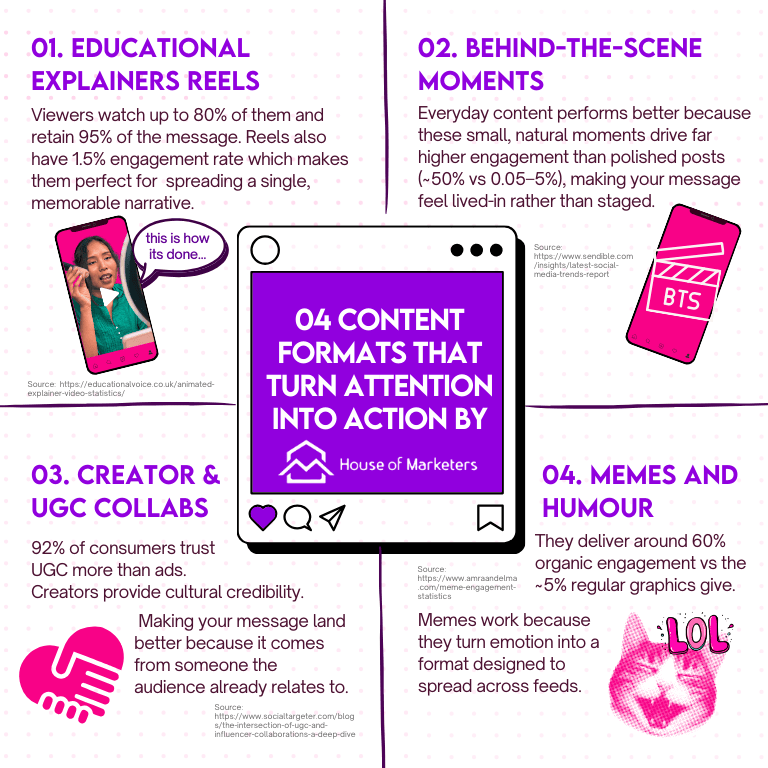
Influencer partnerships, multilingual outreach, visual creativity, and community engagement all flowed together as one unified system. Nothing felt out of place. Nothing felt forced. That cohesion made the campaign unmistakable.
The Final Lesson for Marketers
The shape of marketing is changing. Mamdani’s social media marketing showed exactly how. He didn’t run a campaign built around old formats. He built a creator-driven approach shaped by the city’s culture.
Simple messages cut deeper than complex ones. Cultural fluency builds relationships that no amount of spending can buy. Real moments stay with people longer than polished ads. Creator partnerships reach communities that traditional tactics can’t touch. Bold visuals help you claim space before you say a word. And authentic community engagement moves people to act.
Turn These Insights Into Action
If Mamdani’s campaign proved anything, it’s that people respond to messages that feel close to their lives. Brands are no different. When you show up in the feed with cultural fluency, creator-led storytelling, and content that feels human, your audience leans in.
At House of Marketers, we help brands build that kind of connection every day. From d’Alba’s global skincare growth to Invoice Fly’s 70K+ downloads and NN Insurance’s 6.9M video views, our creator-led systems turn authentic moments into lasting growth.
Explore our Instagram Influencer Marketing Services to learn how to design campaigns that move with culture and see what creator-first marketing can do for your brand.

House of Marketers (HOM) is a leading TikTok Marketing Agency. Our global agency was built by early TikTok Employees & TikTok Partners, which gives us the insider knowledge to help leading brands, like Redbull, Playtika, Badoo, and HelloFresh win on TikTok. Want us to convert more of Gen Z and Millennials with TikTok? Get in touch with our friendly team, here.