




Why sing your own praises when you can have someone else do it for you, often better than you ever could?
Influencers shape consumer decisions at every stage of the buying journey, and yet most small businesses still jump in without a strategy, pick the wrong creators, and wonder why it didn’t work.
If you’re wondering how to do social media influencer marketing in a way that actually moves the needle, the answer isn’t just “find someone with a big following and hope for the best.” It takes a strategy, especially one tailored to your brand goals and your audience.
That’s exactly what this guide covers. House of Marketers walks you through 5 proven steps to build an influencer marketing strategy that delivers real results.
What is influencer marketing?
Influencer marketing is a strategy where brands partner with individuals who have an established audience on social media platforms to promote their products or services authentically. Unlike traditional advertising, it works because the recommendation comes from a trusted voice the audience already follows. When done well, it drives brand awareness, engagement, and sales far more efficiently than most paid channels.
How to Do Social Media Influencer Marketing
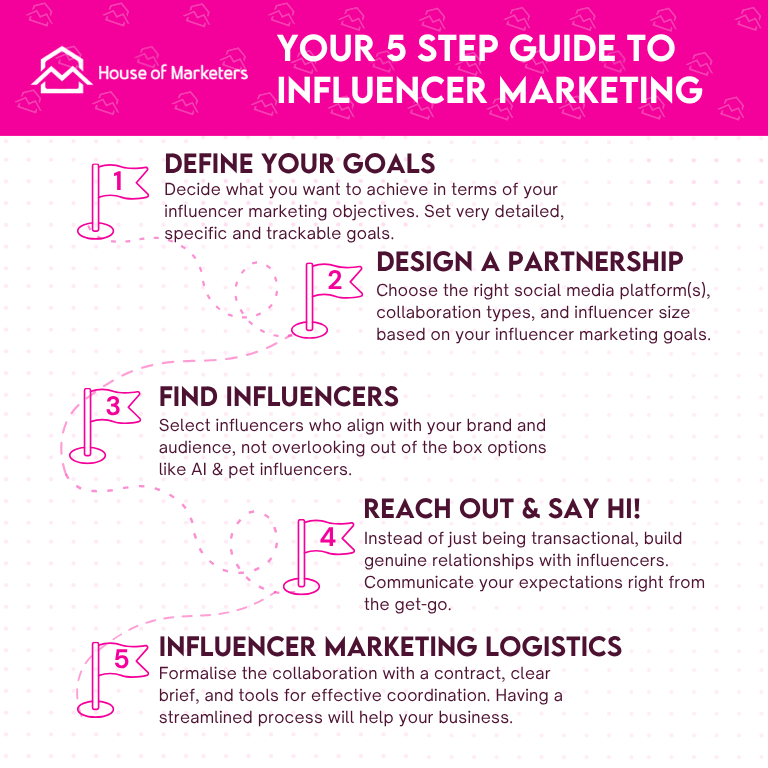
The full breakdown of each step is covered in detail below. But here’s the complete framework at a glance:
- Define clear, measurable goals: Decide what success looks like before anything else. Are you building brand awareness, driving sales, or growing your following? Your goal determines every decision that follows.
- Map your ideal influencer collaboration: Choose your platform, content format, influencer tier, and how many creators you need. Match these decisions to your budget and campaign goals.
- Find relevant influencers: Look for creators whose audience matches your target customer, not just their follower count. Authenticity and audience fit matter more than reach.
- Reach out and build relationships: Contact influencers with a personalised pitch, not a generic template. Focus on building a genuine partnership, not a one-off transaction.
- Set up a smooth collaboration process: Put a contract in place, write a detailed brief, and establish clear systems for payment, communication, and performance tracking.
How to Do Social Media Influencer Marketing
Step 1: Define Clear, Measurable Influencer Marketing Goals
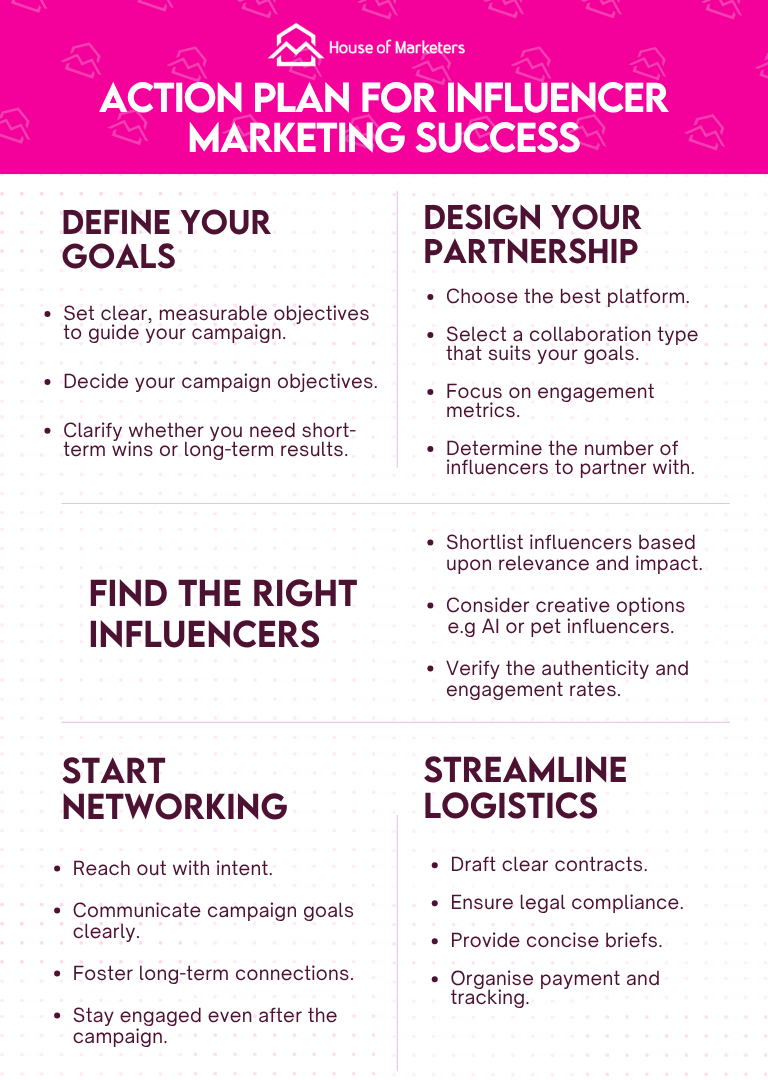
Setting clear, measurable goals is crucial for tracking progress and optimising your campaign. Ask yourself the following questions to help guide your objectives:
- Are you looking to increase brand awareness or to grow your social media following and engagement?
- Are you looking to drive traffic to your website or do you want to boost sales of a specific product?
- Are you trying to increase revenue across the board or just looking to promote an event or product launch?
- Do you need long-term brand advocates or is this a short-term arrangement?
Once you gain clarity on this step, you will have a better understanding of where influencer marketing fits into your overall marketing strategy as you go on over to step 2.
Step 2: Map Your Ideal Influencer Collaboration
Once you’ve defined your goals, it’s time to pinpoint the influencers and collaboration types that align with your strategy. You need to determine five things to map your ideal influencer partnership(s) that are best suited to your campaign.
- Choose the Platform(s) for Your Influencer Marketing Campaigns
- Decide the Type of Collaboration to Meet Your Goals
- Determine the Size of Influencers Based on Your Budget
- Determining the Right Metrics for a Successful Campaign
- Decide on the Number of Creators to Partner With
Let’s explore these elements in more detail.
Choose the Platform(s) for Your Influencer Marketing Campaigns
There isn’t a one-size-fits-all answer when it comes to choosing the right platform. The key is identifying where your target audience spends their time and focusing your influencer marketing efforts on that platform.
- TikTok is great for fast-paced, engaging content and reaching younger audiences with trends and challenges. It’s ideal for short, snappy content that goes viral quickly.
- Instagram is perfect for highly visual content like beauty, fashion, and lifestyle, offering a mix of Stories, Reels, and in-feed posts.
- YouTube allows for longer-form content, perfect for in-depth reviews, tutorials, or unboxing videos, which can provide more detailed product showcases.
- Facebook and Twitter work well for building conversations and driving engagement through posts and community-focused content, especially for brands with a strong social element.
Expanding your presence across multiple platforms can be highly beneficial, however, it’s wise to start small. Focus on one platform first, gather insights on what works best for your brand, and then gradually expand to other platforms as you refine your strategy.
Read more:
- TikTok SEO Explained: How to Boost Visibility and Grow Audience on TikTok
- Brand Strategy Guide: How To Go Viral on Instagram
- How to Get TikTok Famous: Ultimate Brand Guide
Decide the Type of Collaboration that Meets Your Goals
Which type of collaboration should you create with influencers?
It depends on your budget and campaign goals. Here are some options to try according to your influencer marketing campaign goals:
- Sponsored posts are ideal for increasing brand awareness or promoting a specific product. You provide influencers with a brief to create content that includes your brand or product, organically.
- Giveaways are excellent for growing your social following or driving engagement. You can host giveaways, generate excitement, and encourage audience participation.
- Product reviews allow influencers to offer their genuine opinions, while unboxing videos generate excitement around a launch.
- Affiliate marketing is ideal for driving sales. Such partnerships allow influencers to earn a commission for every sale they generate via links or discount codes.
Each type of collaboration serves different purposes, so it’s important to choose one that aligns with the metrics you’re looking to improve.
Size of Influencers To Look for Based on Your Budget
It’s easy to assume that a higher follower count translates to better results, but that’s not always the case. In fact, micro-influencers have higher engagement rates.
Nano-influencers (1K–10K followers) are becoming increasingly popular among marketers, especially those with fewer than 500 followers, who seem to have the highest engagement rates at 2.53%,
Micro-influencers (10K–100K followers) are also popular because they offer a good balance between reach and authenticity, although their usage has slightly declined in recent years.
View this post on Instagram
Macro influencers, though less frequently used, still play a crucial role for brands aiming for mass-market appeal. Established brands often leverage trending topics to organically promote their products to broader audiences.
Why the difference? It all comes down to relatability. Audiences often feel a stronger connection with a regular person sharing everyday experiences than with high-profile celebrities.
Choose The Right Metrics
When selecting influencers, it’s essential to focus on the metrics that will have the greatest impact on your campaign. Here are some key metrics to consider:
Analyse Engagement Rate
Look at engagement metrics, i.e., likes, comments, and shares, to gauge how well the influencer’s content resonates with their audience. As a benchmark, aim for an engagement rate above 3% for micro-influencers and above 1.5% for macro-influencers. Anything below 1% is a red flag, regardless of follower count.
Given recent developments with AI in Meta’s algorithms, follower engagement is more important than ever, as it determines more than you’d think. Read more about that here.
Measure Follower Growth & Engagement
Keep an eye on how many new followers your brand gains during the campaign. Ideally, a campaign should drive a measurable uplift of at least 3–5% on your existing follower count. This indicates how effectively the influencer is expanding your reach. If follower growth is flat despite a high impressions rate, the influencer’s audience likely isn’t aligned with your brand.
Track Lead Generation and Conversions
Track the number of direct messages, website visits, and email sign-ups generated by the campaign using UTM parameters on every link the influencer shares. For conversion-focused campaigns, a click-through rate (CTR) above 1% is considered solid for influencer content. Cost per engagement (CPE) under $0.20 is strong for most niches. If you’re paying more than $0.50 per engagement, reassess either the creator or the content format.
Measure Brand Values Alignment
Finally, vet every influencer for brand values alignment before outreach. Check their last 12 posts for consistency in tone, audience comments for sentiment, and their history for any controversies. Use an audience authenticity tool like HypeAuditor or Modash to verify that their followers are real; a fake follower rate above 20% is an immediate disqualifier, regardless of how strong their other metrics look.
Decide on the Number of Creators to Partner With
A single, well-chosen influencer is perfect for targeting a specific niche, ideal for smaller brands. Collaborating with multiple influencers lets you reach diverse audiences and test different segments.
This is because in most campaigns, a small percentage of creators drive the majority of results, while the rest contribute marginally. Collaborating with a bigger number of influencers helps you find out which influencers are the best fit for your brand.
This will help you allocate your funds better, so that you are spending on the creators who work the best. In the long-term this will maximise your influencer marketing ROI too.
Just remember, managing these relationships requires significant effort—we’ll dive deeper into this in Step 5.
Step 3: Find Relevant Influencers
A single, well-chosen influencer is perfect for targeting a specific niche, ideal for smaller brands.
Collaborating with multiple influencers lets you reach diverse audiences and test different segments.
A single, well-chosen influencer is perfect for targeting a specific niche, ideal for smaller brands.
Collaborating with multiple influencers lets you reach diverse audiences and test different segments.
This is because in most campaigns, a small percentage of creators drive the majority of results, while the rest contribute marginally. So do not spend on all creators equally. Allocate your funds so that you are spending on the creators who work the best. This will help minimise campaign spend on creators who are not working for your campaign’s goals.
In the long-term this will maximise your influencer marketing ROI too.
Just remember, managing influencer relationships at this scale requires significant effort—we’ll dive deeper into this in Step 5.
View this post on Instagram
But it doesn’t stop there, AI influencers are another growing trend. For instance, virtual influencers like Lil Miquela (with over 2.5 million followers) are tapping into new audiences and creating a buzz for brands.
View this post on Instagram
Step 4: Start Reaching Out to Relevant Influencers
Now that you know “what” you want, you want to think about “how” you’ll get it.
Once you’ve identified potential influencers, how do you actually contact them? Remember that building a relationship is key. A single direct message won’t be enough to create a lasting partnership.
Build Relationships, Not Just Transactions
Successful influencer marketing is about forming relationships rather than treating the process like a simple transaction. Focus on engaging with influencers authentically and communicating your vision clearly. Here’s how to approach outreach:
1. Start with a simple, sincere introduction.
Your first message should be brief but thoughtful. Show that you’ve taken the time to get to know their content and why they would be a good fit for your brand. Avoid sounding generic or spammy.
2. Follow up according to their response.
If they say no, thank them for their time and leave the door open for future opportunities. For example, “Thanks for your response! I appreciate your time and would love to keep in touch for future opportunities.”
If they say yes, move forward with a more detailed conversation. Email or call them to discuss campaign goals, expectations, deliverables, and budget. Being transparent and clear in this stage helps avoid any miscommunication.
Stay connected even after the campaign.
Continue to engage with their content, share their posts if relevant, and maintain an ongoing relationship. This builds goodwill and opens doors for future collaborations.
Step 5: Setting Up a Smooth Influencer Collaboration Process
Yay! You’ve selected and hired your influencer, but don’t celebrate just yet—there’s still some work ahead.
Next comes the logistics, and influencer marketing involves a lot of administrative tasks. It’s essential to set clear expectations and have all your processes in place before the collaboration begins. Here’s what you need to do:
Create Your Influencer Contract
Before starting any campaign, you need to formalise the partnership with a solid contract. This agreement should cover:
- Ensure compliance with legal regulations, including proper disclosure of sponsored content (such as #ad or #sponsored), and adhere to any regional advertising laws.
- Determine who owns the influencer-generated content. Can you repurpose their posts for future marketing efforts, or does the influencer retain full ownership?
- Clearly outline the performance metrics you expect the influencer to share with you. Include the goals and KPIs (key performance indicators) for the campaign to ensure both parties are aligned from the start.
- Be upfront about payment—whether it’s a flat fee, commission-based, or a product exchange. Detail how and when the influencer will be paid.
Create Influencer Briefs for Each Campaign or Post
Every campaign is different, so each one needs a tailored influencer brief. These briefs should clearly outline,
- What are you hoping to achieve with this collaboration? Is it boosting brand awareness, driving sales, or promoting a new product? make sure the influencer understands your goals.
- Provide the influencer with messaging points or visual guidelines they should follow to stay on-brand.
- Allow room for the influencer’s creative input. Influencers know their audience best, so letting them handle the content can lead to better results.
For more information on how to craft the perfect influencer marketing brief, check out our guide.
As an influencer marketing agency, we know how to save you the trouble of managing all this. Contact us for social media influencer marketing services and get a free campaign proposal!
Establish In-House Processes for Payment, Tracking, and Communication
If you don’t already have an internal system in place for managing influencer partnerships, now’s the time to create one. This should include:
- Ensure payments are timely and follow the terms laid out in your contract.
- Set up tools or systems to track campaign metrics, such as reach, engagement, and conversions. This helps you measure success and optimise future campaigns.
- Coordinate on a project management tool like Slack. Whether you’re coordinating deadlines or discussing results, timely and clear communication is crucial to a successful partnership.
Conclusion
Influencer marketing works when it’s built on strategy, not guesswork. Start by defining exactly what you want to achieve because your goal shapes every decision that follows.
From there, choose the platform and influencer tier that matches both your audience and your budget, prioritising engagement and audience fit over raw follower counts.
Find creators whose content and values align naturally with your brand. Reach out to them with a personalised pitch. Before any content goes live, lock in a contract that covers deliverables, payment, ownership rights, and disclosure requirements.
Influencer marketing, when done strategically, can be a game-changer for small businesses and established brands alike. Remember, it’s not just about choosing the biggest influencers—it’s about finding the right fit for YOUR brand.
If you’re ready to take your social media influencer marketing to the next level but need expert guidance, consider partnering with a top social media influencer marketing agency in the UK like House of Marketers. Our social media influencer marketing agency can help you implement any campaigns for brands BIG and SMALL. Take a look at our influencer marketing case studies here.
Reach out today and let’s create influencer campaigns that deliver results!
Contact for free campaign proposal
Frequently Asked Questions
How much does influencer marketing cost?
Influencer marketing costs vary widely depending on platform, follower count, and content format. Nano-influencers may work for free product, while micro-influencers typically charge $500–$5,000 per post. Macro and celebrity influencers can run into six figures. Most small businesses find the best ROI working with micro-influencers in the $200–$1,000 range per post.
What is the ROI of influencer marketing?
Influencer marketing delivers an average of $4.12 in earned media value for every $1 spent, and generates 11x the ROI of traditional banner advertising. That said, ROI depends heavily on your goals. Brand awareness campaigns are measured differently from direct-response campaigns tracking clicks, sign-ups, or purchases. Always define your KPIs before launch.
How to measure influencer marketing ROI?
Measure influencer ROI by tracking metrics tied to your campaign goal. For awareness, monitor reach, impressions, and follower growth. For engagement, track likes, comments, shares, and saves. For conversions, use unique discount codes or UTM-tracked affiliate links to attribute sales directly. Compare total campaign spend against the revenue or media value generated to calculate your return.
What should an influencer contract include?
A solid influencer contract should cover six things: deliverables and deadlines, payment terms and amount, content ownership and repurposing rights, disclosure requirements such as #ad or #sponsored, exclusivity clauses if applicable, and the KPIs you expect the creator to report back on. Without a contract, both parties are exposed to miscommunication and legal risk.
What’s the difference between macro and micro influencers
Macro influencers have between 100K and 1M followers and offer broad reach, making them suited to mass-market brand awareness campaigns. Micro-influencers have between 10K and 100K followers and typically deliver higher engagement rates and stronger audience trust within a specific niche. For most small businesses, micro-influencers offer better value and more targeted results per dollar spent.
What is the best platform for influencer marketing?
Instagram remains the leading platform for influencer marketing, used by 39.2% of brands for campaigns. TikTok is the fastest-growing option, particularly for reaching audiences under 35 with short-form video. YouTube suits longer-form content like tutorials and reviews. The best platform is wherever your specific target audience is most active, not necessarily where influencers have the largest following.
How long should an influencer campaign run?
Most brands see meaningful results from campaigns that run four to eight weeks at a minimum. Short bursts under two weeks rarely generate enough impressions for brand recall to build. For long-term brand advocates or ambassador programmes, three to six months allows enough time to test content formats, optimise spend, and build genuine audience trust around your brand.
What is the Best Influencer Marketing Platform for B2B?
Instagram is used by 39.2% of brands for influencer campaigns. However, TikTok is rapidly gaining ground, with 38% of marketers using it for short-form content. YouTube and Facebook are still valuable for specific campaigns.
What are the most common influencer marketing mistakes?
The most common mistakes are selecting influencers based on follower count rather than audience fit, skipping a written contract, providing no creative brief, failing to disclose sponsored content, which is a legal requirement in most markets, and not tracking performance metrics. Avoiding these five mistakes alone will put your campaign ahead of most first-time efforts.