
Overview
- Muse Image by Meta is the first image-generation model built in-house by Meta’s Superintelligence Labs AI research group.
- Muse Image is rolling out to advertisers. Muse Image can interpret full creative briefs, i.e., restyling existing ads, generating still images from video, and producing on-brand variations with fewer iterations.
- Advertiser access arrives through Advantage+ creative in the coming weeks.
- House of Marketers‘ insights on Muse Image and our take on how marketers should actually put it to work.
Meta has launched Muse Image, a new AI image-generation model aimed at helping advertisers produce more ad variations that align with what’s already performing on Facebook and Instagram.
Muse Image is developed by Meta’s Superintelligence Labs and is Meta’s first in-house image model and its second major release after the Muse Spark language model earlier this year.
For advertisers, this update means they can now generate faster, on-brand creative at scale. But the broader question is how do you use that speed without flattening your brand into generic AI output?
What is Muse Image?
Muse Image is an AI image-generation model that interprets complete creative briefs rather than isolated keywords. Meta describes it as built with “agentic visual reasoning and self-refinement”. This means that it reasons through a request, i.e., plans layouts, adjusts elements, and swaps styles the way a designer would. Then it refines its own output to produce on-brand variations with fewer iterations.
For advertisers, the practical promise is fewer rounds of prompting to reach a usable asset. Learn more about Muse Image here.
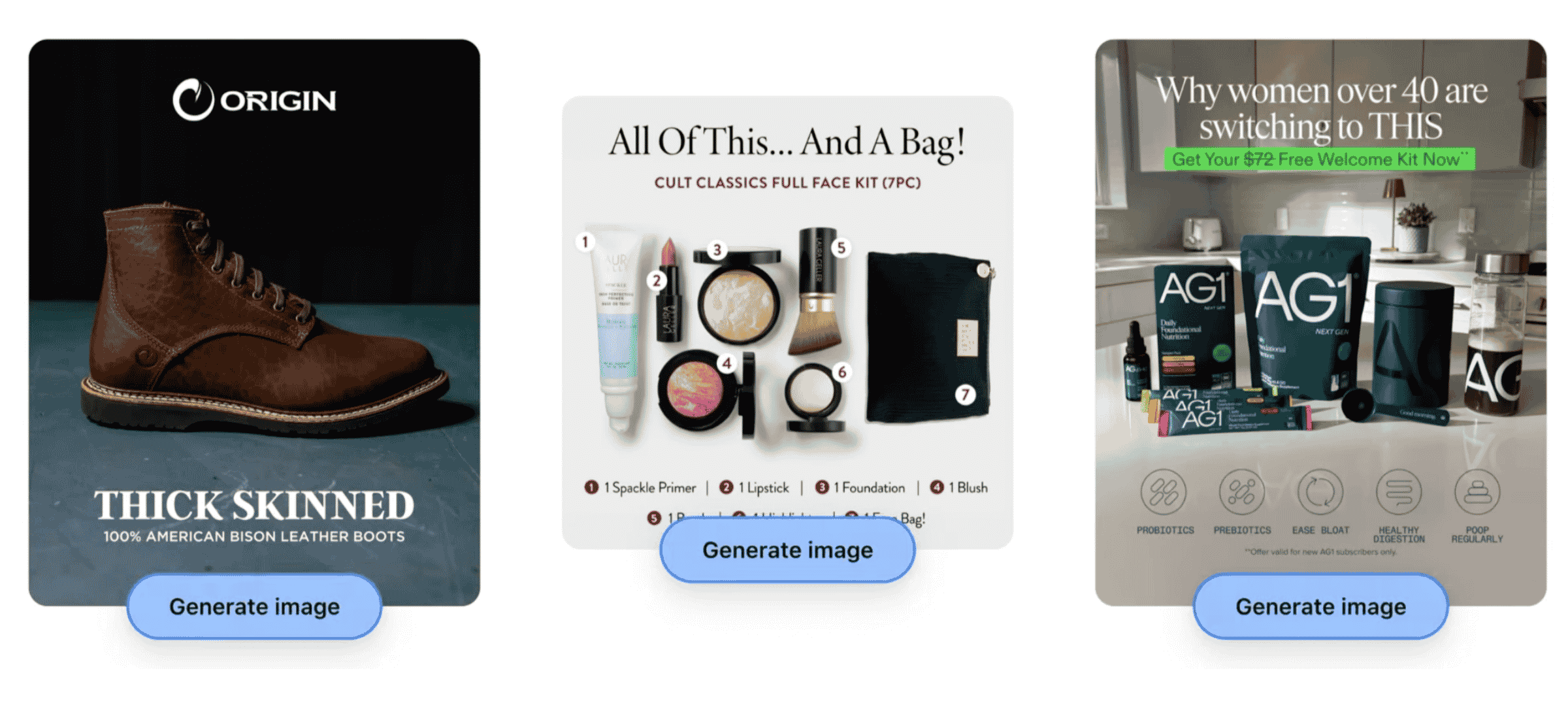
Source: Meta
Pro Tip: Marketers should treat it as a variation engine, not an origination engine — bring a strong hero concept, then use Muse Image to multiply it across placements.
How does Muse Image help with ad creative?
Muse Image lets marketers restyle existing ad images, taking cues from creative that’s already resonating on each platform, and generate fresh variations from that base. Because it’s grounded in Meta’s understanding of what drives response on Facebook and Instagram, the tool nudges output toward what each app’s audience tends to engage with.
Pro Tip: If you have data on your niche audience then you should feed Muse Image your proven winners, not your untested ideas. The model amplifies what you give it, so the input quality sets the ceiling.
Can Muse Image turn video into still images?
Yes. Muse Image can generate still images directly from video assets. For advertisers running video-first campaigns. This lets marketers produce static creative for placements that need it without a separate shoot or design pass.
Pro Tip: Marketers should use this to keep static and video creative visually consistent across a campaign — pull stills from your best-performing video rather than briefing stills from scratch.
How is Muse Image with Photorealism and Product Accuracy?
Early testers report higher-quality outputs from Muse Image, including improved photorealism and better preservation of product integrity. Meta is also extending Muse Image into shopping. This means that when a user uploads a photo of their living space, Meta AI can restyle the room using real products from a business’s catalog, letting them compare options and tap through to buy.
Pro Tip: Marketers should still quality test every generated asset for product accuracy before it goes live. Because a warped product shot erodes trust faster than it saves time.
House of Marketers Insight for Marketers
Meta is embedding creative generation directly inside the ad platform, where more than 8 million advertisers already use at least one of its generative AI tools.
That lowers the cost of testing dramatically. But cheap variations only pay off if the underlying creative idea and audience insight are strong. Because creative volume without a strategy attached just produces forgettable ads all over again.
At House of Marketers, we’ve seen the same pattern play out across platforms: the brands acing it with AI-assisted creative are the ones that treat it as leverage on a sharp human concept, not a replacement for one.
Muse Image will make it trivial to produce fifty on-brand variations — the advantage goes to the marketers who know which one is actually worth running, and why.
At House of Marketers, we work with brands to design influencer marketing strategies built for pairing AI-powered trend insight with creators who bring the credibility that generated content can’t, then using paid media boosting to scale the content that’s proving itself. If tools like Meta’s Muse Image fit in your social media marketing strategy, Contact for Free Campaign Proposal, and let’s build it.