Do you put all your campaign spend on one macro influencer…or instead take your chance with multiple micro influencers instead? This situation is one most marketers find themselves in at some point.
Without the proper data to guide you, deciding one option over the other can feel like you’re making a gamble. But it does not have to work that way.
As a TikTok Marketing Agency, we help you seek and work with micro and macro influencers based on your brand, budget and industry. This guide will give you a clearer understanding of the influencer marketing landscape in 2026, so you can make the best decision possible for your campaigns.
Let’s get started.
Summary
- Micro influencers (10k–100k followers) typically drive higher engagement, making them effective for niche targeting and revenue-focused campaigns.
- Macro influencers (100k–1M followers) offer scale, visibility, and strong brand awareness, but often at a higher cost and lower engagement rates.
- Influencer marketing ROI is shaped by conversion efficiency, CPE, operational costs, and campaign objectives.
- Social search and authenticity trends favour credible, relatable creators, making behavioural fit more important than audience volume.
- The strongest strategies combine macro scale with micro depth to build a full-funnel performance engine.
Micro and Macro Influencers in a Nutshell
Who are micro influencers?
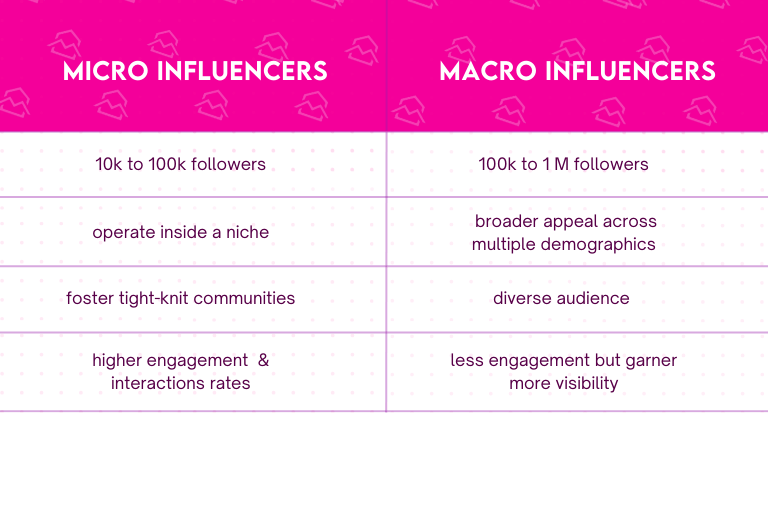
Micro-influencers are creators who have 10,000 to 100,000 followers. Their content is very niche, often centred around specific interests such as skincare, fitness, gaming, or lifestyle. Because of this, the crowd they attract is also very niche, making their communities tight-knit. This creates a familiarity between the creator and the audience, leading to higher engagement rates and meaningful interactions via comments and DMs.
Who are macro influencers?
Macro-influencers are creators who have 100,000 to 1 million followers. Their massive following leads them to have a broader appeal, often spanning multiple demographics. This is why even a single post of theirs can generate substantial reach quickly.
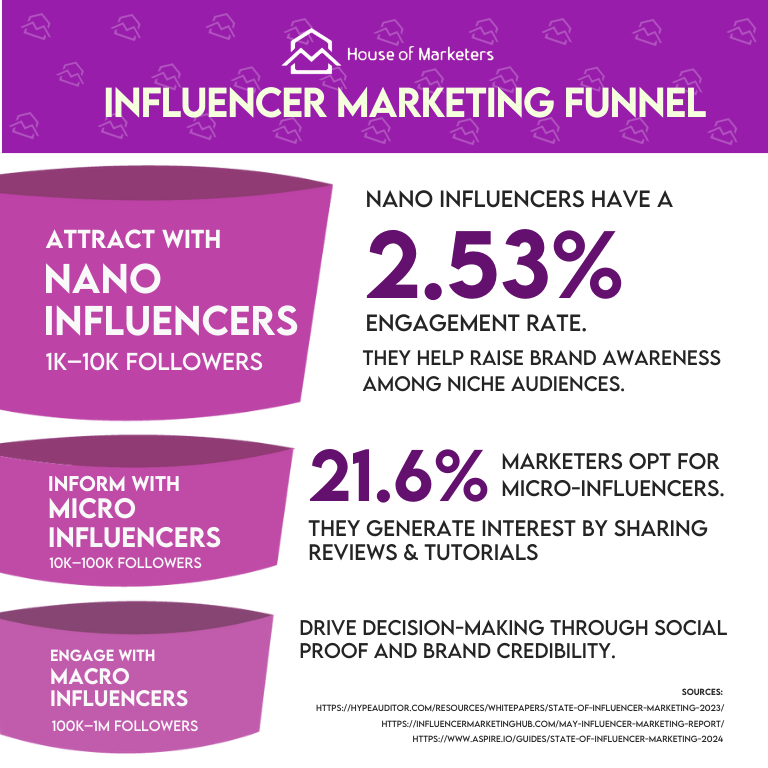
The differences between these two influencer tiers are more than just their following sizes. Each plays a significant role in the influencer marketing funnel; it all depends on how marketers can play to each’s strengths instead of forcing them into roles they can’t deliver in.
Micro vs Macro Influencers Statistics
 These statistics provide a practical lens for decision-making rather than a simple winner-versus-loser comparison between the two influencer marketing tiers
- Engagement Rate
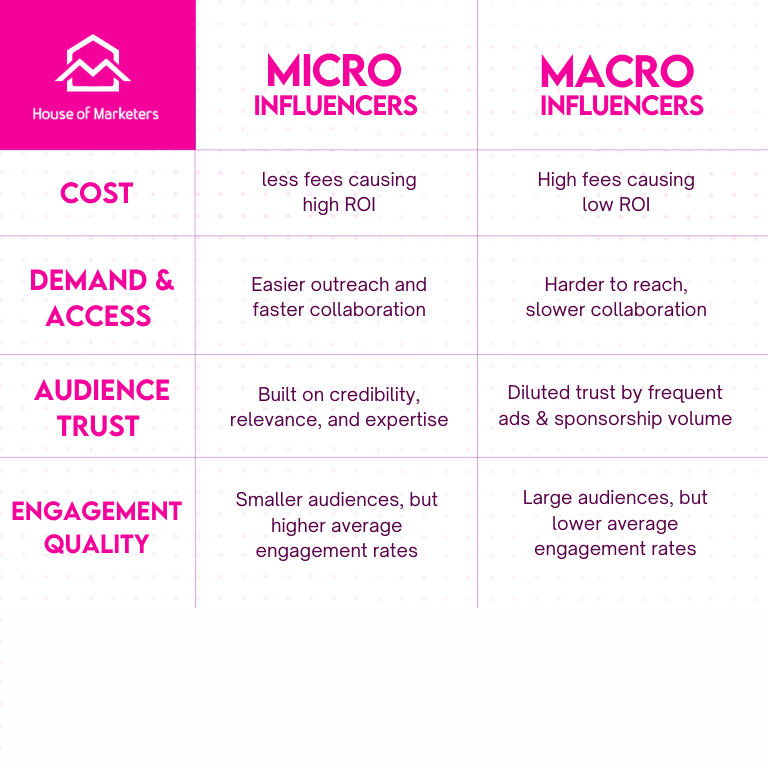
Micro influencers’ higher engagement rates improve content’s algorithmic performance and visibility. However, macro influencers also give results because of their reach and follower size.
Recent AI-driven feed developments, platforms assess both reach and engagement quality when determining content visibility. In this context, both micro and macro influencers can strengthen brand visibility.
- Conversion rates
Micro influencers have a 20% higher conversion rate compared to other tiers. This is especially useful for niche or highly targeted products. Because of their increased trust and highly engaged audiences, a micro influencer’s audience is already halfway across the purchasing funnel. They already trust the creator and value his opinion, and hence, when a recommendation is made, they are one click away from purchase.
Macro influencers, on the other hand, are useful when product awareness matters more. Their audiences are a big mix of different intents and engagement levels. A macro creator is best for broad-scale visibility, especially when the goal is not conversions
- Cost Per Engagement (CPE)
Micro influencers cost ~ $0.20 per engagement, compared to around $0.33 per engagement for macro influencers. Micro influencers drive a good bargain in collaboration fees as well. Their lower costs allow better creator diversification and testing for campaign performance.
- Perceived Trust
50% of Millennials trust micro influencer recommendations. This indicates that relatable micro-influencers reduce purchase hesitation in users. Users trust a creator that seem familiar. This is especially true for beauty influencers who garner a “big sister effect” that adds to their relatability appeal. However, macro influencers offer brands social proof within wide audiences, which can be equally valuable in certain campaign positioning strategies.
- Content Style & Quality
Micro influencer creators seem more spontaneous and informal, which improves authenticity perception. 3 in 4 consumers skip content that feels overly produced or inauthentic, according to TikTok’s recent study. Macro creators often produce more polished, professionally edited content, which can suit premium & brand-building campaigns. Do not confuse well-polished content with inauthenticity. But rather than promotion for the sake of promotion is gimmicky and audiences are immune to that now.
All together, these statistics paint a much more nuanced picture than just telling whether micro influencers are better than macro influencers or not.
For marketers, these stats indicate the strengths of both influencer marketing tiers and offer new insight on how each can be employed to propel campaign growth.
Source: Influencer Marketing Stats You Need to Know
Micro vs Macro Influencers: Which Delivers Higher ROI for Brands in 2026
Influencer marketing ROI conversation often begins with talk of engagement and pricing. But ROI is determined by much more than just those two factors. As an influencer marketing agency, we suggest looking at how conversion efficiency, cost structure, and reach volume all work together and affect the final ROI.
Read more on how to measure influencer marketing ROI the correct way in our guide here.
CPE and Pricing Reality
If engagement costs less and converts more often, that will obviously improve campaign economics.
However, engagement rate and cost efficiency are not the same metric. While engagement percentages often decline as follower counts grow, pricing does not always scale proportionally. In some datasets, very small influencers (2k–5k followers) show significantly higher cost per engagement than creators in the 500k–1M range.
For Example:
| Metric | (Micro) A | (Macro) B |
| Followers | 20,000 | 500,000 |
| Engagement Rate | 6% | 2% |
| Total Engagements | 1,200 | 10,000 |
| Fee | $1,200 | $5,000 |
| Cost Per Engagement (CPE) | $1.00 | $0.50 |
Even though the micro influencer has a much higher engagement rate (6% vs 2%), the macro influencer delivers more total interactions at a lower cost per engagement.
That is why engagement rate alone can be misleading. The goal should always be to ensure that cost scales meaningfully with output.
Scale & Diversification
Micro influencer campaigns allow brands to distribute budget across multiple creators. This creates padding from risk & trial and error. This makes sense because of the Pareto-style distribution of influencer marketing. In many campaigns, a smaller percentage of creators drive most of the revenue impact, while others contribute incremental lift. Micro-influencers help with finding winners and eliminating less functional creators easily, with minimal loss in campaign spend.
Operational Cost
There is also an operational cost to consider. Managing multiple micro influencers requires more coordination, contracts, briefings, and eventually more tracking. Time and internal resources affect true ROI, even if they do not appear in campaign spreadsheets.
A smaller number of macro influencers in a campaign can simplify campaign execution immensely and also accelerate brand awareness due to their follower volume. But at the same time, it increases reliance on a select few creators. Selecting this model makes sense when you are sure of a strong resonance of the campaign with the target users.
Do Micro Influencers Deliver Higher ROI than Macro Influencers?
There is no one clear winner between the two. ROI improves when the campaign’s economic structure matches the campaign’s objective. Both the tiers bring something unique to the table; it all depends on your campaign’s restraints and requirements.
How to Choose Between a Micro and Macro Influencer
Choosing between micro and macro influencers is not about which one is better. Instead, that choice should be made by deciding what you need them to do.
There are four simple filters that usually make the decision clearer:
- Your budget
- Your campaign goal
- Your target audience
Let’s break them down.
Budget
If you are working with a budget of under $10,000, micro influencers are usually the best choice. They are more affordable, and you can work with several creators instead of putting all your eggs in one basket.
However, if your budget is above $50,000, you have more room to test macro placements or build a campaign that has a mix of both tiers.
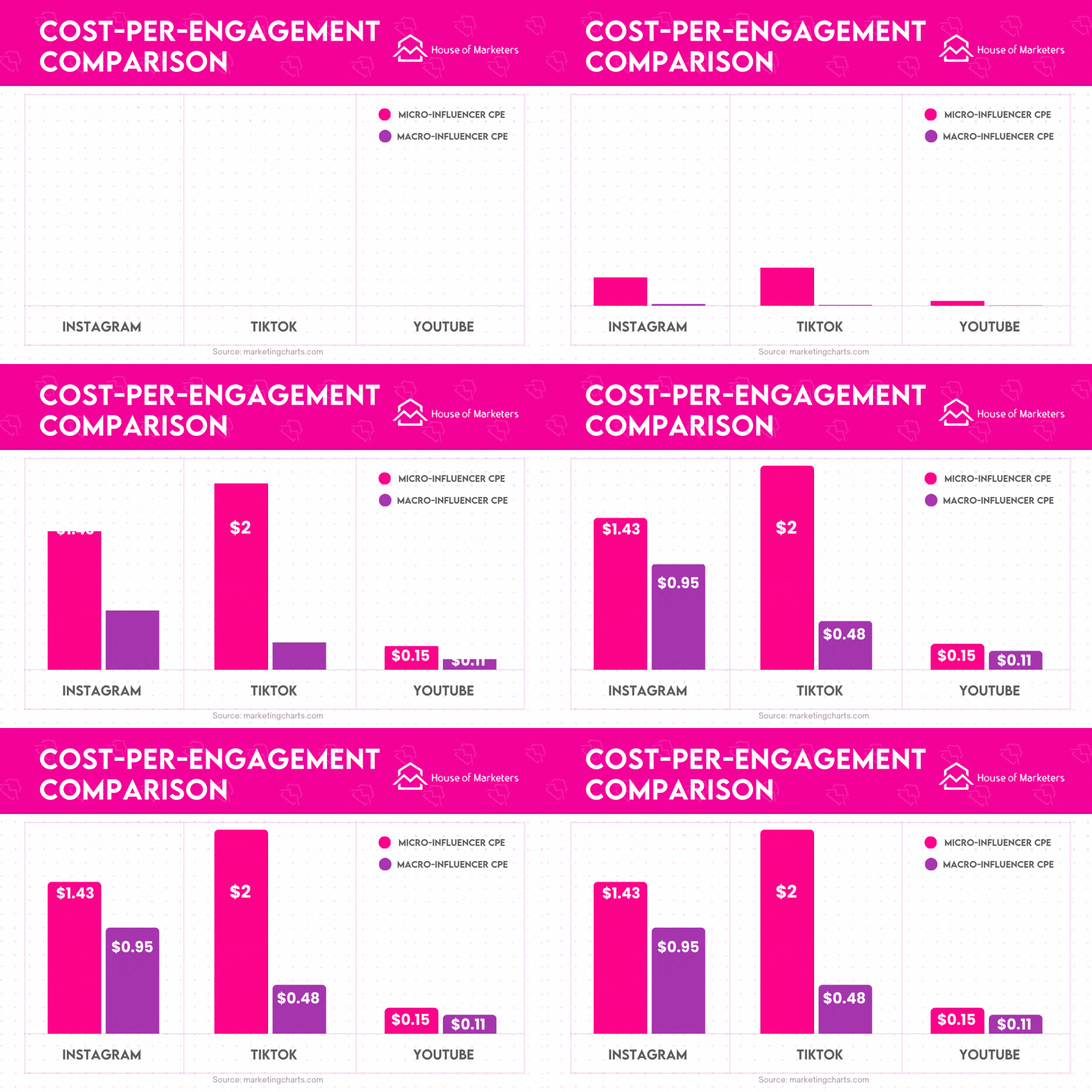
Source: Micro-Influencer Marketing Stats: Engagement, ROI & Platform Benchmarks
Campaign Objectives
Micro influencers often perform well if you want engagement, conversations, and stronger trust signals. However, if you want quick awareness and large-scale visibility, macro influencers help you get there faster.
So think of it this way,
- Micro influencers build depth via relatability.
- Macro influencers build scale via visibility.
Target Audience
The more niche your audience, the more precision matters.
If you are targeting something specific, like vegan bodybuilders or vintage camera collectors, micro influencers inside those communities are usually more effective. Their credibility is built on shared interests.
Read how the House of Marketers helped a niche AI-designed custom sneakers brand using micro influencers.
On the other hand, if your product appeals to a wide market, macro influencers can help you reach that broader group quickly.
House of Marketers’ 2026 Trends Insights for Influencer Marketing
influencer marketing’s commercial contribution will reach US$1.2 trillion by 2030, a 1.4× increase from 2025.
This is proof that influencer marketing has now embedded itself into the fabric of social media marketing. Knowing this, all the social media platforms are constantly coming out with new tools and ways to help marketers and brands create a robust economic engine on their platforms.
Let’s discuss some of the most recent updates in the influencer marketing landscape since the beginning of the year.
- Influencer Marketing on TikTok
TikTok’s recent reports highlight the importance of brand authenticity. 76% users are more likely to search, click, and add to cart after engaging with authentic content, particularly during the consideration phase.
Because of this, marketers should shift focus toward content that feels real rather than overly refined. Raw, story-led, and honest creator content aligns more closely with how audiences consume and trust information today.
- Social Search On Social Media
This aligns with a broader behavioural shift amongst online users. 67% of Gen Z use Instagram as a search engine, 62% search on TikTok. Nearly 1 in 10 Gen Z users rely more on TikTok than Google for everyday answers. Brand and product discovery itself is becoming creator-led.
As House of Marketers Founder Inigo Rivero defines it:
“Social search has changed how discovery works. People no longer find answers through neutral results pages. They find them through creators demonstrating solutions in public. On platforms like TikTok, search results are personalised by behaviour.
What a user sees is shaped by their past engagement, the content they interact with, and the signals they send over time.
For brands, this means visibility is no longer earned through keyword optimisation alone, but through creator-led content that aligns with how audiences actually search and behave.”
These trends highlight that it’s best to use both the micro and macro influencer tiers to your advantage.
- Macro influencers remain powerful for scale, launches, and mass visibility.
- Micro influencers align more closely with social search behaviour.
As an influencer marketing agency, we advise brands to plan campaigns with less emphasis on follower count and more focus on behavioural fit.
Conclusion
All this to say that the micro vs macro debate is not about choosing sides. Instead, start thinking about
- What role does this creator need to play in the funnel?
- Does this partnership optimise for efficiency or scale?
- Does the content align with how our audience actually discovers and decides?
The strongest campaigns combine both tiers strategically. Macro influencers create awareness and cultural visibility. Micro influencers build consideration and drive efficient conversions. Together, they form a full-funnel engine.
As an influencer marketing agency, we can help you strike that balance between the two tiers according to your campaign goals.
If you need support identifying the right creators, building a balanced influencer marketing strategy, or measuring real influencer ROI, our team can help you design a plan built around performance, not assumptions.
Contact for free campaign proposal