“Why can’t we do something like this?”
We all have this conversation in our marketing group after sending a TikTok link of some new brand executing their social media strategy.
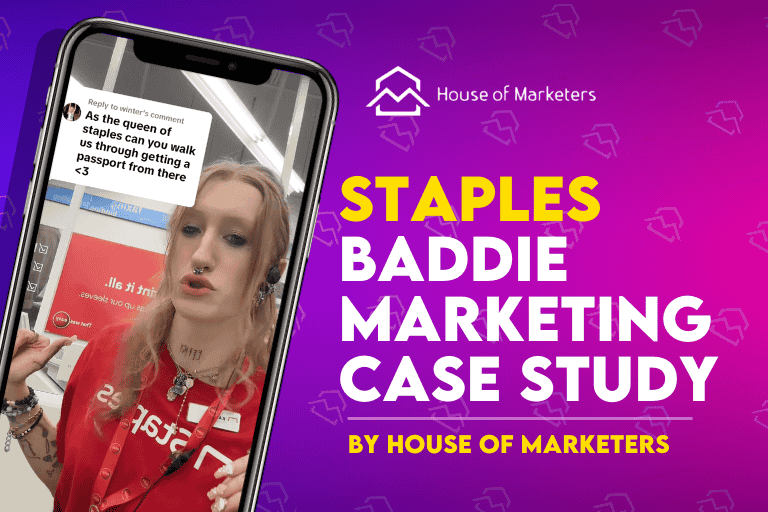
Lately, that TikTok link may be about a certain Staples Baddie that is rousing the heritage office supply retail company Staples from becoming obsolete.
As an influencer marketing agency, we see all the intricacies of how Staples has landed on this gold mine of social content. Let’s walk through the why and how of this strategy so you can replicate it too.
Let’s get started.
Summary
Staples, an American office supply retail company, had been fading into the background for years, until a 22-year-old print specialist started posting TikToks about custom mugs and direct mail on her lunch break. Just one UGC creator resuscitated Staples’ online presence and sent real customers to Staples’ doors.
In this case study, we break down why it worked, how Staples responded, and the four lessons every marketer can steal from it, from finding your frontline voices to why overproducing organic content kills the very thing that made it work.
Who Is the Staples Baddie?
Staples Baddie a.k.a Kaeden is a Print Specialist at a Staples location on the East Coast. On TikTok, she goes by Oblivion (@blivxx). She started making videos once she realised that people aren’t actually aware of all the amenities and services available at Staples.
Because Staples has been around since 1986, and for a certain generation, Staples was the back-to-school destination.
But it struggled to make the transition into the social media era. Their digital marketing leaned heavily on promotions, discounts, and product catalogues basically being completely invisible to younger audiences. And all it took was one UGC to resuscitate Staples’ online presence.
As an influencer marketing agency, we would even go as far as to say that the lack of a corporate strategy brief and brand approval process is exactly what worked in Staples’ favour. This is because 76% of consumers want brands to show up with more authentic content, according to TikTok.
Many times, brands overthink influencer marketing and creator collaboration to the point that what is finally produced has all the soul sucked out of it, and it feels too polished and safe. Whereas more and more data now support that the more raw, authentic, and down-to-earth your brand’s social presence is, the better its perceived trustworthiness is amongst younger audiences.
This is why Staples baddie’s UGC blew up. Her videos blend ASMR-style product walkthroughs with current memes, dry humour, and the kind of unfiltered commentary that makes you feel like you’re texting with a friend who happens to work at Staples, and you are hanging out with them on their break.
@blivxxYall wanted to meet the printers♬ original sound – 🦷✨oblivion✨🦷
What Is UGC Marketing, and Why Does It Hit Differently?
User-generated content (UGC) is content created by real people about a brand, product, or service. The statistics around UGC success are genuinely striking. Consumers consider UGC 50% more trustworthy and 20% more influential than other media types. UGC-based ads get four times higher click-through rates than average, and 84% of consumers are more likely to trust a brand’s marketing campaign if it features user-generated content. TikTok’s own insights show that creator-led content drives 70% higher click-through rates and 159% higher engagement than non-creator ads at the same CPM.
For marketers on a tight budget that can’t afford big creators, UGC solves that problem for them. It is the highest-trust, lowest-cost content format available to any brand. The catch is that you cannot manufacture it.
TikTok’s guide on “Unlocking Business Impact through Personal Cultural Relevance” highlights that 40% of users say a brand’s personality is what makes it feel relevant. Case in point, it’s not a big production budget nor big celeb names. Personality. Staples Baddie displays that in abundance. Staples, the corporate brand, on its own did not.
TikTok’s study cites e.l.f and Liquid Death as masters of brands that showcase their personality really well online. Read our case studies on e.l.f and Liquid Death to learn more on how to replicate that for yourself.
Liquid Death Marketing Case Study
The Impact Of UGC Marketing on Staples
Because of this new Staples Baddie moment, people are thinking about Staples more than ever before. Staples has not released official sales figures tied to the Staples Baddie moment. But the social media hubbub lets us have some idea.
Staple baddie’s most viral videos pulled between 2 million and 4.2 million views each, with engagement levels as high as +16%. During this whole ordeal, she grew from around 10,000 followers to over 485.8K. Contrast this to Staples’ own official TikTok account with around 47,000 followers and a maximum 1% engagement rate.
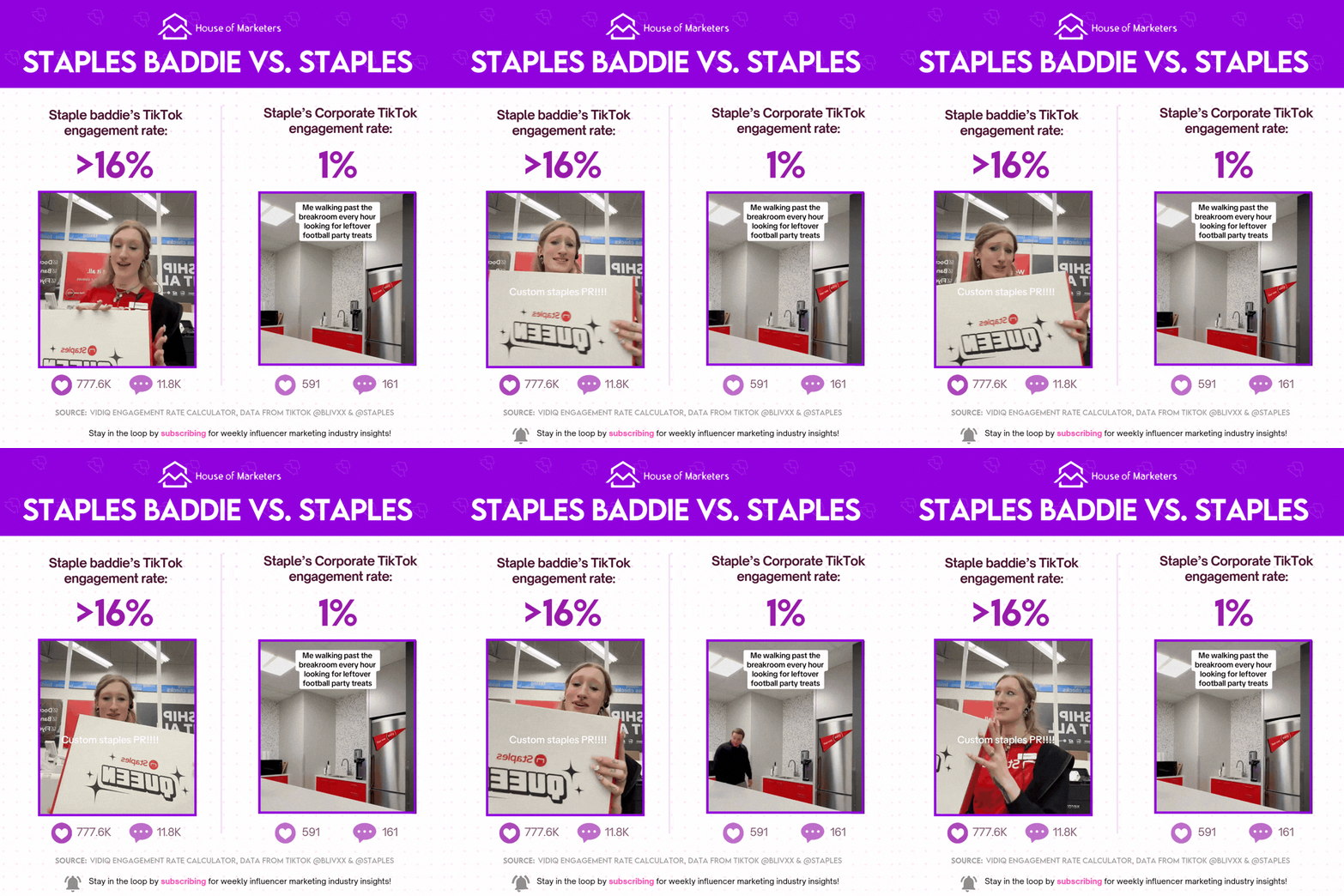
Data proves that employee-generated posts get eight times more engagement than brand posts. This move by Staples to let the Staples Baddie be the star of the show helped their reach expand way beyond just one UGC creator. Other creators started making content about Staples while tagging Staples and Staples Baddie.
One TikTok by @hopeidontknowyou showed a creator saving a thousand dollars on a project thanks to her advice, and pulled 1.4 million views on its own.
@hopeidontknowyou haven’t been to @Staples since I was 13 but I’m now in love with it again all thanks to @🦷✨oblivion✨🦷 and I’m making diy skateboard wall art !! #staples #skateboardart #skateboard #diy #art ♬ original sound – alexandra
In the comments, people reminisced about their childhood memories of making a trip to Staples and expressed their surprise about discovering recent services on Staples that they never knew existed.
Businesses started switching their printing orders to Staples based on just one UGC creator’s word of mouth.
What Staples Actually Did, And What They Wisely Did Not Do – Staples’ Response to Staples Baddie
When Staples baddie first started making headlines, especially in such a non-corporate-approved context, any brand’s first instinct would have been to pull all brakes, maybe even issue a warning. But Staples did not shut it down.
Many brands have social media policies that exist precisely to prevent employees from posting brand-related content without approval. The stunt Staples Baddie pulled would have been flagged by the marketing departments immediately. This type of unvetted messaging, uncontrolled narrative, and no legal sign-off can, in some cases, become legal trouble. Kaeden herself admitted she was initially nervous about whether she would get fired or praised.
So yes, Staples’ rise to social media fame did come with some caveats. But understanding that deep down, the things Staples Baddie posted under the brand’s employment did not necessarily hurt its brand image at all. Evidence suggests the contrary.
In hindsight, Staples made the right choice to be an ally. Their official account began commenting on her videos, under a custom mug tutorial, they said “W tutorial” and liked comments asking about her.
When the viral momentum became undeniable, Staples’ PR team reached out to her store to say they loved what she was doing. They sent her a custom-branded care package.
Bob Sherwin, Staples’ chief marketing officer, told Fast Company:
“Kaeden will continue to film her content as Staples Baddie, with the support of Staples, which is mutually beneficial for everyone involved. We’ve connected with her to share our appreciation, and we are exploring opportunities to collaborate and continue supporting her creativity and engagement with the community.”
What they did not do was announce a paid partnership. They did not roll out a campaign. They did not attempt to replicate her content with a production team. This is the best thing they have done to help themselves as a brand. Monetising any of this attention publicly would have removed all the authenticity it worked so hard to build.
As marketers its important to know the big picture consequences of small actions like this. Staples acknowledged the person who got them all this attention, but made no moves to change anything, not the style, messaging, or the quality of the videos, either. They left it all to the creators’ devices.
This is exactly one of the rules of UGC and influencer marketing. Let the creators maintain their storytelling style and narrative. Once you hijack it, thinking you know the creators’ audience better than they know theirs, you have set yourselves back several steps.
Read more: How to do Social Media Influencer Marketing in 5 Simple Steps
What Marketers Can Learn from Staples UGC strategy
Here is how you translate Staples UGC marketing success into something actionable for your own brands and campaigns.
Find your frontline voices.
Your brand’s frontline voices are the people closest to your product or service, i.e., your employees, your most engaged customers, and your community members who already talk about you. They know things your marketing team does not. They understand the use case facets of your brand that can only be learned by repeated use and experience. Hence, they speak in ways your customers actually respond to. Staples Baddie realised that people did not understand the full scope of what Staples offered. That knowledge gap became the UGC strategy.
Other brands also utilise similar strategies. If you want to see a variation of this strategy, then take a look at the Ordinary Skincare case study and their use of employees as content creators and brand voices.
Look for the equivalent in your own brand: the thing your team knows that your audience does not, and find the person who can communicate it naturally.
Make room for creativity in your brand policy.
If your social media policy is primarily a list of restrictions, you are not just protecting yourself from risk; you are also silencing some of the possible avenues that can connect you to your customer. This does not mean opening the floodgates. It means creating a framework where employees understand what they can talk about, what the brand values look and sound like, and who to loop in if things get traction.
Don’t over-produce your content.
When Staples Baddie became viral, Staples acknowledged it. They commented, liked posts, and sent a care package. What they did not do is immediately wrap it in a paid campaign, put a script in her hands, or start A/B testing her thumbnails. The moment you over-produce organic content, you kill the thing that made it work.
Think about product education, not just product promotion.
One of the most underappreciated elements of this story is the specific angle Kaeden took. She basically made tutorials for how to use the services at Staples. A lot of Staples customers had walked past the printing machines and laminators for years without knowing what was in there. The discovery itself was the hook. What does your audience not know about what you offer? What assumption are they operating under that, if you corrected it, would change how they see your brand?
The answers to these questions will give you ideas to connect with your audience with a fitting marketing strategy.
Heritage Brands and the New Relevance Problem
Staples has been a staple of every childhood school project, and yet, as things became more digital, the brand slowly faded into the background.
This shows that heritage brands are stuck on how to balance the old with the new. And the instinct is to abandon the things that feel “old”, to chase trends, to produce content that looks like what a Gen Z brand looks like. While it may work for some, make sure you are not abandoning your brand identity when you make this shift.
Staples is not the only brand wrestling with going obsolete in changing times. Chili’s has been through a version of the same journey, a heritage brand that found a new generation not through a rebrand or a celebrity campaign, but through leaning into the things that made it recognisable in the first place, translated into the visual language of modern social platforms.
Read how Chili’s revived its connection with its audience in this digital age in this Chili’s case study.
Relevance is not about abandoning your roots. It is about finding the person who can translate them. For Staples, that person was Staples Baddie, a 22-year-old print specialist who thought it was a shame that nobody was ordering direct mail.
Conclusion
The Staples Baddie moment is more than just a feel-good story about a viral employee. It indicates where audience trust lives in 2026. It lives with real people, telling real stories, from inside the brands they work for or care about. And it is the highest-value marketing you can access, if you are willing to loosen the grip enough to let it happen.
If you are ready to design a UGC strategy that works as a growth engine rather than a campaign experiment, as an influencer marketing agency, we can help you build it with precision and performance in mind.
If you need support identifying the right creators, building a balanced influencer marketing strategy, or measuring real influencer ROI, our team can help you design a plan built around performance, not assumptions. Reach out to discuss your next campaign today!
House of Marketers (HOM) is a leading TikTok Marketing Agency. Our global agency was built by early TikTok Employees & TikTok Partners, which gives us the insider knowledge to help leading brands, like Redbull, Playtika, Badoo, and HelloFresh win on TikTok. Want us to convert more of Gen Z and Millennials with TikTok? Get in touch with our friendly team, here.