
Before planning for 2026, it is worth taking a clear look at what worked and what did not last year. Let’s take a look at some of 2025’s best campaigns and spot patterns that work.
All of these didn’t follow the same formula. Some were mission-led. Some were creator-led. Others were product-led. But what they all shared in common was clarity. They aced clarity of message, timely execution, and garnered a caring audience.
As a global TikTok marketing agency, we break down what worked, how it worked, and why it worked. So you can apply the thinking, not just admire the results.
Each section breaks down why the campaign resonated, what signals mattered, and what you can realistically take forward without copying the surface-level idea.
Let us take a closer look.
Dove’s #ShareTheFirst Beauty Campaign
In 2025, Ozempic and preventative cosmetic procedures dominated public discussion. But Dove dared to shift the focus away from constant improvement.
#ShareTheFirst invited people to share their first unfiltered photo. Before retouching, filters, or self-surveillance was applied.
This simple prompt garnered an amazing response.
The campaign generated over 1 billion impressions, 1.4 million engagements, and achieved 94 percent positive sentiment. It ran across 14 global markets and lifted key brand metrics.
@beberexha #dovepartner I’m partnering with @Dove to remind women to #sharethefirst photo and free themselves from the pressure of a perfect social media feed. 6 in 10 women won’t post special moments because they think they don’t look perfect. I’ve shared a real, first pic #and it felt good – I hope it inspires you to do the same! #sharethefirst #Dove #letschangebeauty #realbeauty ♬ original sound – Bebe Rexha
Creators were allowed to be vulnerable and share their personal experiences. Visually, the campaign resembled a camera roll, blending creator imagery with ordinary moments.
View this post on Instagram
Not giving in to what other beauty brands were doing is what made this campaign a global success. Not flashy marketing.
In a media environment built around self-display, #ShareTheFirst succeeded by lowering the bar rather than raising it. The campaign trusted creators. Creator-led marketing allowed familiarity to do all the work.
American Eagle’s Controversial Sydney Sweeney Campaign
If Dove showed restraint, American Eagle went all out.
Whether the campaign’s wordplay around jeans and genes was deliberate or simply provocative is open to interpretation. The ambiguity alone was enough to generate attention. What is not debatable is the scale of the response.
Anchored by Sydney Sweeney, the campaign exploded across social and earned a whopping 40 billion impressions, making it one of the most visible retail campaigns of the year. During the campaign window, American Eagle cited roughly 700,000 new customers.
The campaign sparked conversation, parody, debate, and criticism in equal measure. Craig Brommers, American Eagle’s CMO told Glossy
“What I learned through this experience is you have to take the big bets at big moments,” Brommers said. “You can’t be generic. The biggest risk in marketing these days is being boring. We’ve been conditioned as marketers to always do the ‘right things,’ but then we’re creating marketing campaigns that become generic wallpaper.
And that is precisely why it worked.
This was celebrity influencer marketing sharpened to a point. The virality converted into measurable business outcomes, even as it ignited controversy.
This is a reminder for marketers that: attention is not always neutral. This is a truth that often gets lost in polite marketing discourse. Polarisation can fuel growth provided that it’s handled correctly.
Gap’s Collab with K-pop Girl Group Katseye
Where American Eagle leaned into provocation, Gap took a different route. Instead of courting controversy, the brand aligned itself with existing cultural momentum.
Gap partnered with Katseye, a rising pop group. Katseye was already commanding attention across Gen Z audiences. Rather than attempting to manufacture relevance, the campaign positioned Gap alongside it.
“Better in Denim” blended pop culture with product storytelling, generating over 8 billion impressions and 500 million social and video views, while contributing to double-digit growth in denim sales.
The creative sat somewhere between a music video and a fashion ad. Its choreography was designed to be copied, fitting naturally into TikTok’s remix culture.
@besperon Replying to @Kita B @KATSEYE x @Gap 👖 (dc: @Robbie Blue) #katseye #gap #milkshake ♬ original sound – André Manguba
Viewers were active participants in the campaign. In doing so, the campaign extended beyond Gap’s own channels and into the hands of fans who were already engaged with Katseye.
This campaign demonstrates the advantage of cultural proximity. Gap did not have to build attention from scratch. It simply had to create space for that relevance to intersect with its product, allowing reach and impact to compound rather than compete.
Nike Celebrated Women Athletes with So Win
This year, Nike celebrated women’s sports with its “So Win” campaign, which cleverly coincided with the Oscars.
View this post on Instagram
The brand spotlighted a powerful lineup of women, including top athletes like Alexia Putellas and Paige Bueckers, alongside Grammy-winning music star Doechii. By blending sport and culture in one campaign, Nike aligned itself with conversations around empowerment and representation.
This campaign is a reminder that relevance matters more than recognition. Brands do not need to be understood by everyone to be meaningful to the people who matter most.
Nike’s Influencer Marketing Case Study
Within 24 hours, the So Win ad became Nike’s most-watched Instagram video ever, hitting 66 million views, while igniting debate, praise, and memes across TikTok and X.
And in marketing, conversation is currency.
Dunkin’ x Sabrina Carpenter in Shake That Ess
If any campaign showed how pop culture, humour, and speed came together in 2025, it was Dunkin’.
Inspired by Sabrina Carpenter’s hit “Espresso,” “Shake That Ess” launched as a tongue-in-cheek, music-video-style campaign promoting Dunkin’s iced brown sugar espresso. Capitalising on the self-branding of Sabrina herself, the creative leaned into it with cheeky puns and double entendres.
View this post on Instagram
The results were staggering.
- 32.4 million Instagram views, with 96 percent coming from non-followers
- 8.2 million TikTok views in 48 hours
- 12.7 billion earned media impressions
- Double-digit growth in the iced espresso category
Dunkin did not outspend its competitors.
This was culture-first marketing executed at internet speed, proving that relevance beats reach when the moment is right.
As marketers keep an eye out for when a trend genuinely aligns with your brand’s ethos. In such cases, speed and relevance can outperform working from scratch.
Crumbl x Dove: A Category Collision That Worked
Ever smelled a soap so good you wished you could eat it?
That curiosity became the starting point for one of 2025’s most unexpected collaborations. Dove partnered with Crumbl to launch a limited-edition, cookie-inspired product line, available exclusively at Walmart.
The collection hit a six-month sales goal in one month, with more than half of buyers being new to Dove.
View this post on Instagram
On social, the launch generated 53.7 million video views and over 3.2 billion impressions, supported by more than 490 creator videos on TikTok.
By borrowing cultural equity from an adjacent category and letting creators drive excitement, Dove reached entirely new audiences without diluting its brand meaning.
This campaign is a reminder that relevance matters more than recognition. Brands do not need to be understood by everyone to be meaningful to the people who matter most.
Crumbl’s Influencer Marketing Case Study
Liquid Death x Ozzy Osbourne: Weirdest Campaign of 2025
Some brands win by being sincere. Others win by being unhinged.
Liquid Death continues to belong firmly in the second category.
“Infinite Ozzy” was a hyper-limited drop of iced tea cans containing trace DNA from Ozzy Osbourne himself. Each can was hand-signed and sold for $450. The entire run sold out in under ten minutes.
The stunt functioned as both a tribute to a rock legend and a deliberately unhinged attempt at immortality. Jokes about cloning Ozzy quickly spread across social media, turning the release into a meme-driven moment rather than a traditional product launch.
Absurd? Absolutely.
Liquid Death understands its audience deeply. This stunt did not feel random. Given Liquid Death’s track record, it felt inevitable.
The takeaway is simple: when your brand voice is coherent, even the wildest ideas make sense.
This campaign is a reminder that relevance matters more than recognition. Brands do not need to be understood by everyone to be meaningful to the people who matter most.
Liquid Death’s TikTok Marketing Case Study
Duolingo, The Death…and Resurrection of Duo
Few brands understand internet culture like Duolingo.
Its green owl mascot, Duo, has long been a fixture of meme culture, supported by a loyal and highly engaged fanbase
But in early 2025, Duolingo announced that its green owl mascot had died. What followed was a dramatic, darkly humorous storyline involving a Cybertruck, cryptic posts, and eventually, a fan-driven resurrection.
@duolingo RIP DUO #duolingo ♬ Dixon Dallas Good Lookin – Jake Hill
The reveal video alone pulled in 120 million TikTok views.
This was participatory storytelling at scale. It invited fandom to co-author the narrative.
Brands that want to stay part of the conversation need to offer more than products. By building stories people can engage with, react to, and extend, you can create a connection even before a purchase happens, and sometimes without one at all.
This campaign is a reminder that relevance matters more than recognition. Brands do not need to be understood by everyone to be meaningful to the people who matter most.
Read How Duolingo Boosted App Engagement Here
e.l.f. Beauty invited people to Give an e.l.f.
As an affordable, drugstore brand, e.l.f. has long positioned itself around accessibility and inclusion. Those values are not an add-on to the brand. They are its foundation.
Give an e.l.f. built directly on that ethos by inviting consumers to choose causes they cared about through a New York City activation, with e.l.f. donating on their behalf.
View this post on Instagram
Kory Marchisotto, Chief Marketing Officer, e.l.f. Beauty says,
“This campaign is our collective voice calling the world to stand up, speak up and show up for what matters. It’s turning caring into a cultural movement. We’re force multiplying with icons like Billie Jean King and Amanda Nguyen to inspire everyone to take action on what they give an e.l.f. about.”
Give an e.l.f shows that values resonate most when they feel lived in.
In 2026, Purpose-led work will be most effective when it aligns with what a brand already stands for and shows up in tangible ways. When action comes first, credibility tends to follow.
e.l.f Cosmetics TikTok Case Study
Starface x Heaven, Know Exactly Who You Are For
Gen Z is a generation more comfortable showing flaws than hiding them. That mindset sits at the core of Starface, the famous Gen Z pimple patches brand.
Starface partnered with Heaven by Marc Jacobs on a limited-edition drop that treated skincare as self-expression rather than correction. The collaboration featured tattooed Big Yellow mirrored compacts and acne patches designed by artists, turning blemish care into something visual, playful, and personal.
View this post on Instagram
The campaign leaned into figures and aesthetics deeply rooted in Gen Z culture. The campaign was not designed to translate outward. It was designed to resonate inward.
It did not try to explain itself or broaden its appeal. Starface spoke fluently to the audience they are built for.
This campaign is a reminder that relevance matters more than recognition. Brands do not need to be understood by everyone to be meaningful to the people who matter most.
Starfaces’ Gen Z Marketing Case Study
Takeaways for Marketers
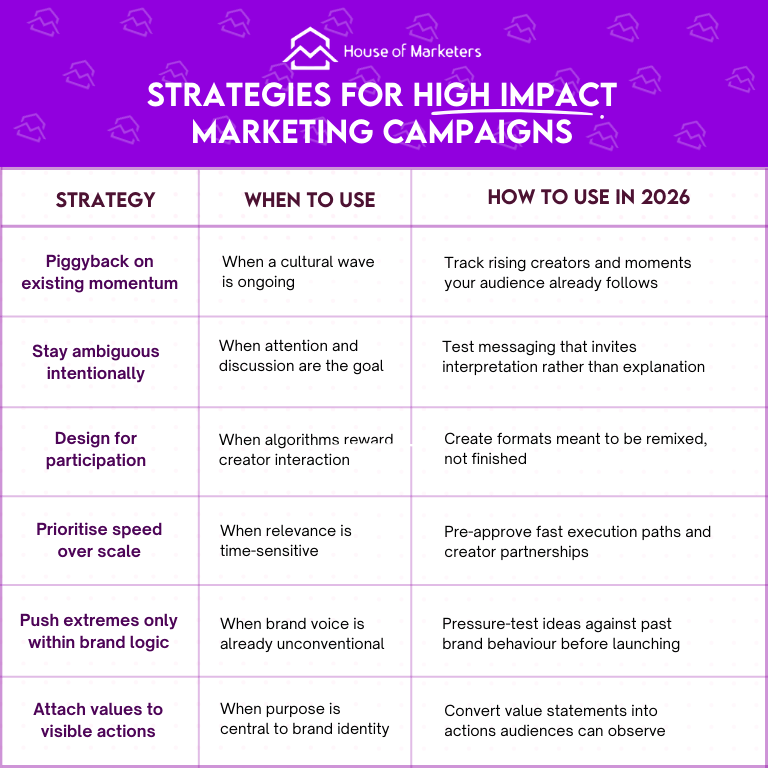
Looking back at 2025, the pattern is clear. The campaigns that stood out were not chasing every trend or trying to be everything to everyone. They were built with intent. They understood who they were for, chose the right cultural moment, and executed with clarity. What mattered was alignment between message, medium, and audience.
That is the shift worth carrying into 2026.
Social media success is no longer about isolated viral moments. It comes from understanding how culture moves, how creators influence trust, and how audiences engage when content feels native rather than forced. The brands that win are the ones that design for participation.
If you are reading this and recognise what you want to achieve but need a partner to help you get there, House of Marketers is here to help.
We specialise in creator-led influencer marketing strategies built for social-first platforms, with a particular focus on TikTok. From campaign strategy and creator selection to execution and performance, we help brands turn cultural insight into measurable growth.
If you are planning your social and influencer strategy for 2026 and want it to be grounded in what actually works, Contact House of Marketers today.
Contact House of Marketers for help
House of Marketers (HOM) is a leading TikTok Marketing Agency. Our global agency was built by early TikTok Employees & TikTok Partners, which gives us the insider knowledge to help leading brands, like Redbull, Playtika, Badoo, and HelloFresh win on TikTok. Want us to convert more of Gen Z and Millennials with TikTok? Get in touch with our friendly team, here.