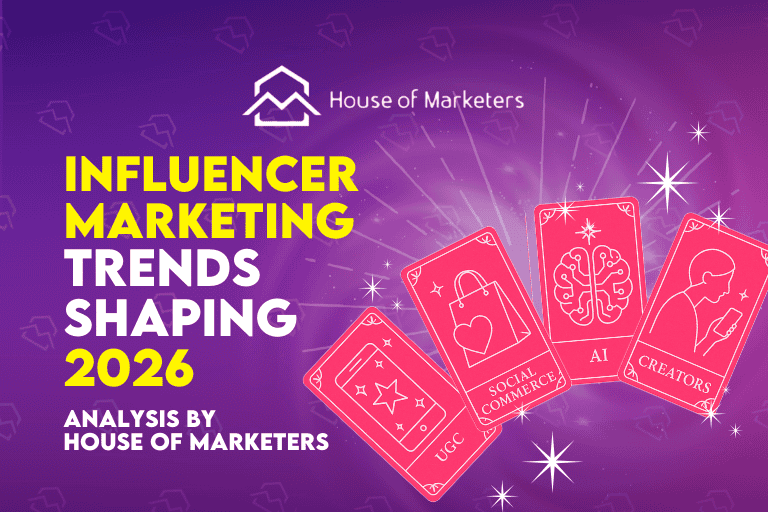
Over the past year, something important has shifted. Creator-led content has started to outperform traditional brand ads at scale, not just in engagement, but in efficiency.
Summary
Creator-led content is becoming core to how brands grow. Five trends are driving this shift:
- Creator ads are outperforming traditional ads in terms of cost and engagement
- Micro creators are converting better than big-name talent
- Fast, AI-assisted content is beating polished production
- Social commerce is merging discovery and purchase into one experience
- Community-building is proving more valuable than follower count.
Brands that embed creators into their long-term strategy will have a clear edge in 2026.
Creator-led content is now outperforming traditional brand ads at scale. Meta’s Advantage+ Creative updates explicitly prioritise UGC-style assets, reporting improved cost efficiencies and stronger engagement when ads resemble creator content. TikTok has made similar adjustments: its Creative Center and Creator Marketplace both highlight that creator-led videos drive higher view-through rates, stronger conversion intent, and more efficient CPVs.
Together, these updates reflect an intentional shift by both platforms to elevate creator-style media within their algorithms and paid-delivery engines.
And according to a recent report by the Interactive Advertising Bureau (IAB), U.S. ad spend on the creator economy is projected to reach $37 billion in 2025, growing at roughly four times the overall media industry rate.
Below are the five shifts we believe will define the 2026 creator economy from a business, performance, and investment perspective.
1. Creator-Led Advertising Will Become a Core Component of Customer Acquisition Models
Creator-led content is becoming a foundational driver of CAC efficiency across major ad platforms and it makes sense that this will be a big part of advertising budgets for brands.
Brands are experiencing the clearest performance gap to date between creator-style content and studio-produced ads. We are observing the shift in our own House of Marketers’ campaigns. The data is clear in our platform reports and retail-media analytics across our campaigns over the past 18 months:
- Creator-led ads delivered 2–4× higher CTRs than brand-shot assets
- CPVs dropped 30–70% on both TikTok and Meta
- Creator-style videos produced longer watch times and higher repeat exposure
These are aligned with industry-wide signals:
- TikTok reports that creator-led ads deliver stronger performance at the same CPM, driving 70% higher click-through rates and 159% higher engagement rates compared to non-creator ads.
- Ads posted on creators’ own accounts generate 59% higher engagement and 16% higher six-second view-through rates than ads not posted to creator accounts.
- Social media platforms are now prioritising UGC-style content.
- TikTok’s trend predictions also reveal that human content centered around humor and authenticity will be a prominent trend in 2026.
Because of the rise in influencer marketing globally, platforms and regulators are setting clearer expectations around how influencer content is disclosed, approved, and reused across ads, commerce placements, and retail media.
What is changing for influencer campaigns:
- Disclosure requirements: Platforms are now strictly enforcing rules that require paid influencer posts to be clearly labeled as ads.
- AI transparency: Influencer content created with AI assistance must now be clearly labelled
- Youth protection and data governance: Brands are under tighter scrutiny when working with younger influencers or featuring minors
This may sound like hurdles, but it also removes uncertainty for marketers. You no longer need to guess what is allowed, what is risky, or what will be restricted later.
Leading brands have already rewired their creative strategies:
- e.l.f. Cosmetics sustains top-market share through creator-heavy pipelines
- SKIMS Campaigns drives global demand through micro-creator storytelling
- Gymshark Marketing continues to outperform competitors through hybrid creator-performance execution
In our campaigns, creator content consistently drove the highest-engaged views and conversion efficiency, signaling a market and user behavior shift.
2. Social Search Is Shifting Purchase Power to Micro Creators
In the past, brands looked for celebrity brand endorsements, today with influencer marketing conversions are more often driven by smaller creators whose content keeps showing up when people are researching a product or a specific query.
This shift is being driven by a mix of trust and visibility. Smaller creators tend to explain products in practical terms, answer common questions, and post consistently within a niche, which means their content keeps resurfacing in social search when people are actively researching what to buy.
We explore this shift in more depth in our guide, what is social search and how creators are influencing buying decisions beyond the feed.
Brands are increasingly investing in smaller creators because micro influencers often deliver much higher engagement rates and conversion efficiency than larger accounts.
For example, micro influencers achieve engagement rates significantly above macro creators, and recent benchmarks show micro influencer campaigns driving higher ROI and conversions in practice. Across TikTok Shop, Amazon’s Influencer Program, and Meta campaigns, creators in the 10k–500k follower range consistently deliver:
- Higher engagement per follower
- Stronger purchase intent
- More repeat exposure over time
- Lower CPMs and lower cost per conversion
We saw this clearly in a Pantum printer’s campaign across MENA and Africa. The strongest results came from smaller creators already speaking to home office users and small businesses:
- 3.63 million organic views generated
- 53 percent increase in brand favourability
- 58 percent lift in brand curiosity
- 30 percent content overdelivery vs targets
The same pattern is visible across the wider market:
- Many top TikTok Shop sellers have fewer than 200,000 followers
- Beauty and skincare brands now rely on micro creators for early product trials and reviews that build trust and help shoppers decide what to buy, a pattern reflected in the category’s explosive TikTok Shop performance.
- Retail media teams increasingly prioritise niche creators over macro talent for measurable downstream impact
What is changing is the role creators play in the funnel. Micro creators are no longer just awareness drivers. They are influencing decisions at the point where people are actively weighing options.
Micro-Influencer Marketing Stats: Engagement, ROI & Platform Benchmarks
3. Quick Content Output beats Hyper Polished Content
AI has impacted social media content production by rewriting the economics of content creation, reshaping both creator output and brand-side creative optimisation.
Creators are using AI to accelerate production across every stage. Industry analyses note that AI tools are automating parts of the social workflow (idea generation, captions, edits, trend suggestions) and fundamentally accelerating content production compared to manual creation. In a global study of over 16,000 creators, Adobe found that 76 % say generative AI has helped grow their business or personal brand. A clear signal that creators are no longer experimenting with AI, they’re scaling with it.
Platforms are institutionalising AI at the infrastructure level:
- TikTok’s Symphony Studio enables instant creator-style content generation
- Meta is expanding Advantage+ automation across ad creative
- YouTube and Amazon are deploying AI-driven discovery and recommendation engines
4. Social Commerce will Be Fully Integrated into Marketing Pipelines
The most significant commercial transformation is occurring in commerce infrastructure. Platforms are building systems where consumers discover products, receive social proof, and convert—all in one place. The line between discovery and purchase will blur further, where users expect to buy without leaving the platform.
Platforms are actively designing for this behaviour. TikTok Shop, Meta’s in-app checkout, Amazon Inspire, and Walmart Connect are all pushing toward closed-loop systems where creator content drives attention straight into conversion. Learn more about this in our analysis of How Influencer Content, Paid Media Boosting & Paid Social Ads Work Together.
Key signals:
- TikTok Shop GMV Max has been growing at double- and triple-digit rates in multiple markets
- Amazon is embedding short-form creator content into product detail pages
- Walmart is integrating creator videos into retail media campaigns
- Instagram is re-prioritising commerce after strong adoption in beauty and fashion
This aligns with performance observations from our campaigns. For example, TikTok Shop partnerships in beauty and lifestyle categories convert faster than campaigns that rely solely on external landing pages.
What is changing is not just where people buy, but how marketers can measure impact. Creators are no longer just driving discovery. They are becoming part of the transaction layer.’
5. Engagement is The Superior Metric Over Follower Count
Engagement is what actually moves the needle. Follower count is simply a vanity metric at this point. Today’s users aren’t just scrolling passively; they’re joining private groups, participating in creator-led spaces, and showing up in comment sections to have real conversations. This is further proved by the rise in Patreon members seeking a stronger community with their favourite creators. According to the latest company update, Patreon has over 10 million active monthly supporters. This proves that social media has become less of a broadcast channel and more of a gathering place.
The data backs this up: nearly 4 in 5 consumers want brands to help them connect with like-minded people, and almost half say they feel more loyal to brands that actively nurture a community.
As marketers, this is a sign to shift from chasing reach to building community through live events, collaborative content, and conversations that put the audience at the centre.
Peloton is a great case study of a brand that got this right. Peloton is basically a tribe. Peloton turned solo home workouts into a shared experience. That sense of belonging is a huge reason why Peloton retained such a fierce fanbase even through periods of public difficulty. The product got people in the door, but the community kept them there.
Peloton’s UGC Marketing Case Study
The lesson for marketers is clear: visibility fades, but community compounds. Brands that invest in spaces where people can connect, contribute, and feel seen are the ones earning loyalty that lasts.
Difference Between a Fad Trend and a Long-term Trend
Fads create bursts of attention for small amounts of time. But long-term trends create sustained opportunities to acquire customers, build audiences, and scale efficiently. Both can have a significant impact on business results.
So telling them apart will help you know how much time and energy to allocate to a trend.
Durable trends show consistent growth across time and gain traction across multiple industries. Their influence is so strong that they start shaping how people behave, not just what they consume.
Social search is one such trend. It fundamentally changed how users interact with platforms and brands. These shifts reflect changes in underlying behaviour, not surface-level novelty.
The five trends outlined above share these same characteristics. Each is backed by platform-level infrastructure investment, measurable performance data, and cross-industry adoption signals.
For brand leaders planning 2026 strategy, the distinction matters: chasing every trend is a risk, but identifying the right structural shifts early is where competitive advantage is built.
What This Means for Brands in 2026
Looking across our work in consumer tech, sports, beauty, health, and mobile apps, a clear pattern is emerging. Creator marketing is no longer an experimental line item. It is becoming core infrastructure.
Four realities now define how brands should think about growth in 2026:
Creator marketing is moving into the performance budget.
It is no longer a discretionary spend. Creator-led content is contributing directly to acquisition efficiency, retention, and revenue, with measurable impact on CAC and ROAS. For many brands, it now sits alongside paid social and search as a primary growth lever.
Speed and iteration matter more than polish.
The advantage is shifting to teams that can test, learn, and scale creative quickly. Brands that pair creators with faster production and optimisation workflows will outpace those still operating on slow, campaign-based cycles.
Commerce is becoming social by default.
Discovery, validation, and conversion are collapsing into the same environments. As retail media and social platforms converge, creators are increasingly responsible for driving not just attention, but transactions across the full funnel.
Inefficiency is the real risk.
Brands that are slow to adopt creator-led assets will face rising acquisition costs and weaker algorithmic visibility. Those gaps create opportunities for more agile competitors who can move faster, test more, and compound performance over time. Creator marketing is becoming more predictable, more measurable, and more deeply embedded in how modern businesses grow. For brands, it marks a strategic inflection point.
Tap into The Performance Era of Creator Marketing
The next phase of the creator economy will be defined by execution.
Creators are evolving into scalable distribution partners. Platforms are building infrastructure that ties content directly to commerce. And brands are learning how to operationalise creator-led media as a repeatable growth engine.
The organisations that win in 2026 will be the ones that stop treating creators as campaign tactics and start treating them as long-term performance assets, embedded into acquisition, product launches, and go-to-market strategy.
The shift is already underway. The advantage belongs to those who adapt early.
At House of Marketers, we don’t do one-off collabs but help you build repeatable content systems that drive measurable performance. Creator-led content is now a core part of how brands acquire customers, support commerce, and scale efficiently across platforms.
If you are refining your creator and influencer strategy for the year ahead, House of Marketers helps brands design, execute, and scale creator-led performance campaigns with clarity and confidence. Contact us today for a free consultation!
Contact us for a free campaign proposal
House of Marketers (HOM) is a leading TikTok Marketing Agency. Our global agency was built by early TikTok Employees & TikTok Partners, which gives us the insider knowledge to help leading brands, like Redbull, Playtika, Badoo, and HelloFresh win on TikTok. Want us to convert more of Gen Z and Millennials with TikTok? Get in touch with our friendly team, here.