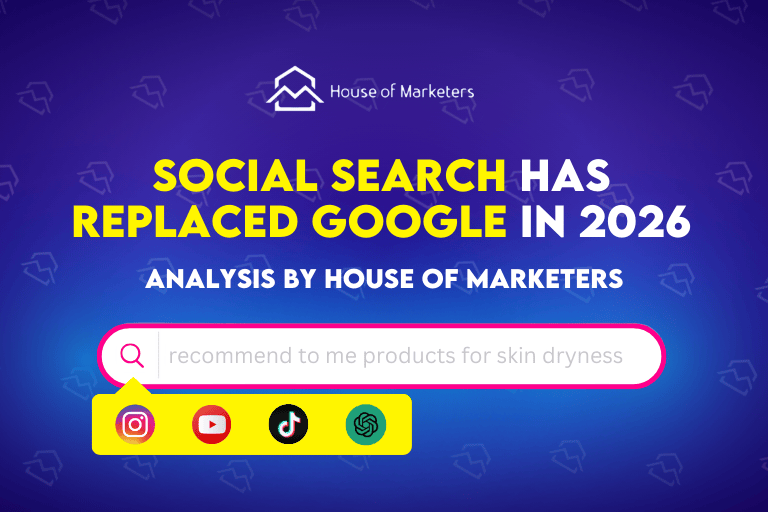
Over the past year, social platforms have quietly rolled out changes that should make every marketer rethink how discovery actually works.
TikTok’s recent push into Search Ads and product-discovery formats, combined with Instagram’s growing emphasis on keyword-driven Reels placement, signals a simple shift: people are no longer starting their research on Google. They’re starting with creators.
What is Social Search?
If you’ve worked in marketing long enough, you’ll remember when “search” meant a blue link, a meta description, and a handful of keywords placed carefully on a webpage.
As House of Marketers Founder Inigo Rivero defines it:
“Social search has changed how discovery works. People no longer find answers through neutral results pages. They find them through creators demonstrating solutions in public. On platforms like TikTok, search results are personalised by behaviour.
What a user sees is shaped by their past engagement, the content they interact with, and the signals they send over time.
For brands, this means visibility is no longer earned through keyword optimisation alone, but through creator-led content that aligns with how audiences actually search and behave.”
But that version of search no longer reflects how people actually find things. When someone wants a new skincare routine, a restaurant recommendation, or help choosing between products, they don’t start with a typed query on Google.
They open TikTok. Or Instagram. Or YouTube. Or even ChatGPT.
And the numbers are clear. According to Forbes, 67% of Gen Z use Instagram as a search engine, 62% search on TikTok, and Google sits slightly lower at 61%. Adobe’s findings echo the trend: nearly 1 in 10 Gen Z users are more likely to rely on TikTok than Google for everyday answers.
In practice, most young consumers jump between platforms but the direction of travel is clear: search has moved to social.
And the reason is clear – they are looking for a real person explaining the answer in a way that feels specific to them.
That behaviour is Social Search.
It’s search-driven by identity, not just information.
People are not asking, “What’s the best?” They’re asking, “What works for someone like me?” And that subtle shift in intent is what gives creators – ordinary people with specific experiences – a level of influence that traditional SEO simply isn’t designed to capture.
What makes Social Search even more interesting is how it blends discovery, evaluation, and trust-building into one fluid moment. There’s no funnel step where a user “moves” from research to consideration.
They see it happen in front of them: the problem, the product, the experience, the reaction. It’s the kind of frictionless journey that marketers have tried to engineer for years, happening organically inside a video feed.
How Social Search is Rewriting the Search Funnel
The classic funnel assumed a neat sequence: awareness → consideration → decision.
But Social Search collapses all of it, because users start their journey already immersed in real experiences from people they relate to.
Instead of moving step-by-step, they encounter discovery, validation, and decision-making in the same moment — the moment the content matches their intent. And because so much of that content is creator-led, it behaves more like a performance engine than a passive awareness layer. We see this clearly when creator posts fuel both organic search lift and paid amplification, a dynamic we break down in our analysis of influencer content vs paid media boosting.
We’re also seeing platforms reinforce this shift.
- TikTok rewards videos that answer specific questions with strong watch-time and save rates.
- Instagram has quietly increased the weight of keyword-rich Reels overlays and captions.
- And YouTube, long known for structured education content, now surfaces Shorts in response to conversational queries.
Each platform is now optimising for intent-rich behaviours, not passive browsing, and that shift reshapes how content ranks and how users decide.
How TikTok, Instagram, and YouTube Turn Everyday Searches into Discovery Moments
Social platforms are now answering questions in ways traditional search never could. People aren’t looking for perfectly packaged information, they’re looking for quick signals, real context, and content that feels close to their everyday lives.
TikTok, Instagram, and YouTube each play a part in that process, and understanding their roles helps explain why Social Search has taken over so quickly.
TikTok is The Discovery Engine
TikTok’s algorithm moves the quickest, especially when it comes to identifying new behaviour patterns, making it the place where most searches start. The platform reads behaviour more closely than it reads keywords — how long someone watches, where they pause, what they rewatch, what they save. Those small actions tell TikTok which videos feel genuinely useful.
Creators who talk the way people search tend to perform best. Clear phrasing, on-screen text, and natural examples are all picked up by TikTok’s system, and they are then matched to real queries. If the video answers a need, it keeps resurfacing for new audiences without the creator doing anything extra.
TikTok also leans heavily on completion rate now. Longer videos that hold attention often get elevated in search results because they signal genuine value. That’s how discovery happens on the platform: one useful moment at a time.
Long-form content has also changed the game. Creators who previously posted 6-second clips are now producing 30-, 45-, and even 60-second explanations because the new algorithm rewards completion and retention.
The result is a platform where product discovery is not a linear step; it’s a moment that happens inside entertainment. Users don’t even feel like they’re researching—they’re just watching, saving, and returning when they’re ready.
Instagram is The Community Builder
If TikTok is where discovery happens, Instagram is where credibility is checked. People come here to see how a product fits within their lifestyle: the aesthetic, the social validation, the “do people like me use this?” factor.
Instagram’s quiet shift toward more robust keyword relevance has accelerated this behaviour.
Reels that include natural-language overlays, descriptive titles, or even subtle keyword cues are now ranking in Explore for very specific searches—“London date ideas,” “neutral home decor,” “pet-friendly hotels,” “workout plan for beginners.”
The platform also rewards what feels aspirational but attainable. A creator showing their morning routine, a travel itinerary, a restaurant review—it’s less about the information and more about the feeling of seeing someone live an experience you might want to have.
Instagram has effectively become the “second step” in Social Search: users find on TikTok, validate on Instagram, and decide based on the overall aesthetic, tone, and community conversation around the product or experience.
YouTube is The Education Portal
YouTube has the longest history as a search engine, and it still dominates when a person wants depth, clarity, or a detailed comparison.
But the rise of Shorts has introduced a new layer to the platform: snackable answers that surface in response to conversational queries.
This means users can now move between a 15-second clip and a 15-minute breakdown without leaving the platform—and the algorithm understands when a user needs one versus the other.
YouTube’s strength lies in trust. If TikTok sparks an idea and Instagram shapes the desire, YouTube closes the loop with detail and authority and people come to YouTube when they want to make sure they’re making the right decision.
And when creators rank well on all three platforms for similar search intents, that’s when brands see the greatest lift in awareness, credibility, and conversions.
How Social Search Actually Ranks Content?
One of the biggest misunderstandings about Social Search is that it works like Google with different packaging. It doesn’t. Platforms aren’t ranking content based on authority; they’re ranking it based on how people behave with the video in front of them. Meaning that, social search relies on real-time behavioural signals.
Now, algorithms aren’t just evaluating what a video contains – they’re evaluating what people do with it.
Watch Time and Retention Are the Strongest Social Search Ranking Signals
One of the strongest indicators of relevance today is retention depth. If viewers stay engaged past the first few seconds, the algorithm assumes the content answered something important. If they rewatch, that signal becomes even stronger. Platforms interpret the replay as: “This solved a problem worth understanding again.”
Saves Function as High-Intent Indicators in Social Search
They show intent and not passive interest. A save is a user saying, “I’ll come back when I’m ready to take action.” This is why save-heavy videos often rank higher for practical searches like recipes, product reviews, travel planning, and how-to content.
Shares Act as Proof of Usefulness, Not Just Virality
When a video gets shared, the algorithm sees confirmation that the content carries social value. That value isn’t about virality — it’s about usefulness. Even quiet shares, the kind sent privately, weigh heavily in ranking models because they signal trust.
Multimodal Keyword Inputs Strengthen a Video’s Search Relevance
Another underestimated factor is keyword proximity in multimodal inputs. Platforms now analyse:
- spoken keywords in the audio
- on-screen text and subtitles
- hashtags and metadata
- caption phrasing
- comments
- recurring user questions around the topic
When all these elements align naturally around the same theme, a video becomes semantically stronger. The algorithm can match it more confidently to niche, conversational queries, the kind users now prefer.
Consistent Topic Patterns Help Creators Build Search Authority
But perhaps the most overlooked driver of ranking is pattern reinforcement. When a creator consistently produces content that solves the same category of problems, their entire library becomes more discoverable. The algorithm recognises a pattern and begins testing more of their videos in similar search results. This is how micro-creators quietly dominate topics without having massive followings.
For brands, this means one thing: Social Search isn’t driven by isolated posts; it’s driven by consistency of perspective. Creators who specialise, repeat, refine, and respond become easier for algorithms to index, and therefore easier for users to find.
How Creator-Led Content Has Become the Engine of Social Search
If you strip Social Search down to its core mechanics, you realise something important: the entire system runs on creator-generated content.
People don’t just want information; they want to see how someone like them handles the same situation. Creators provide that context almost effortlessly, and platforms have learned to surface those moments because users respond to them.
This is why creator-led content consistently outperforms brand content in search environments. Creators explain things the way people actually think about them. They talk through problems, show the outcome, mention the little details, and do it in a tone that feels natural. That language lines up with the way users search, which makes their videos easier for algorithms to match with real intent.
But the deeper reason creators dominate Social Search is that their content is structurally aligned with how algorithms interpret intent.
Most creators naturally produce:
- Problem–solution storytelling
- Clear demonstrations
- Personal context
- Specific, niche phrasing
- Repetitive category content
- A recognisable style that the algorithm can easily classify
All of this makes their content easier for platforms to understand — and therefore easier to rank. Brands try to recreate this style, but it usually falls flat because the content feels engineered instead of lived. Creator content works because it’s grounded in real experience and delivered in a way audiences instantly understand.
This is where a structured, Social-Search-first influencer strategy becomes indispensable.
The House of Marketers Approach: Designing Campaigns for Social Search, Not Just Social Reach
Our internal process starts long before choosing creators. We begin by analysing how people search within the category, because search intent determines which creators will naturally rank — not follower count, not production quality, not general alignment.
We map:
- The exact phrasing users type or say
- The problems they reference repeatedly
- The tone and language patterns used in successful organic videos
- The level of specificity audiences expect
- The formats dominating search results (reviews, comparisons, challenges, routines)
Once we understand the intent, the strategy becomes clear. We select creators whose natural voice, niche expertise, and posting history already align with those search pathways. This dramatically increases ranking probability because the creator’s existing behaviour matches what the algorithm expects from credible, category-specific content.
Inigo Rivero, Founder of House of Marketers, explains the operational shift:
“We are already running campaigns where Social Search is built into the brief, the creator selection, and the reporting. It is not a future concept for us. It is how campaigns are being executed right now.”
From there, we build briefs that guide creators toward the search-informed version of their style, not scripts. We don’t tell creators what to say; we help them frame their existing storytelling through the lens of how real people are searching.
A typical HOM brief includes:
- The search questions users are asking
- The conversational phrasing they use
- The scenarios people want demonstrated
- The outcome or transformation they need to see
- The keywords that appear naturally in real speech
- The formats that match user intent
This ensures content is:
- Native to the creator
- Useful to the audience
- Understandable to the algorithm
And because creators execute the idea in their own voice, the content gains both authenticity and semantic strength — two qualities that define today’s Social Search ecosystem.
How the Social Search-led Approach Works in Practice
When creators align with user intent, ranking becomes a by-product rather than a goal. In a recent campaign, we focused on micro-creators addressing tightly defined problems instead of broad category claims. Because their videos reflected the exact questions users typed into TikTok, several pieces began ranking organically within days — without paid support.
We saw this clearly in our Cetaphil Derm On Tour campaign, where creator-led routines outperformed polished brand assets because they showed real skin, real conditions, and real results.
In another campaign, Dr. Hypes generated 2M+ impressions, rapidly expanding brand visibility across the US. That scale reflects strong creative resonance, with creator-led content earning wide distribution across the platform.
That kind of scale rarely comes from promotion alone; it comes from content that functions as an answer inside Social Search.
This confirms that Social Search rewards content that feels like an answer, not an advertisement.
And because creator content lives across Instagram and YouTube as well, we often see a compounding effect: a creator ranks for the same intent across multiple platforms, giving the brand expanded discoverability with no additional production overhead.
This is the future of influence – not reach, but relevance inside the search experience.
Social Search isn’t “the next thing” anymore; it’s the system shaping how people discover, compare, and decide. Creators now sit at the centre of that journey, and platforms are building around their influence rather than around traditional search behaviour.
The shift has already happened. The only question is whether brands will move with it or lose visibility to creators who understand how people actually search.
If you’re planning your 2026 roadmap and want content that shows up where real intent lives – not just inside a feed – we can help.
House of Marketers builds creator-led Social Search frameworks designed to rank, resonate, and convert across TikTok, Instagram, and YouTube.
When you’re ready to turn Social Search into a competitive edge, let’s talk.

House of Marketers (HOM) is a leading TikTok Marketing Agency. Our global agency was built by early TikTok Employees & TikTok Partners, which gives us the insider knowledge to help leading brands, like Redbull, Playtika, Badoo, and HelloFresh win on TikTok. Want us to convert more of Gen Z and Millennials with TikTok? Get in touch with our friendly team, here.