
Social search has completely changed how people want to be marketed to. People now open TikTok, Instagram, and YouTube and type exactly what they want (“best moisturiser for dry skin,” “honest review of X supplement,” etc.). This means that they are seeking real people talking about the problem they want to solve. And a UGC creator or influencer review is exactly what answers their questions.
That is why influencer marketing and UGC marketing sit right at the intersection of modern consumers and their search behaviors. With the recent e-commerce updates in Meta, it is further emphasised that influencer and UGC content play a big role in the marketing funnel.
For brands, this trend is both an opportunity and a pressure test. But knowing which strategy to use is where most brands get it wrong. The difference between UGC vs influencer marketing is a strategic one that directly impacts where your brand shows up, how much trust it earns, and whether that trust converts into sales.
House of Marketers has built and managed creator programmes that answer exactly that question at scale. We are a TikTok influencer agency that has helped brands like Beauty of Joseon reach the number one bestselling position on Amazon through creator-driven demand and turned viral spikes into sustained category dominance.
This guide is built on that experience. You will get clear definitions, an honest breakdown of pros and cons, and a practical framework for deciding what belongs in your next campaign.
Let’s get started
Summary
UGC marketing and influencer marketing are two very different tools, and most brands are using them incorrectly. In this guide, you’ll learn the clear definitions, a UGC creator vs influencer breakdown, pros and cons of each, and a hybrid strategy that covers the full funnel.
What Is Influencer Marketing?
Influencer marketing is a promotional strategy where brands collaborate with established creators to expand reach and drive revenue for brands. It works because influencers have already earned the trust of a specific audience, and that trust transfers to the brand when the partnership feels genuine. Influencers range from micro creators with ~10k+ followers all the way to macro creators and celebrities.
Influencer marketing works when the brand provides compensation and free products/experiences. In return, an influencer creates posts, videos, or stories across platforms like Instagram, TikTok, and YouTube that showcase the brand within their existing content style.
Why brands use it:
Here’s why brands prefer them
- 69% of consumers trust influencer recommendations more
- It cuts your work in half in appealing to your ICP (Ideal Customer Profile)
What is the Definition of UGC in Influencer Marketing?
UGC (user-generated content) is made by customers, fans, or everyday creators, i.e., selfie videos, unboxings, before-and-after clips, honest reviews, and product demos filmed at home. Some of it appears organically when a happy customer posts without any prompting. Some of it is commissioned from paid UGC creators who film to your brief but do not post to their own channels. You get the raw files, and you own that content.
UGC is not the same as an influencer post. A UGC creator may have zero public following. Their job is not to distribute to an audience; it is to produce content that feels like a friend’s take, not a brand’s pitch. You distribute it yourself through your paid channels, product pages, email, and social feeds.
Why brands use it:
Here’s why brands prefer them
- It feels like a friend talking, not a brand selling
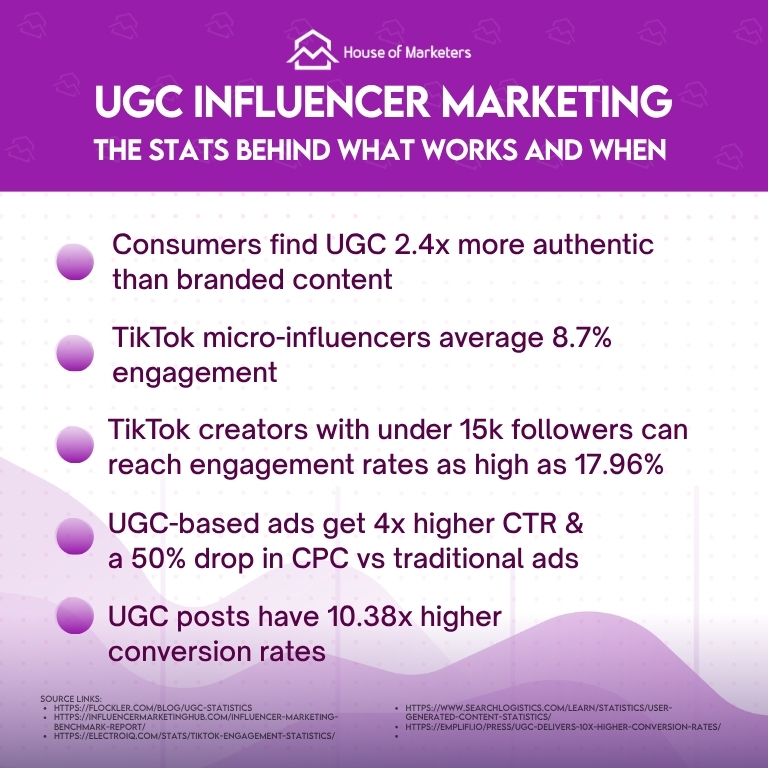
- Consumers find UGC 2.4x more authentic than branded content
- UGC posts have 10.38x higher conversion rates
- It is faster and cheaper to produce and test
- It does not require paying for someone’s audience
What Is the Difference Between UGC and Influencer Marketing?
The core difference between a UGC creator vs influencer is that with influencer marketing, you pay for reach, with UGC marketing, you pay for raw, authentic content.
Here is how the two differ in detail:
| Aspect | Influencer Marketing | UGC Marketing |
| Creator Type | Creators with established audiences | Customers (organic) or paid UGC creators |
| Distribution | Published on creator channels | Primarily used on brand-owned channels (ads, product pages, email), sometimes posted by customers |
| Primary Goal | Reach, awareness, discovery | Trust, validation, conversion |
| Control | Guided by briefs, shaped by creator voice | Ranges from none (organic) to fully brand-directed (paid UGC) |
| Trust Mechanism | Built through audience loyalty and creator credibility | Built through relatability and real-user perspective |
| Strength | Scales quickly through existing audiences | Performs strongest in conversion-focused placements |
Pros and Cons of Influencer Marketing
Pros of Influencer Marketing
- Reach and discovery at speed
Influencer content can reach a creator’s full audience the moment it goes live, with no media budget required to generate the initial impression.
- Borrowed credibility
Influencers transfer their existing trust to your brand. A fitness coach recommending your protein powder carries far more weight than your own ad saying the same thing.
- Access to specific communities
A mid-tier creator in the home improvement niche gives you direct access to the exact buyers you want, without building that audience yourself.
- Storytelling that converts
Influencer content delivers brand messages through a relatable voice, which builds the kind of emotional connection a static ad rarely can.
- Works across multiple platforms and formats
Influencer content adapts to platform behavior in ways that feel native rather than forced.
Cons of Influencer Marketing
- Brand reputation risk
When you tie your brand to a creator, you become associated with them and their public mistakes by proxy. A poorly matched influencer who gets caught in controversy will drag your brand into the same conversation.
Fix: Add a morality clause to contracts that lets you exit the partnership immediately if needed.
- Influencer Marketing ROI requires layered tracking
You will need layered tracking: unique codes, UTM links, and a tolerance for blended measurement to justify influencer spend with clean data.
Fix: Assign each creator a unique discount code or UTM link so conversions trace back to them directly.
- Cost variability
Influencer fees shift based on platform, niche, follower count, and usage rights. Budgeting becomes difficult when a creator you planned around doubles their rate between campaigns.
Fix: Lock in rates and usage rights for multiple posts upfront with a longer-term contract.
- Authenticity concerns at scale
Followers notice when an influencer is posting a new sponsored product every three days. Overexposure turns trust into skepticism fast.
Fix: Vet creators for low sponsorship frequency and choose ones that cap the number of brands they work with concurrently.
- Post timing can slip
Build buffer time into every campaign plan. Influencer schedules are unpredictable, and a delayed post during a launch window is a real operational risk.
Fix: Require content approval and a confirmed publish date in the contract, with a penalty clause for late delivery.
Pros and Cons of UGC Marketing
Pros of UGC Marketing
- It has trust and credibility that branded content cannot replicate
Audiences trust recommendations from other customers far more than polished brand messaging.
- Cost-effective content at scale
Customers create the content themselves, or UGC creators produce it at a fraction of the cost of a traditional shoot. Brands then repurpose it across ads, social feeds, and landing pages with minimal production overhead.
- Performance channel fuel
UGC thrives inside paid social. Scroll-stopping, native-looking creative consistently outperforms branded ads in DTC categories like beauty, wellness, fitness, and home goods.
- Conversion lift where it counts
Real photos, reviews, and testimonial clips on product pages and in email sequences influence buying decisions at the bottom of the funnel, where the sale actually happens.
- Full content ownership
Commissioned UGC deals typically grant you complete usage rights. You control where it runs and for how long, with no expiration windows to negotiate.
Cons of UGC Marketing
- Lack of content control with organic UGC.
Content made without a brief can drift far from your brand’s tone and visual standards. What a customer thinks looks great may not align with what you need.
Fix: Amplify the pieces that happen to meet your standards. For everything else, you fill the gap with paid UGC creators who work to a brief.
- Requires active monitoring.
UGC campaigns need ongoing moderation to filter out misleading, offensive, or off-brand content that could embarrass the brand or mislead other customers.
Fix: Set up real-time brand mention alerts. Use a social listening tool with keyword filters to auto-flag content for human review before you amplify it
- Legal and copyright exposure.
Reposting or running a customer’s content as an ad without explicit written permission opens the door to intellectual property disputes.
Fix: Always collect usage rights before you publish.
UGC Creators vs Influencers Comparison
| Aspect | UGC Creators | Influencer Creators |
| Primary value | Believable demos and social proof | Reach and borrowed credibility |
| Speed | Fast to brief and produce | Slower due to schedules and negotiations |
| Cost | Lower per asset | Higher per post or campaign |
| Content control | High — you own the brief | Lower once live on the creator’s channel |
| Ownership | Usually full usage rights | Usage windows vary — negotiate up front |
| Best for | Conversion lift, ad testing, PDPs | Discovery, launches, brand storytelling |
| Measurement | Clean inside paid channels | Requires blended metrics across touchpoints |
| Main risk | Low-quality damages trust | Creator mismatch wastes budget |
Influencer Marketing vs. UGC Marketing: Which Drives More Sales?
Influencer marketing delivers faster reach and is more effective at the top of the funnel. It generates brand awareness, buzz, and primes the audience towards the brand. But… it does not sustain the same conversion impact once a campaign ends.
Meanwhile, UGC drives stronger conversions in the lower funnel. Real photos, testimonials, and demo clips are just the right push that a customer needs to hit “buy”. 79% of people say UGC directly impacts their purchasing decisions.
Both play a different role in the marketing funnel: Influencer marketing opens the door, and UGC marketing closes the sale.
The brands seeing the strongest results in 2026 are not choosing between the two. They are running both in sequence and playing to the strength of each.
UGC creator vs Influencer: Which Strategy Is Right For Your Brand?
Choose UGC creators when:
- You are running performance campaigns and need fresh creative to test
- You want proof on product pages and in email sequences
- Your product has a clear visual demo or transformation
- You are a DTC or eCommerce brand that lives inside paid social
- You need to lower content production costs without sacrificing authenticity
Choose influencer marketing when:
- You are launching a new product and need visibility fast
- Your category requires education, expertise, or trust — health, finance, specialty tech
- You need to reach a new audience, geography, or subculture
- You want brand storytelling at scale through a credible, relatable voice
- You have usage rights and whitelisting in your plan to extend the campaign’s life
Run both when:
- You want to cover the full funnel — awareness through conversion
- You need a steady creative pipeline across a full quarter
- You can brief three to five UGC creators monthly and keep one or two influencer partners for deeper moments each quarter
A skincare brand, for example, might book a dermatologist influencer for a launch week educational post, then run ten UGC testimonial clips in retargeting for the following three weeks. The influencer creates context and credibility. The UGC closes the sale.
UGC and Influencer Marketing: The Hybrid That Actually Works
The strongest brands are not treating UGC and influencer marketing as separate budgets. They are stacking them.
Here is a simple hybrid model you can follow:
Step 1: Seed and spark. Send product to micro influencers and loyal customers. Invite honest takes with no pressure. Repost the best organic content with permission.
Step 2: Anchor with authority. Book two or three well-matched influencers for a campaign moment. They bring reach and context. You clip their content into shorter assets.
Step 3: Scale with paid. Turn UGC and influencer clips into ad variants. Test different hooks, opening frames, offers, and CTAs. Use creator whitelisting to run ads from the influencer’s handle to maintain the authentic feel with paid distribution behind it.
Step 4: Maintain momentum. Commission monthly UGC batches to keep your creative library fresh. Keep one or two influencer partners active each quarter for deeper storytelling.
UGC and micro influencer marketing work well together precisely because micro influencers tend to have high engagement rates and audience trust that mirrors the authenticity of UGC — without the production costs of a macro campaign.
Need help finding influencers according to your niche? Check out these compilations
- 48+ Social Media Top Tech Influencers in the U.S (& Global)
- Top 25 Food Influencers in the U.S. Helping Brands Sell Out Stock
- Influencer vs. KOL Marketing: Differences and Pros & Cons
The Bottom Line
UGC vs influencer marketing is not a competition. It is a question of what job you need done right now.
UGC feeds your performance engine. It gives you believable proof, fast creative tests, and content that converts at the bottom of the funnel. Influencer marketing expands your reach and adds the kind of authority and storytelling that opens new audiences.
Most brands need both for a good social media marketing campaign. The question is sequencing them correctly and knowing what metrics to hold each one accountable to.
If you want an influencer marketing agency in the UK that builds both influencer strategy and UGC campaigns, a TikTok influencer agency like House of Marketers can help.