
Heritage brands, include restaurant chains are facing a conundrum in today’s social media age. On one hand, they have decades of cultural memory and operational scale, but on the other hand, the same history that built them can easily age them out of relevance. We’ve got an example of how a restaurant marketing case study that will activate your taste buds.
Chili’s was approaching its 50th anniversary. It owns one of the most recognisable restaurant jingles in America. It has institutional brand equity that most start-ups would pay millions to acquire.
And yet none of that guarantees discovery in a social-first world.
The real question was not whether people remembered Chili’s. It was whether they would choose it. As marketers, this is a problem whose solution is a delicate balance between the past and the present. And Chili’s positioning is a master class in doing this well.
Let’s take a look at how Chili’s revamped its marketing to create better engagement in today’s age and increase its appeal amongst a new and younger audience. It’s a top restaurant marketing case study that all brands can learn from.
Summary
In this case study, we deep dive into how Chili’s transformed its most “filmable” menu items into social media distribution engines. Their visually engaging menu items drove 70% year-over-year growth & now account for 11% of total business. Creator partnerships also fueled UGC participation. Nostalgia was carefully balanced with modern marketing to keep the brand culturally relevant.
Use Price Stability as a Competitive Advantage
In recent years, inflation and the rising cost of food items have been a hot topic. Fast food chains were charging premium prices, like $18 for Big Mac combo meals. In this chaos, where most companies adjacent to Chili’s were going bankrupt, Chili’s somehow managed to come out as a winner.
Instead of raising their prices, cutting corners on quality, or simply shutting down, they repositioned. Chilli’s employed social listening, noticing the rising trend of Sticker shock, and leaned into its affordable yet enjoyable dine-in experience with its $10.99 “3 For Me” appetiser offer.
Chilli’s CMO George Felix summarised the repositioning as,
“We believe Chili’s 3 For Me offers better value than you’ll find in any drive-thru.”
How did Chili’s land on this idea? How did they know it would be a hit?
Internally, their team described the pivot shift idea as “digging through the attic,” which is essentially rediscovering what made the brand culturally magnetic in the first place. Chilli’s has always been a family-friendly, affordable chain restaurant. So they just repositioned while still staying true to their brand ethos and audience.
As marketers who want to learn from Chili’s marketing strategy, we advise that you monitor all the big picture events taking place and analyse how you can insert your brand in that conversation. But make sure that in doing so, you are still true to your brand’s ethos and staying close to your roots.
Turn Your Most Filmable Products Into a Distribution Engine
Chilli’s had found a sore spot in the market and was able to soothe it by providing real value at a budget price. This increased their social engagement, and that led to them discovering the next best thing for their marketing. Some of their popular menu items revealed to them a new way to gain popularity on social media.
Chilli’s noticed that people made most content about their food, which featured,
- Cheese pulls
- Dipping experiences
- Shared platters
- Interactive formats
This is the power of having an experiential dining experience. This was a jackpot alignment between product design and current user behaviour.
As marketers, we need to understand that Gen Z does not dine in for just the food. They dine in for the experience, the aesthetic, and the social currency it might earn them. Products that move, stretch, dip, or reveal tend to outperform static plates on social platforms. Especially with the rising trend in reels and the algorithms favouring reel and short-form content, this makes sense as well.
So, to cater to a Gen Z audience instead of inventing a new “TikTok product,” as would be the first idea for any marketer, Chili’s amplified what already fit their brand.
The triple dipper was introduced for its social media appeal. It provided novelty without abandoning familiarity. The new variation prioritised TikTok and social media, combined with appealing to creators and influencers.
This shift resulted in increased 70% year-over-year sales and now accounts for 11% of Chili’s total business. The platter’s popularity also contributed to a 14.1% increase in same-store sales growth for the quarter ending September 25, along with a 6% increase in traffic.
@ireneykim a triple dipper will forever have my heart ❤️ @Chili’s Grill & Bar #chilis #chilismukbang #tripledipper #tripledippermukbang #mozzarellasticks ♬ original sound – irene kim 🧸
: Chili’s CEO Kevin Hochman attributed the success to the brand being “very relevant with younger guests and how they prefer to eat.”
This relevance led Chili’s to raise its annual revenue forecast from $4.55–$4.62 billion to $4.7–$4.75 billion.
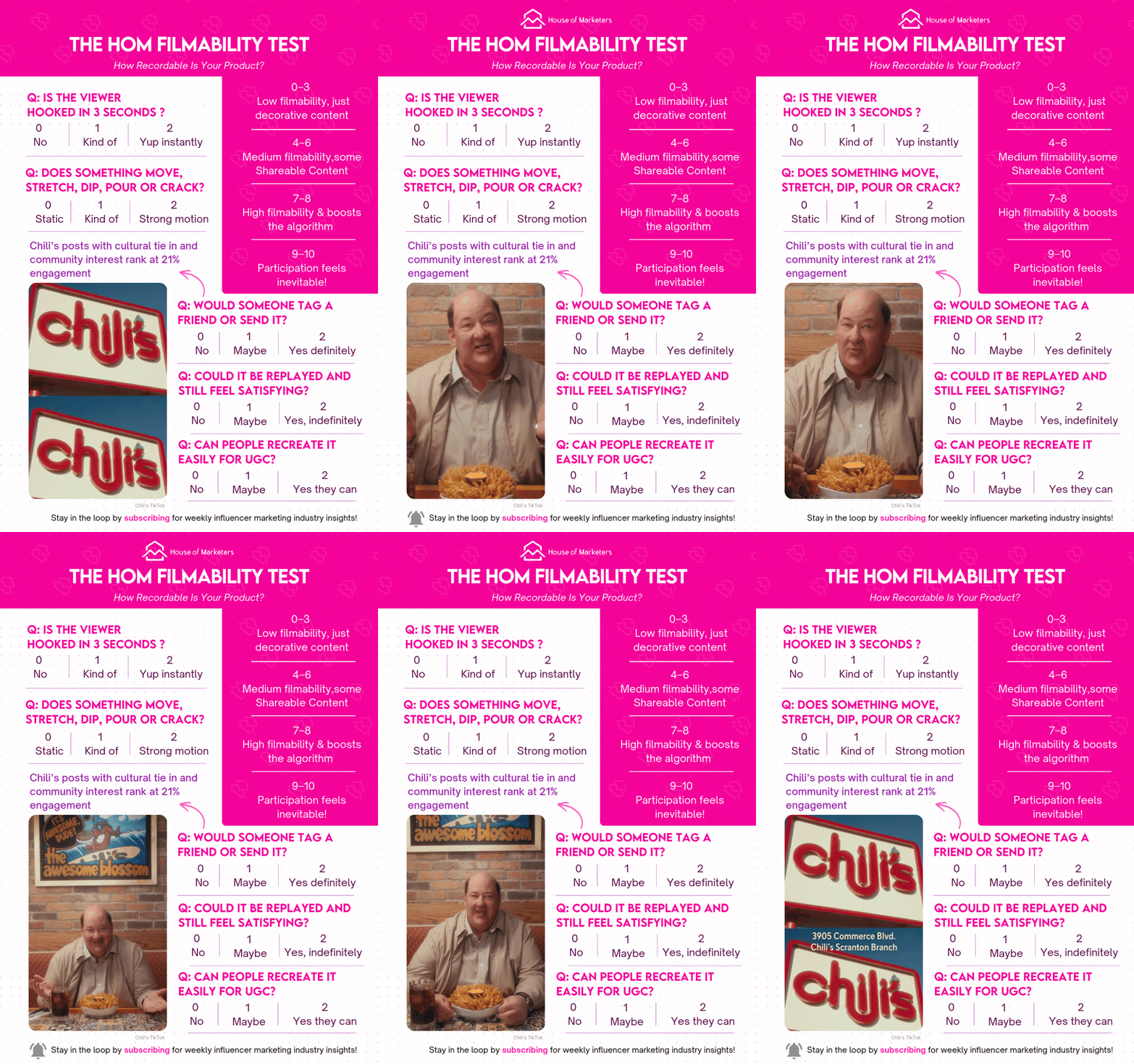
So, as marketers, audit your products and brand experience for film-ability. Ask:
- Would someone instinctively record it?
- Would they be interested in its visual appeal to be shareable and interesting?
If yes, you already have content equity.
Chili’s is not the only brand that has figured out that social media visual appeal is a big factor in popularity amongst a younger audience. Crumbl Cookies does this, too. Check out Crumbl’s case study to see how it puts this strategy to use.
Chili’s Restaurant Marketing Case Study
Anchor Your Celebrity Partnerships to Product Strategy
With its social media appeal bait in place, Chili’s used creators and celebrity collaborations to expand its brand’s reach.
On Instagram and TikTok, Chili’s leaned into recognisable personalities in ways that felt culturally relevant. Here are some recent Chili’s campaigns featuring influencer marketing.
Chili’s Espresso Martini with Tequila Katie & Scheana Shay
Chili’s partnered with reality television personalities Scheana Shay and Katie Maloney for its tequila and espresso martini push.
@chilisofficialThe Chili’s Espresso Martini is as real as it gets.♬ original sound – Chili’s Grill & Bar
Katie Maloney, long associated with the nickname “Tequila Katie” from Vanderpump Rules, already had cultural credibility around tequila-driven nightlife moments. Scheana Shay similarly carries strong associations with bar culture and reality TV social circles and had worked at Chili’s in the past.
Chili’s aligned the drink with creators who already embodied the behavior the product represents: nightlife, fun, and great company.
#ChilisMozzMates with Jana Craig
Similarly, the #ChilisMozzMates campaign invited audiences to compete for a date at Chili’s with Netflix personality Jana Craig. This campaign required user participation with its “cheesy” hook that pulls its target audience in.
@chilisofficialu can pull me for a chat if you buy me the Chili’s MozzPals costume available on oct 1st.♬ The Island Paradise – ZydSounds
#Chilis3ForMe Campaign
Even value-driven campaigns such as #Chilis3ForMeRescue encouraged audiences to publicly compare Chili’s pricing with fast food.
do you think Chili’s is better than fast food??
Quote Retweet this using #Chilis3ForMeRescue and let us know why you think Chili’s is better than fast food and we’ll buy 300 people a 3 For Me on us!
Rules: https://t.co/SLTKe3cZKY pic.twitter.com/ohkJ5Oz5Ep
— Chili’s Grill & Bar (@Chilis) May 2, 2024
Chilis’ Radical ‘Rita’ with Tiffani Thiessen
Chili’s has not abandoned its past in its push for modern relevance. It has curated it. As CMO George Felix has noted, “It would be silly to ignore our history. But it’s also dangerous to rely on it.”
That balance is visible in how the brand uses nostalgia.
When Chili’s partnered with actress Tiffani Thiessen on the Radical Rita, a personality that was iconic in the 90s era. The vibrant purple cocktail, paired with collectible 90s-inspired swizzle sticks, turned the drink into a memory trigger.
@chilisofficial A $6 Radical ‘Rita is extremely scandalous. Right @tiffanithiessen ♬ original sound – Zachariah
Chili’s X The Office Homage
The same thinking shows up in the creation of the Scranton Branch in Pennsylvania, a permanent location designed to honor Chili’s long-running association with the popular sitcom The Office. For years, fans connected the brand to the show despite no real Scranton location existing. Instead of letting that cultural tie fade, Chili’s formalised it.
As Felix explained:
“For decades, Chili’s has inserted itself in culture… But we’ve also seen the brand come to life on screen through the years, and that includes being tied to Scranton despite never having a location there… A moment this big was way more than a pop-up could pay off, so we created Chili’s Scranton Branch to feel like a familiar home to fans.”
This is just a brief snapshot of how Chili’s employs strategic partnerships with influencers to borrow some of their cultural limelight without making it feel forced. This prevented influencer activity from feeling disconnected from the brand’s core strategy.
So, as marketers, make sure that when using influencers or celebrities,
- Anchor them to a specific product or cultural moment.
- Ensure the collaboration reinforces an existing narrative.
- Design for participation, not just impressions.
- Avoid standalone endorsements that lack strategic context.
Chili’s marketing strategy approach shows that influencer marketing becomes powerful when it extends a cohesive strategy, not when it attempts to become a substitute for one.
How Chili’s Uses Paid Media to Scale What Works
Chili’s follows a tried and trusted pattern when it comes to paid media amplification.
- Identify a cultural hook.
- Build a product or experience around it.
- Let creators validate it organically.
- Use paid media to scale proven momentum.
The “Chili’s Patrón Party” event followed this exact sequence.
The brand created an immersive, highly visual pop-up built around frozen margaritas. Ice bars. Instagram-ready booths, along with high-contrast lighting, accompanied by bright, saturated drinks, set the scene.
Then, Chili’s invited TikTok creators, influencers, and fans to create UGCs in real time, creating immediate organic distribution before paid media entered the picture.
Once the content showed traction, Chili’s scaled it.
For the PATRÓN Frozen Margarita push, the brand used TikTok Pulse Custom Lineups to place ads directly after frozen beverage user-generated content. That meant users already consuming similar drink content encountered the Chili’s messaging in context.
The lift came from placement, not reinvention:
+21.9% increase in ad recall
+11.3% lift in brand awareness
+52% increase in average watch time
The outcome was not just engagement but measurable commercial impact, which culminated in recognition at Ad Age’s 2025 Creativity Awards for Best ROI: Work That Works.
Make Sure Your Marketing Aligns With Your Execution
Good marketing can generate traffic and create more sales; however, marketing alone can’t guarantee long-term sustainable results.
Chili’s success does not hinge on its marketing glow-up alone. You have to account for all the operational simplifications that led to this success as well. Chili’s reduced its menu complexity to prioritise its execution consistency.
As Chili’s CMO Felix puts it
“The worst thing you can do is have good marketing if the experience doesn’t deliver.”
If you create amazing influencer campaigns that drive traffic to your brand, but the product experience disappoints, all that brand awareness converts into negative word-of-mouth. Social amplification works both ways.
This is where many modern campaigns fail. Brands scale attention faster than they scale execution.
So before increasing influencer spend or paid distribution budget, make sure that your brand is ready for all that traffic.
What Marketers Should Learn from Chili’s Marketing Strategy
Chili’s marketing revamp is not just about modernising its discovery engines, but its shift is much broader than that. Here are the lessons that matter most for marketers trying to modernise a heritage brand without turning it into a stranger.
Nostalgia is not a strategy.
Heritage brands often overdo their marketing around their own past. Chili’s uses nostalgia as proof of cultural legitimacy, not as the main storyline.
Focusing simply on being a heritage brand can work in your favour only when the brand and its product make sense for that. But to paint a heritage brand into a modern light, you have to contribute its heritage in the marketing very tastefully
Chili’s employs nostalgia only to make the brand feel familiar while the rest of it modernises.
Treat “Marketing” like a loop instead of a linear system
Most marketers run campaigns in a straight line: brief, build, launch, report.
However, Chili’s operates more like a feedback engine,
Listen → spot behaviour → package it → amplify it → measure → repeat.
So build a weekly “signal review” ritual; it doesn’t have to be more than 30 minutes. And measure actual customer behaviours: what are people filming, repeating, remixing, comparing, saving, searching. This will offer you new creative options to try and explore avenues you otherwise may not have thought of.
Don’t be too quick to jump on every trend that seems popular
Reacting fast is easy. Reacting fast without looking desperate is the hard part.
Chili’s manages to protect its brand’s tone. They aren’t trying too hard to appeal to a wholly new audience; they are balancing this while not neglecting their existing fan base
Try to define your “brand reaction rules” on one page:
- What topics are you allowed to jump on?
- What formats do you always win in?
- What is off-limits because it will look forced?
Film-ability is the new product strategy now
The product experience, being inherently recordable, is the most important factor nowadays.
Chili’s did not make Gen Z interested in cheese pulls. They recognised that their product has something that is enticing this new audience, and they amplified it. No forced relatability campaign needed.
Influencers work best when they are plugged into a narrative, not hired to invent one.
A lot of influencer marketing fails because brands use creators like a shortcut for strategy. Chili’s uses creators like fuel, while their well-thought-out strategy is the engine. The narrative already exists; creators simply increase its speed and reach.
That is why their tried and tested formula is
personality match + cultural moment + product behaviour.
So before you brief a creator on your marketing campaign, consider that,
“This creator is here to make this specific story travel.”
Having an answer to this statement will make your influencer marketing ROI boom.
House of Marketers Insights
Chili’s strategy works because it understands how discovery actually happens in today’s age. Consumers are no longer discovering restaurants through TV ads or even Google searches first. They are discovering them through their for you page or content feeds via creators and influencers.
Chili’s uses influencers to seed its brand into the algorithm via dipping shots, drink reveals, and cheese pulls. This is because platforms now optimise content distribution based on performance signals like watch time, rewatches, saves, shares, and engagement.
When creators consistently post in formats that trigger those signals, the system learns who responds and when.
Top Restaurant Marketing Case Study Conclusion
Heritage brands fear irrelevance, but Chili’s is proof that relevance is not about abandoning your roots. It is about translating them to a modern audience. And in today’s age, the language is social-first, creator-informed, and algorithm-aware.
If you are ready to design an influencer strategy that works as a growth engine rather than a campaign experiment, as an TikTok marketing agency, we can help you build it with precision and performance in mind.
If you need support identifying the right creators, building a balanced influencer marketing strategy, or measuring real influencer ROI, our team can help you design a plan built around performance, not assumptions. Contact us for a free campaign proposal!