Most marketers agree that micro-influencers work.
Far fewer can explain how well, where, or under what conditions they work best.
Micro-influencer marketing often turns into guesswork very quickly, which results in decisions being made on instinct rather than evidence.
As an influencer marketing agency, this is something we see all the time.
Below, we break down the current micro-influencer benchmarks and show how experienced brands apply this data in practice. So you can make clearer decisions about your micro-influencer marketing campaigns.
Let’s get started.
Micro-influencers make up 47.3% of all content creators
Influencers generally fall into several tiers, each suited to different use cases. Nano, micro, and macro creators all play a role. But when you look at the market as it exists today, one tier clearly dominates.
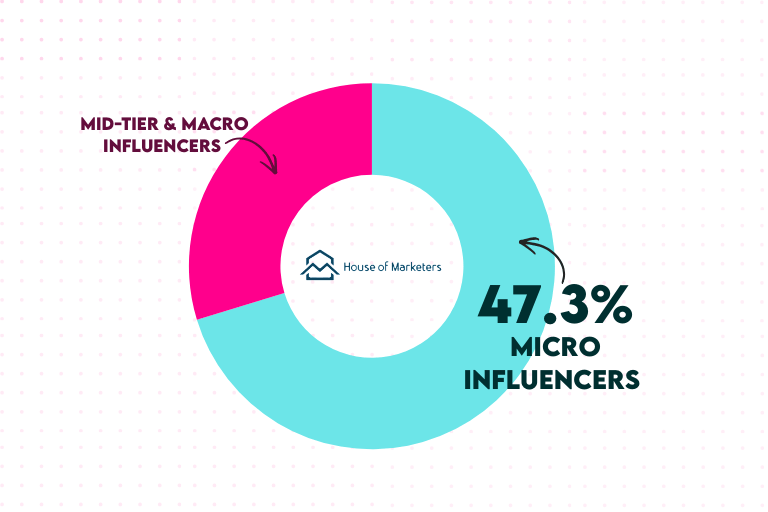
Over 75% of creators on Instagram fall into the nano and micro tiers.
Micro-influencers make up the largest segment of the influencer economy. Their dominance is reflected in how brands allocate budget.
Nearly 73% of marketers prefer micro and mid-tier creators
The main goal of influencer marketing campaigns is brand awareness. For that reason, micro-influencers are especially effective at top-of-funnel reach, helping brands get in front of new audiences and increase visibility.
What is a Good Engagement Rate for Micro-Influencers?
A larger following ≠ higher engagement. In influencer marketing, it’s the opposite instead.
Micro-influencers have engagement rates between 2.0% and 3.0%
Compared to macro-influencers (1.5%–2.0% engagement), micro-influencers consistently deliver 25%–100% higher engagement rates.
Why do micro-influencers beat macro-influencers on engagement?
As creators grow, their audiences start to include more people who may be passive followers. Comment participation declines, feedback loops weaken, and interaction spreads thinner across a larger follower base.
Micro influencers avoid this dilution. Their audiences are smaller, more relevant, and more willing to engage, resulting in tighter and more consistent feedback loops.
This is why micro-influencers have a higher engagement rate compared to macro influencers.
Micro-Influencer Instagram Engagement Rate Benchmarks
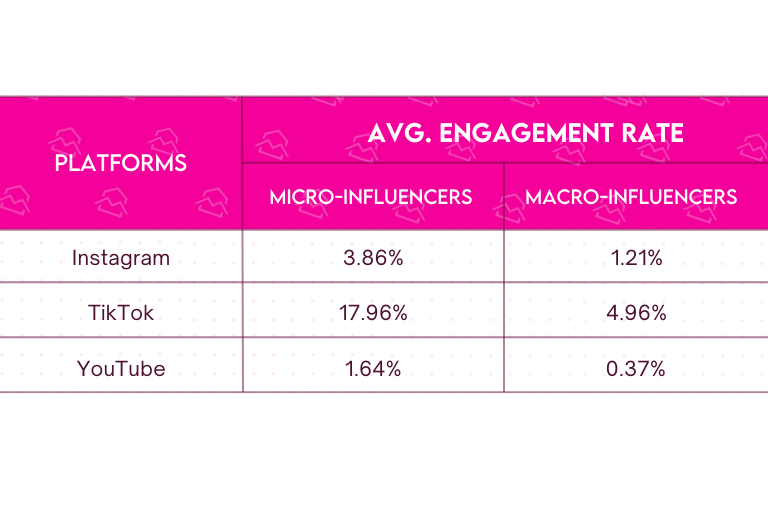
Instagram micro-influencers average 3.86% engagement, compared to 1.21% for larger creators
Micro-influencers generate over 3× higher engagement than other creators.
Instagram accounts with 1.5M+ followers average only 2.80% organic engagement
Macro-influencers are structurally less effective for a brand awareness campaign. Their relationship with their audience is more passive, leading to less engagement.
Micro-Influencer TikTok Engagement Rate Benchmarks
TikTok follows a similar pattern.
TikTok micro-influencers average 8.7% engagement
TikTok’s algorithm promotes videos based on performance signals instead of followers. This allows micro influencers to compete with, and often outperform, macro influencers.
TikTok creators with under 15k followers can reach engagement rates as high as 17.96%
TikTok engagement is driven far more by content quality than follower size. Brands that lean into creator-led and UGC-style content are better positioned to capture this engagement and translate it into consistent performance.
How to Use UGC to Increase Brand Engagement
Micro-Influencer Content Format Benchmarks
87% of micro-influencer content requested by brands is short-form video
Short-form video is now the dominant content format in micro-influencer campaigns because it performs both in brand discovery and engagement-driven environments.
20 to 40 seconds is the ideal length for Top-performing micro-influencer content
Across TikTok and Instagram Reels, 20 to 40 seconds offer enough time for explanation/demonstration without losing attention.
Micro-influencer videos with voice-overs in ads can increase consumer trust in a brand by 65%.
Use audio-video content to improve clarity and support social search and TikTok SEO. Guide creators on how to deliver the message clearly and in the right format, rather than giving strict talking points.
Template Brief for Influencer Marketing Success
Micro-Influencers Average CPE on Instagram, TikTok & YouTube
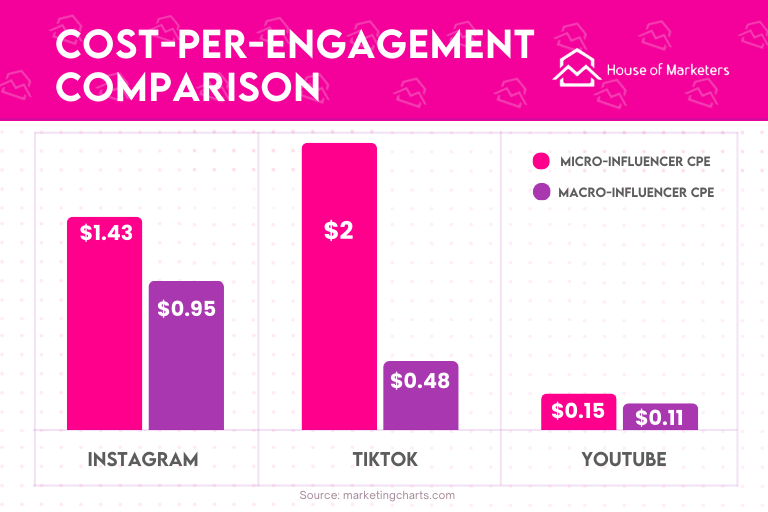
Micro influencers have the highest average CPE of $1.43 on Instagram
Nano influencers have the lowest average CPE at $0.59, followed by Macro influencers (200,000+ followers) at $0.95.
Micro influencers on TikTok show the highest average CPE at $2.00.
Nano influencers average just $0.06 per engagement, with Macro influencers at $0.48.
Micro influencers on YouTube have an average CPE of $0.15.
Mid-tier and Macro creators share the lowest average CPE at $0.11. YouTube has the lowest overall average CPE, compared to TikTok and Instagram.
A micro-influencer typically reaches 8.5% story exposure
Comments and Stories often drive replies, saves, and swipe-ups. These actions do not always appear in standard engagement metrics.
Brands can see what messages, formats, and hooks actually prompt responses. Each piece of content reveals how the audience thinks and reacts. The feedback is specific and actionable, helping brands refine creative, targeting, and messaging faster than with larger influencer tiers.
Micro-Influencers ROI
With micro-influencers, costs stay low while engagement remains concentrated. This is why they often deliver better ROI.
Micro-influencer marketing typically delivers CPMs of around $4–$5. This makes them more efficient from the start.
The advantage is not limited to lower costs. A single micro-influencer partnership can generate 5 to 10 reusable content assets. Each asset can be reused across channels, creating compounding ROI over time.
66% of brands repurpose micro-influencer content into paid ads
Paid media boosting extends the lifespan of creator posts without stripping away what makes them work in the first place. Whitelisted creator ads consistently outperform branded ads on both CPC and ROAS. People trust people more than logos, and that trust shows up in performance. Use Ad formats like TikTok Spark Ads and Instagram Partnership Ads help scale UGC while keeping it authentic.
Brands are collaborating with 33% more micro-influencers year-over-year
Spreading the budget across more creators increases testing and learning. Influencer performance usually follows a Pareto pattern, where a small number of creators deliver most results.
Working with more micro-influencers helps you identify those top performers earlier. Budget can then be redirected toward what is already working.
Micro-Influencer Campaign Goals Benchmarks
Most micro-influencer campaigns are still designed for the top of the funnel.
Brand awareness is the primary goal for 65% of micro-influencer campaigns
This approach works because micro-influencers tend to create content that answers real questions and shows products in everyday use. They help build familiarity & credibility between your brand and their audience. That trust and recognition lay the groundwork for conversions down the road.
47% of marketers say micro-influencers deliver their most successful campaigns
That is a great, yet most marketers have also seen micro-influencer campaigns underperform. So what explains the gap?
From our experience as an influencer marketing agency, the issue is often the campaign execution.
Treat creator selection as a strategic filter. Instead of choosing creators based on reach alone, assess how well their audience matches your brand, how consistent their content is, how often they post, and the quality of engagement they generate.
This is where tools like Instagram’s downloadable creator account summaries become especially useful. They show real performance data, audience breakdowns, and posting patterns. This will help you make decisions based on evidence, not surface-level metrics or screenshots.
How to Partner With the Right Micro Influencer
The massive number of options that exist when looking to partner with a micro-influencer can be daunting. There are simply too many creators to evaluate one by one.
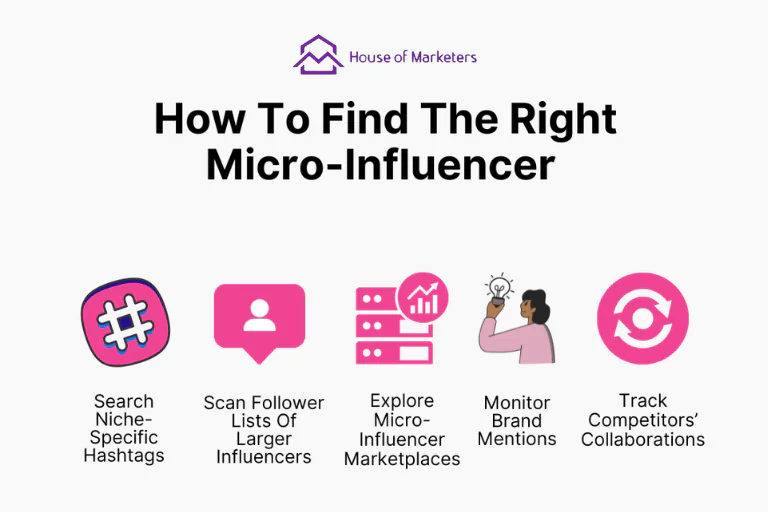
Source: Micro-Influencer Marketing Strategy: The Only Guide You’ll Ever Need
48% of marketers say finding the right influencers is their biggest challenge.
When brands rely on simple searches, they often pick the same creators as everyone else. Over time, this can make your brand look like everyone else.
High-performing brands solve this by using data-led filtering. TikTok Creator Marketplace and Instagram Professional Dashboard can help you assess audience fit, content quality, and past performance before you start outreach.
As an influencer marketing agency, we help brands partner with high-performing micro-influencers. If you are struggling to find the right creators or want to turn micro-influencer marketing into a repeatable system, get in touch today!
Contact House of Marketers for a free campaign proposal
How House of Marketers Builds Micro-Influencer Campaigns That Work
House of Marketers runs micro-influencer programs across markets, categories, and growth stages. We treat micro-influencers as part of a system.
Here is what that looks like in practice.
Do NOT hope for a one-hit wonder
Influencer performance follows a Pareto-style distribution. So do not bet on one post or one creator to hit it big. Instead,
- Work with enough micro-creators for patterns to emerge
- Group creators in similar performance bands
- Reallocate spend toward consistent performers early
This results in lower risk in selecting incompatible influencers and helps you iterate faster with what’s working well.
Leave room for creative expression in the influencer brief
Create an influencer brief that helps the micro-influencers use their own creativity in how best to promote your brand to their audience. They know their listeners better after all.
Over-scripted content consistently underperforms because it removes the creator’s natural voice.
Be mindful of social search
Creators often structure their content around questions and problems people are already searching for. As social platforms become a main way people discover information, this makes creator content more important for visibility and demand.
Instead:
- Design content to answer real questions
- Encourage clear, experience-based explanations
- Think in terms of saves, replays, and delayed action
This turns micro-influencer content into an always-on discovery option.
How to Use Micro-Influencer Marketing Benchmarks to Drive ROI
These benchmarks will only create ROI when theygovern the execution of your influencer marketing campigns. In practice, that means applying them deliberately across creator selection, content design, amplification, and scaling.
- Start with the right creator tier
Choose creators based on cost-efficiency and audience trust. As proven above, Micro and nano creators often deliver stronger engagement with the lowest cost per action. They are ideal for credibility and education-led content.
But if your campaign goals are reach and visibility to a lot of diverse audiences, then macro influencers will perform better
- Match content format to intent
Education-first formats such as ingredient breakdowns, routines, comparisons, and real-world use cases perform best when the goal is sustained demand and long-term brand trust.
Trend-led or more viral formats, on the other hand, are better suited to short-term brand shout-outs, rapid reach, and momentary spikes in attention.
Explore the best influencer marketing campaigns out there to get some ideas on what will suit best for your campaign goals.
Best Influencer Marketing Campaigns
- Let performance decide what scales
Instead of constantly refreshing your creative assets and thinking up new ideas, slow down. First, identify what exceeds benchmark engagement or retention and then amplify it. Paid media boosting works best when it boosts proven creator content rather than pushing untested ideas. This will help in your overall influencer marketing ROI as well.
This exact framework is how House of Marketers approaches influencer marketing. Rather than treating campaigns as one-off activations, we build repeatable systems grounded in benchmark data and real-world outcomes. This is how House of Marketers promoted Azha Perfumes through creator-led storytelling, generating an engagement rate 60% above industry average across social media.
Want to see how this works in practice?
Read how House of Marketers applies these strategies across real campaigns in our influencer marketing case studies.
Read House of Marketers Case Studies
Wrapping Up
The benchmarks in this are provided to inspire you on how to anchor influential marketing decisions as a marketer.
Use these benchmarks to:
- Set realistic engagement expectations by platform
- Choose formats that consistently perform
- Filter creators before contracts are signed
- Allocate spend based on signal, not guesswork
Looking to turn these benchmarks into real results?
As an influencer marketing agency, we help brands partner with high-performing micro-influencers. If you are struggling to find the right creators or want to turn micro-influencer marketing into a repeatable system, get in touch today!
Contact House of Marketers for a free campaign proposal

House of Marketers (HOM) is a leading TikTok Marketing Agency. Our global agency was built by early TikTok Employees & TikTok Partners, which gives us the insider knowledge to help leading brands, like Redbull, Playtika, Badoo, and HelloFresh win on TikTok. Want us to convert more of Gen Z and Millennials with TikTok? Get in touch with our friendly team, here.