


Overview
- TikTok partnered with Warc to examine how generative AI is reshaping creative work.
- AI is now embedded in most creative workflows, but marketers are running into a new problem of generic content with no cultural relevance..
- House of Marketers‘ Insights on what the data means for influencer strategy, and why TikTok influencer marketing functions as the cultural-intelligence layer AI still can’t replace.
A new report from TikTok and Warc (a marketing strategy group) has found that relevance, not output volume, is what separates winning brands in the AI era. Generative AI tools can’t manufacture an innately human relevance on their own. For influencer marketers, this is good news because what AI is missing is exactly
TikTok & Warc’s Report in a Nutshell
The study gathered feedback from 400 marketers across four markets, mapping how the rise of generative AI has changed the creative advertising sector.
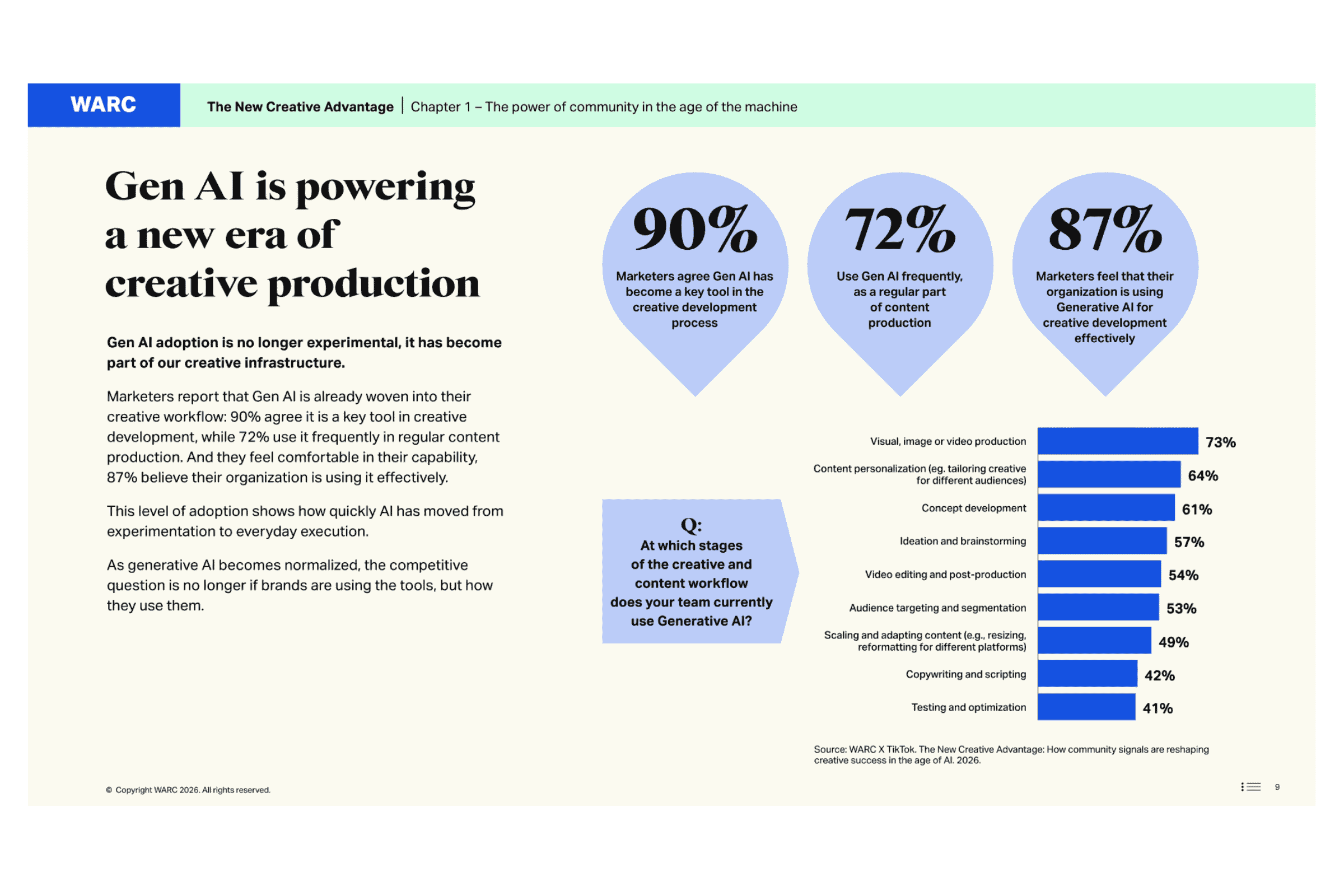
90% of marketers agree Gen AI has become a key tool in creative development, and 72% use it frequently in production. The problem is what that speed has produced.
The report calls it a gap between scale and outcomes: 88% of marketers say AI has increased their creative volume, but only 45% say it has significantly improved quality. Production got faster; resonance didn’t automatically follow.
Because AI has made it possible to produce more assets faster, more and more marketers are feeling pushed to do exactly that. But that has surfaced new problems for marketers now.
How to Overcome AI’s Weaknesses As Marketers
You can overcome AI’s weaknesses with cultural insight.
AI’s usefulness drops on the tasks that carry a brand’s voice. One in three marketers say richer audience or cultural signals would do the most to unlock AI’s advantage, and 86% expect audience behaviour and community signals to influence creative development significantly more over the next three years.
AI can execute at speed; it needs human context to execute on something worth scaling.
What is cultural intelligence?
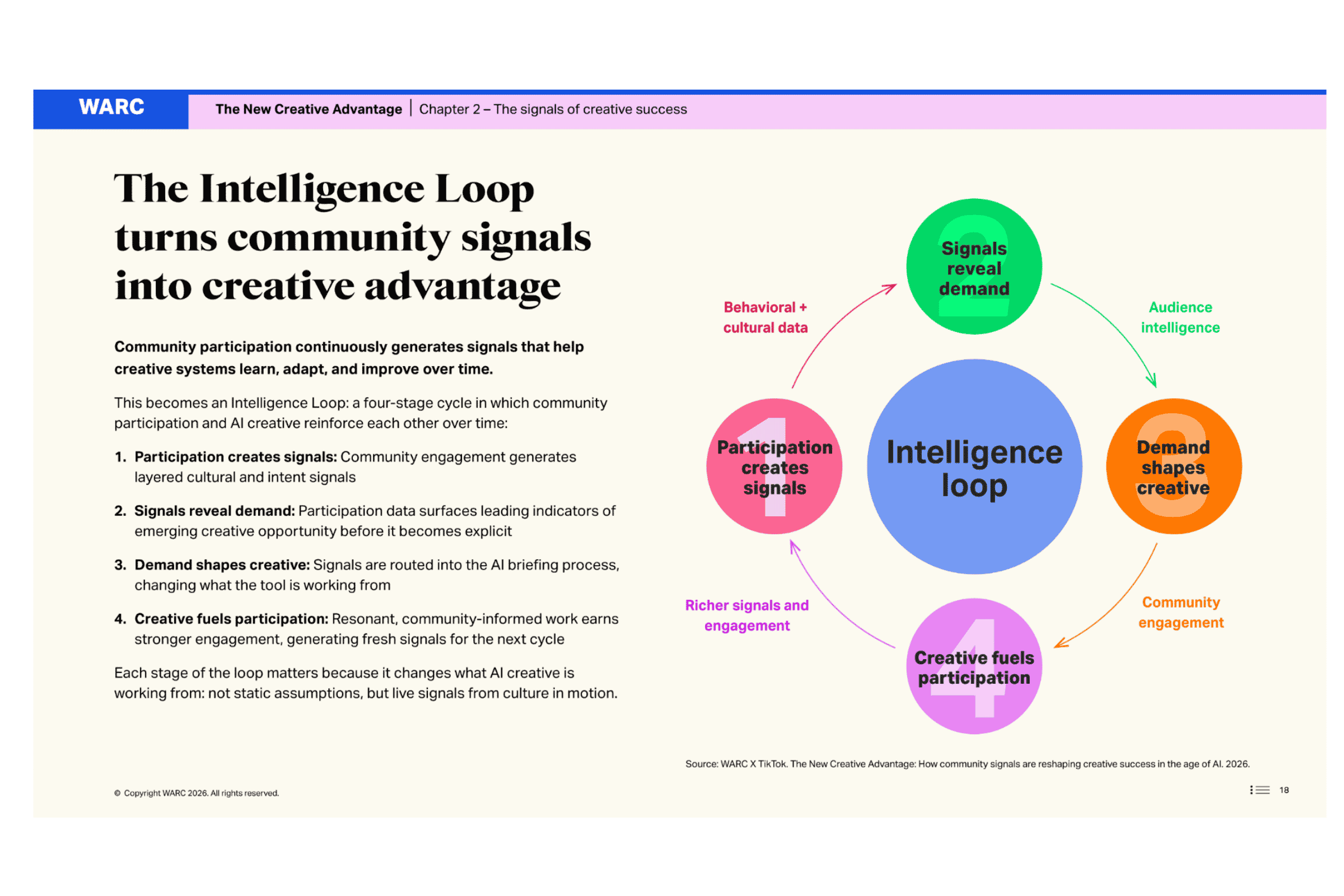
Cultural intelligence is the ability to read what a community values in real time and respond with something that feels native to it rather than bolted on. TikTok’s Global Head of Creative and Brand Ads, Andy Yang, framed it as the real competitive edge. He argues the brands winning today aren’t generating the most content; they’re learning fastest from the people they serve.
But if you are a new brand with no inside knowledge on how to leverage this, the fastest way to learn those signals is through influencer marketing.
Creators are the shortest path to cultural intelligence because they already live inside the communities brands are trying to read. When a creator tells you a format is getting stale or a sound is about to break, you’re getting a real-time read on community value that no demographic profile and no AI prompt can reconstruct after the fact.
The report’s own data backs this up from two directions. Audiences are 1.2x more likely to trust a claim from a creator than from the brand itself. And because participation on TikTok is unusually dense (with a 27.6% median engagement rate), every creator collaboration generates a fresh wave of comments, stitches, and shares, i.e., more signal, feeding the next brief.
Influencer marketing isn’t a distribution tactic bolted onto the end of a campaign; done right, it’s the intelligence-gathering layer at the front of it. That’s the loop the report describes, and creators are what close it.
House of Marketers Insight
As an influencer marketing agency, we’ve made this argument for five years, so it’s useful to see it quantified: the constraint in AI-era marketing was never production capacity. It’s relevance. AI removed the excuse of “we didn’t have time to make it” and replaced it with a harder question — did anyone want to watch it?
The part worth sitting with is where the report locates the missing ingredient. Cultural intelligence isn’t a dataset you can license or a prompt you can write. It lives in the people inside a community, and on TikTok that means creators. A creator who is genuinely embedded in a niche is reading what their audience values as that value is forming, and responding in the platform’s native grammar. That’s the human layer AI keeps asking for.
- So the smart way to read this isn’t “AI vs. creators.” Instead, it’s a sequence. TikTok surfaces the cultural signal
- creators translate that signal into content that feels native
- AI scales the executional layer around it with variations, edits, formats & localisation.
Brands that wire those three together in the right order are the ones the data says will pull ahead.
At House of Marketers, we work with brands to design influencer marketing strategies built for pairing AI-powered trend insight with creators who bring the credibility that generated content can’t, then using paid media boosting to scale the content that’s proving itself. Contact for Free Campaign Proposal, and let’s build it.