


Cluely didn’t out-build its competitors. It out-posted them.
While most AI startups get hung up on polishing their product demo, Cluely was running a content operation with the discipline of a media company.
It amassed dozens of high-follower creators posting daily, hundreds of clippers slicing founder content into shorts around the clock, and a paid UGC layer producing testimonial-style videos on top.
The result was a company generating millions in ARR, built almost entirely on creator content instead of a traditional ad budget.
This guide breaks down:
- How Cluely build a UGC machine,
- Cluely Ads strategy & the infamous Cluely Billboard ads
- The Cluely Business Model UGC engine
- And tips on how your AI brand can create something similar for yourself
But first, a little bit of context on how we got here.
What is Cluely?
Cluely is a real-time AI meeting and interview assistant that listens in the background and feeds users answers, notes, and prompts without anyone else in the room knowing.
It started as an “undetectable AI” tool built to help people cheat on technical interviews, which got founders Roy Lee and Neel Shanmugam suspended from Columbia University. Instead of hiding the origin story, they turned it into the brand.
They leaned into controversy and then backed it with fun episodic fun content in mass volume. That is the actual engine behind Cluely’s growth.
Engineering Virality – The Cluely.ai Method
Roy Lee built an AI product now doing north of $5 million in ARR off the back of one of the most aggressive user-generated content operations in startup history.
And it makes sense why. 79% of people say UGC directly impacts their purchasing decisions, and 90% of consumers say authenticity is the deciding factor in which brands they support.
This is why brands like Cluely are shifting budgets toward creator-made content precisely because it converts where polished ads don’t.
In his own essay on virality published on Cluely’s blog, he described the core mechanic of Cluely’s marketing strategy in blunt terms: a post that deserves to spread on a platform like X “will go viral, without exception, IF seen by at least a few thousand people,”
So using UGC is essentially a shortcut for speedrunning that first wave of exposure. A single branded ad has to earn attention on its own but a flood of native-looking creator content earns it by volume and familiarity.
This is exactly why UGC-based ads see engagement rates roughly 4x higher than standard brand ad creative.
This is Cluely’s base marketing tactic in a nutshell.
Viral UGC & Influencer Marketing Strategy of Cluely
The Cluely business model’s UGC engine has three distinct, separately-managed layers.
1. Paid UGC Campaigns
A group of people produces dedicated branded UGC videos. This testimonial-style, demo-style content that looks organic but is explicitly commissioned and paid.
View this post on Instagram
Embed: Instagram
2. Cluely’s Content Strategy: Recurring Characters and Storylines
Cluely treats its content strategy with the same innovation and creative flair that is mostly found in a TV writers’ room. They have made their mark on social media with a recurring cast, running storylines, and a fanbase that shows up episode after episode. And their crown jewel is the character of Ling Long.
Who Is Ling Long? Cluely’s Recurring Office Character
Ling Long is a fictional office employee played by comedian Remy Zhang, who joined Cluely as Creative Director. Zhang brought a character-driven format in-house and built it around Cluely’s actual office.
Ling Long isn’t a mascot or a spokesperson. He’s a running character with an ongoing arc: an episodic office-comedy series where Ling Long clashes with startup culture, helps a coworker named Tim quit drinking, gets HR complaints, and shows up in a growing catalog of numbered episodes.
Individual episodes routinely pull 50,000 to over 100,000 likes each on TikTok, and Zhang’s own account reported growing Cluely’s Instagram from 0 to 110,000+ followers in four months, averaging 3.7 million views per video, with several breaking 10 million-plus.
Got 10 million+ views on my first @cluely office skit appearance since starting this series back in september. From writing and directing the series bts to now being in front of the camera as Ling Long feels full circle😭
Wild comedian collab from a certain HBO show coming soon 👀
— Remy Zee (@remy_zee) January 23, 2026
Embed: X
Why a Recurring Character Beats a One-Off Viral Clip
Cluely essentially built a mini sitcom universe around its own workplace, and used it to keep people hearing about the app days and weeks apart, not just once.
It also solves a problem which is that growth interns and clippers are built for reach which is to say getting a message in front of as many eyes as possible, as often as possible.
But reach alone doesn’t create loyalty.
A character-driven series does the retention work: it gives people a reason to follow the account itself, not just react to whichever clip the algorithm happened to serve them that day.
Where the growth-intern and clipper layers are optimized for breadth, the Ling Long series is optimized for depth.
View this post on Instagram
Embed: Instagram
There’s a quieter benefit too. Because Ling Long is a fictional character, content that features him doesn’t read as advertising even when it’s directly building Cluely’s brand identity. Nobody skips a Ling Long episode because it feels like an ad, they watch because they want to know what happens to Tim.
Tip: For an AI brand with far less budget than Cluely, the lesson isn’t “hire a comedian and build a sitcom.” Pick one or two recurring bits, characters, or in-jokes tied to your actual product or team, and let them recur on a schedule, instead of treating every post as a standalone piece of content with no memory of what came before it.
3. Growth interns
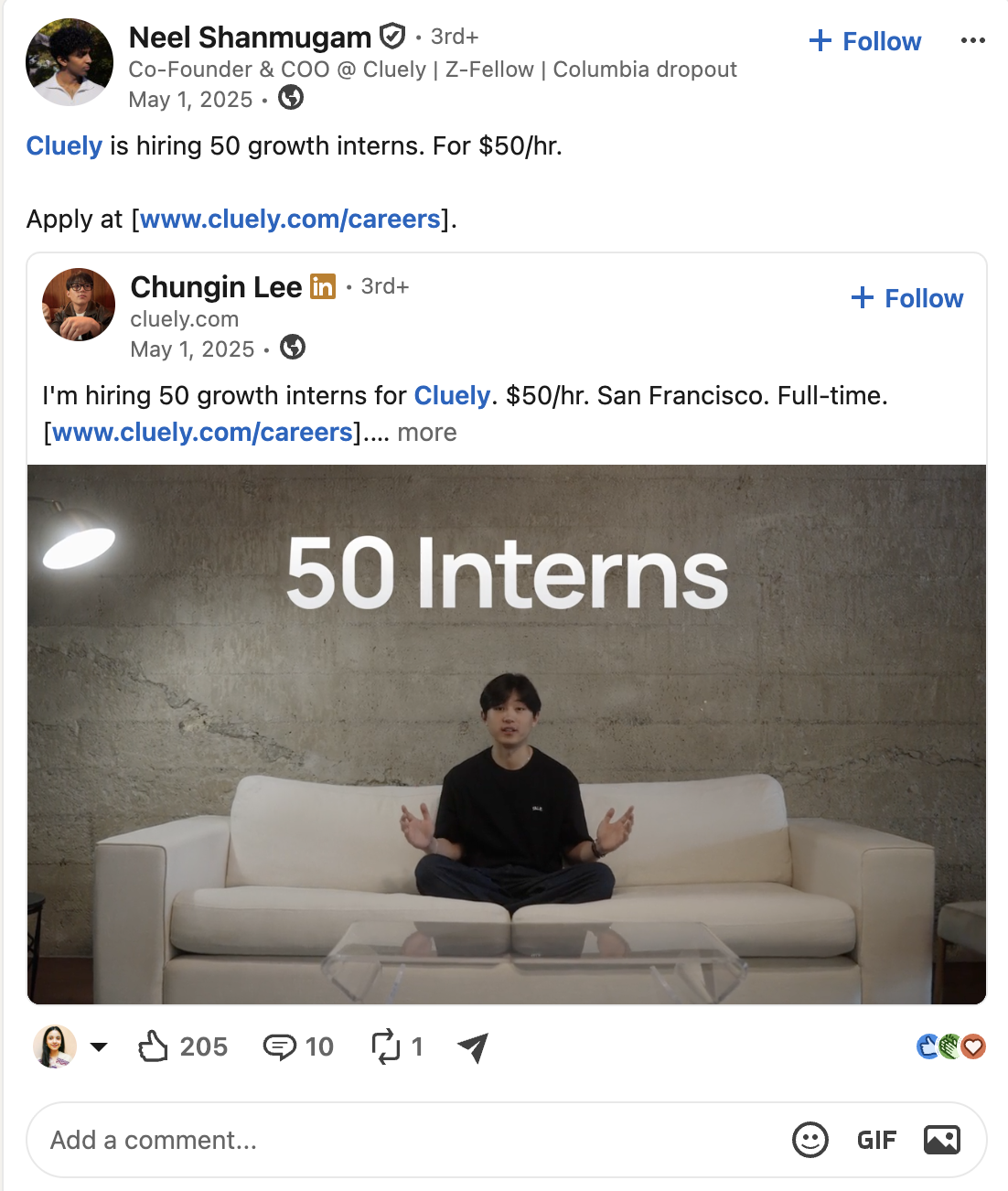
Cluely hired roughly 50 “growth interns.” A growth intern position is a high-intensity, viral-marketing position where interns use social media content creation to drive massive online attention and user acquisition for the brand. These interns at Cluely were required to already have 100,000+ followers on their personal accounts, and contractually required to post around four TikToks a day.
At scale, that’s an estimated 200 organic-style videos a day just from this one layer, before any other content enters the funnel.
Embed: Linkedin
4. Clippers
A separate, larger network of an estimated 700 external “clippers”. A clipper’s role is to take Roy Lee’s long-form podcast appearances, streams, and threads and cuts them into short-form clips distributed across TikTok, Reels, and Shorts.
This is the same model that pioneered creator-economy distribution in music and streaming, repurposed for a B2B/B2C hybrid SaaS product.
Bonus Layer: Paid Media Boosting
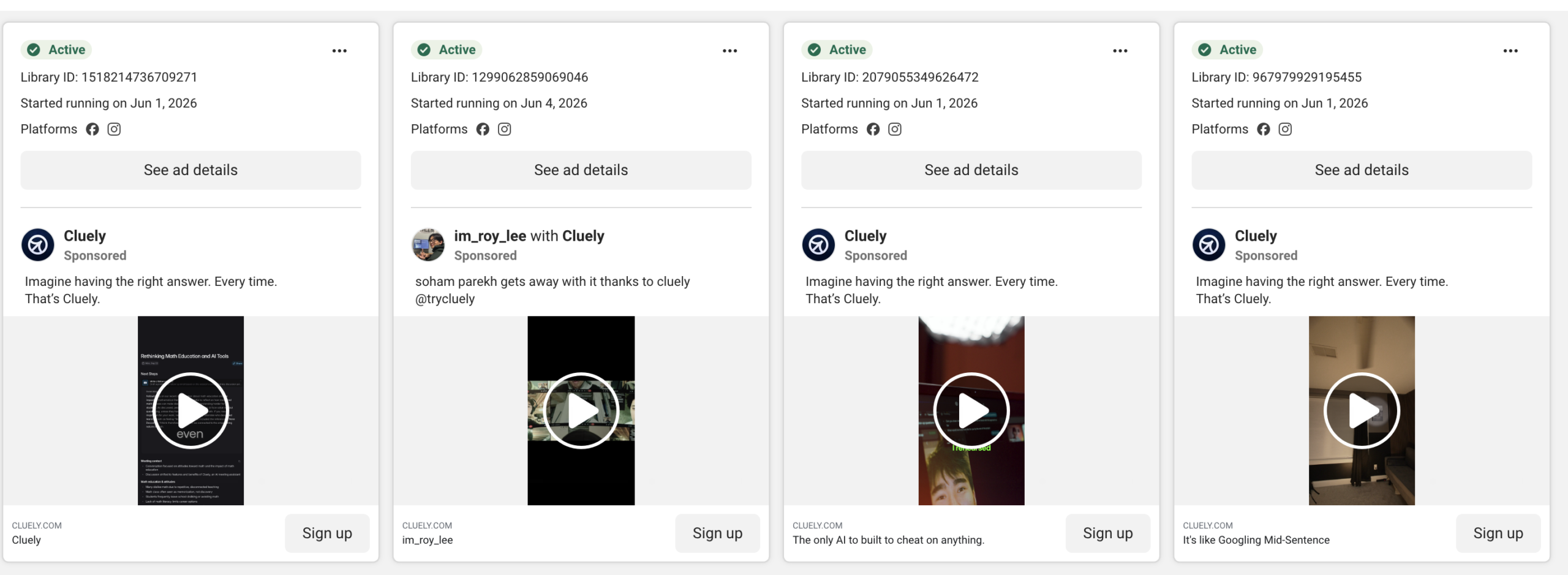
On top of all three layers sits a thin, deliberately unglamorous paid media layer: reporting on Cluely’s ad accounts shows around 24 active Meta ads (all UGC-style video), roughly 33 Google search ads, about 14 LinkedIn image ads, and TikTok Spark Ads used to boost the best-performing organic posts from the intern network.
Source: Postbeam
The Viral Factors Behind Cluely’s Growth
1. Controversial, Founder-Led Marketing
Roy Lee posted as himself, under his own name, using his own age and face as the creative asset. Making himself the face of the brand helped Cluely more than any single piece of content, because it gave every post a face people could argue about.
BREAKING:
Cluely CEO officially responds to TechCrunch https://t.co/EtAurp5zgZ
— Roy (@im_roy_lee) March 9, 2026
Embed: X
Lee basically acts like a KOL (key opinion leader) in Cluely’s context. Cluely’s credibility and reach are tied to his personal voice, not a corporate account, which is exactly what lets a single opinion of his set the tone for the whole company. And most of the time he leads with a controversial one.
In Lee’s own words:
“Every single time you tweet something, if you don’t think half the people in the world would feel very negative about this, then it’s probably not gonna be viral as a tweet.”
He’s equally blunt about his KOL mechanism: “I think I’m particularly good at framing myself in a way that’s controversial.” Said Lee at Techcrunch Disrupt.
Cluely is out. cheat on everything. https://t.co/EsRXQaCfUI
— Roy (@im_roy_lee) April 20, 2025
Embed: X
2. Frequency and Variety Beat Perfection
Where most SaaS companies post once a day, Cluely built a distributed content operation designed to produce hundreds of videos daily across a network of creators rather than relying on a single polished brand channel.
This mirrors a core principle of modern influencer and UGC marketing: reach compounds through frequency and multiple authentic voices, not through one perfectly produced piece of content.
A single glossy ad has one shot to land; a wide, ongoing stream of creator-made and founder-led content gets many shots, across many audiences, in the format each platform actually rewards.
Cluely’s strategy assumed most individual posts would underperform, and that assumption was correct by design. Not every video needs to be a hit, it needs enough of them to matter.
3. The Cluely Billboard: Anti-Advertising as an Attention Strategy
InAugust 2025, Cluely rented eight boards across Times Square and ran plain black text on a stark white background that read: “hi i’m roy im 21 this was very expensive pls buy my thing.”
This is as simple an ad can get.
Times Square draws an estimated 330,000 visitors a day, and the four-week run is estimated to have generated 9–10 million paid impressions, but the real payoff was earned media. The stunt was named by Ad Age as one of its notable creative campaigns of the year, drove widespread press coverage, and spawned its own wave of TikTok and X parodies that functioned as free distribution.
Cluely’s cheat code to their Times Square billboard? Keeping the message simple, self-aware, and sharable. Congrats @im_roy_lee and the @cluely team for making @adage’s “11 Creative Campaigns to Know About Today”:
https://t.co/p5ud0Qwmjw https://t.co/vZ3UK9E8TO
— OUTFRONT Media (@OUTFRONTMEDIAUS) August 15, 2025
Embed: X
If you’re looking for an agency to run this for you, see our list of the top influencer marketing agencies for AI brands.
Read more: Influencer Marketing Agencies AI Brands
How You Can Apply Cluely’s Playbook to Your AI Product or Brand
You don’t need $20 million in funding, 700 clippers, or a controversial origin story to borrow the underlying mechanics of Cluely’s virality. Here’s how the same principles scale down.
1. Give your AI-brand a face
People argue with people, not brand accounts. If you’re a founder, post under your own name. If you’re an agency-run brand, identify a real spokesperson (a founder, a customer, a team lead) and build content around that person consistently.
2. Use Content Volume to Find Winner Content.
Cluely’s model assumes most posts fail and a small percentage carry the brand. Make sure your UGC volume is high enough to let winner content surface. A handful of posts a week won’t generate enough signal to find what works.
3. Separate your creator layers.
Cluely ran three distinct influencer marketing programs
- high-follower internal posters
- external performance-paid clippers
- dedicated paid UGC creators
Each of these had different incentives and different content jobs. This will help you target more outputs with the same methods.
4. Pay for performance where you can.
It’s a given that most AI brands don’t have the internal bandwidth to source, vet, and manage hundreds of individual creator relationships. This is the operational layer a specialized influencer marketing agency is built to run.
An experienced agency already has the creator network, the contracts, and the tracking infrastructure in place, so a brand can plug into a performance-based clipping program without building the sourcing and payment machinery from scratch.
Ready to launch your next influencer campaign?
Get a free proposal from House of Marketers
5. Make your paid media look organic.
Cluely’s Meta and TikTok ad spend goes almost entirely toward boosting UGC-style video that already proved itself organically, not toward brand-made creative. If you’re running paid social for an AI product, prioritize amplifying your best-performing organic UGC over producing new “ad-first” assets.
Read How to do Social Media Influencer Marketing in 5 Simple Steps for a smooth influencer partnership.
Where This Gets Hard to Do Alone
Everything above is learnable in principle. But doing it well means:
- Building creator pipelines
- Negotiating creator deals
- Keeping creator content compliant with disclosure rules
- Knowing when to boost organic content with paid media boosting
And all that is not a weekend project.
Execution is a very valid hurdle for any AI brand to hit when they start marketing their AI product.
That hurdle is what we help AI brands with at House of Marketers. By building the creator layer structure, sourcing and vetting UGC creators, and managing the paid amplification loop so it compounds instead of resetting every campaign. Get in touch with our team for a free campaign proposal.
Contact for Free Campaign Proposal