


What makes someone install an app after watching a 30-second video?
Cal.ai mastered the answer to this one question that most AI brands are currently asking themselves.
We are an Influencer Marketing Agency that specializes in TikTok and Instagram, and we help brands with AI products to scale on social media with influencers.
Cal AI is an amazing case study for any brand looking to grow online. They showed what their product does at scale through influencers to generate an astounding $30M ARR.
We made this guide for other AI brands to understand how Cal AI grew and what the mechanics of its influencer program actually were, so you can take something more specific than “they used influencers” and use these lessons in your own AI brand influencer campaigns.
What is Cal AI?
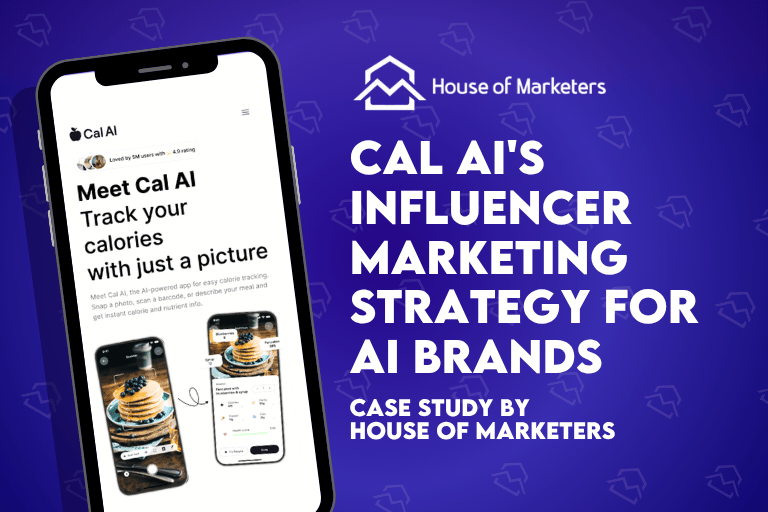
Cal AI is an AI-first nutrition tracking app.
Point your phone’s camera at a plate of food, and it estimates the calories and macros in seconds. The product itself is simple by design. Cal AI’s simplicity turned out to matter more for marketing than it did for the product roadmap, but we’ll get to that.
Cal AI’s Origin Story
Cal AI was founded by a scrappy team with no ad budget to speak of and yet it built one of the most effective creator-marketing machines in the consumer app space. It used that strategy to outgrow companies with decades of category dominance and much deeper pockets.
With their influencer marketing strategy, Cal AI had amassed more than 15 million downloads and was generating over $30 million in annual revenue in less than two years.
How Did Cal AI Market Their Product Using Influencer Marketing
Cal AI didn’t stumble into influencer marketing on a whim. They picked it as their awareness and acquisition channel because they already analysed their market and their audience. Publicly available data helped them strategise accordingly before a single dollar went out the door.
Fitness creators already make “what I eat in a day” videos, low-calorie snack roundups, and transformation content. Slotting a calorie-tracking app into that content required almost no behavioral change from the creator. Plus the integration of the app inside the content looked like the creator’s normal content, not a brand interruption. This is exactly why some of those videos reached millions of views organically, without any paid boosting behind them.
View this post on Instagram
Embed: Instagram
That’s the first lesson for any AI brand evaluating channels: influencer marketing works best when the product slots naturally into content creators are already making. If your product requires a creator to build an entirely new content format around it, it will have to work twice as hard to get half the results.
Ready to launch your next influencer campaign?
Get a free proposal from House of Marketers
If you’re looking for an agency to run this for you, see our list of the top influencer marketing agencies for AI brands.
Read more: Influencer Marketing Agencies AI Brands
Cal AI Marketing Strategy: Influencer Marketing Edition
Let’s understand how Cal AI carried out its winning influencer marketing strategy and how we can learn from it.
Lesson 1: Metrics Cal AI Didn’t Screen For
Several metrics brands typically over-index on actually mean almost nothing when it comes to how successful the campaign will be. These metrics are,
- Follower count
Just because a creator has ten million followers does not mean they have the engagement retention of all ten million. They might have a stale audience that stopped engaging months ago but never bothered to unfollow.
A creator with a fraction of that follower count but consistently strong view-through can outperform them by a wide margin, which is exactly why screening on the headline number alone leads brands to overpay for reach that was never really there.
Read more: Influencer Marketing Stats You Need to Know
- Results in unrelated categories
A creator who drove strong sales for an apparel brand tells you nothing about how they’ll convert for a nutrition app. Because the audience isn’t buying for the same reason. Someone who trusts a creator’s fashion picks isn’t automatically primed to trust their opinion on a calorie-tracking tool.
Past performance is only a useful signal when it’s past performance in the same kind of buying decision you’re trying to trigger, not just proof the creator can sell something to somebody.
- Outside credentials
Awards or notable accomplishments outside the platform have no predictive value for conversion. Treating a prestigious accolade as a proxy for performance is one of the more common ways brands end up paying premium rates for a partnership that never realise into the blockbuster they expect it to be.
Read more: How to Choose The Right Metrics for Social Media Campaign Success
Lesson 2: Influencer Marketing Metrics to Track for Best Results
So if Cal AI didn’t measure those metrics, which ones did they actually measure then? They measured:
- Views
Because Views are the actual unit being purchased in an influencer deal. Views signify attention, engagement, and reach. Which is why if a creator has a massive following but thin view counts, they will fail to deliver in a partnership, no matter how impressive their profile looks at first glance.
Flip that around, and a smaller creator whose videos consistently pull strong views relative to their following is often the better buy, because their audience is actually showing up rather than scrolling past.
- Comment sections.
This was the signal Cal AI trusted most, and for a specific reason.Because comment engagement reads as an intent to be interested enough in the product that it can lead to a conversion.
A comment section full of fire emojis and “you look amazing” is an audience reacting to the creator, not the product. It says nothing about whether anyone watching is actually curious about what’s being shown.
View this post on Instagram
Source: Instagram
But a comment section where people ask “wait, what app is that” or “does this actually work for X” is a different case entirely: it’s an audience already leaning toward the decision to install.
Reading comments takes more effort than pulling a follower count, but it’s a genuine proxy for purchase intent at the top of the funnel stage.
- Depth of audience trust.
Paying an influencer buys two separate things at once: their reach, and the credibility their audience has already extended to them.
When that second part is missing, i.e., when the audience doesn’t have a real, ongoing relationship with the creator, just a passive following, you end up only getting half of what you paid for.
This is also why parasocial closeness (a creator who talks directly to camera, responds to comments, shares unscripted moments) tends to convert disproportionately well against pure production value: trust is the actual product being rented, and a highly produced but distant creator often has less of it than a rougher, more familiar one.
View this post on Instagram
Embed: Instagram
Cal AI is not the only AI brand that has succeeded because of good influencer marketing. We broke down five real AI brand influencer campaigns where this exact dynamic propelled the brand’s success.
Read more: Influencer Marketing for AI Products: 5 Real Campaign Successes Analysed
Lesson 3: How to Manage a big Influencer Marketing Campaign
Managing 300 influencer partnerships is no small task. So how did Cal AI pull it off and especially at this scale?
Cal AI did it by skipping the usual email back-and-forth entirely. The moment a creator responded to outreach, they got on a call. If the fit was right, the deal closed on that same call, i.e., no waiting on a follow-up thread that blocks work.
Read more: How to do Influencer Marketing in 5 Simple Steps – Proven Strategy
Behind that speed was a layer of automation consisting of all the paperwork, the setup, the handoffs.
Running an influencer program at this pace isn’t something most in-house teams can sustain alongside everything else on their plate. It’s a full operating system afterall.
That’s exactly the kind of scaling problem we help brands solve at House of Marketers — building the sourcing & onboarding pipeline so your influencer program grows without falling apart at creator number eleven.
Lesson 4: Keeping Creators on Retainer
Cal AI built a retained creator network that grew to more than 300 influencer partnerships. These partnerships were producing content within 18 months of launching the program, which propelled the app to hit a #1 ranking in Health & Fitness on the App Store.
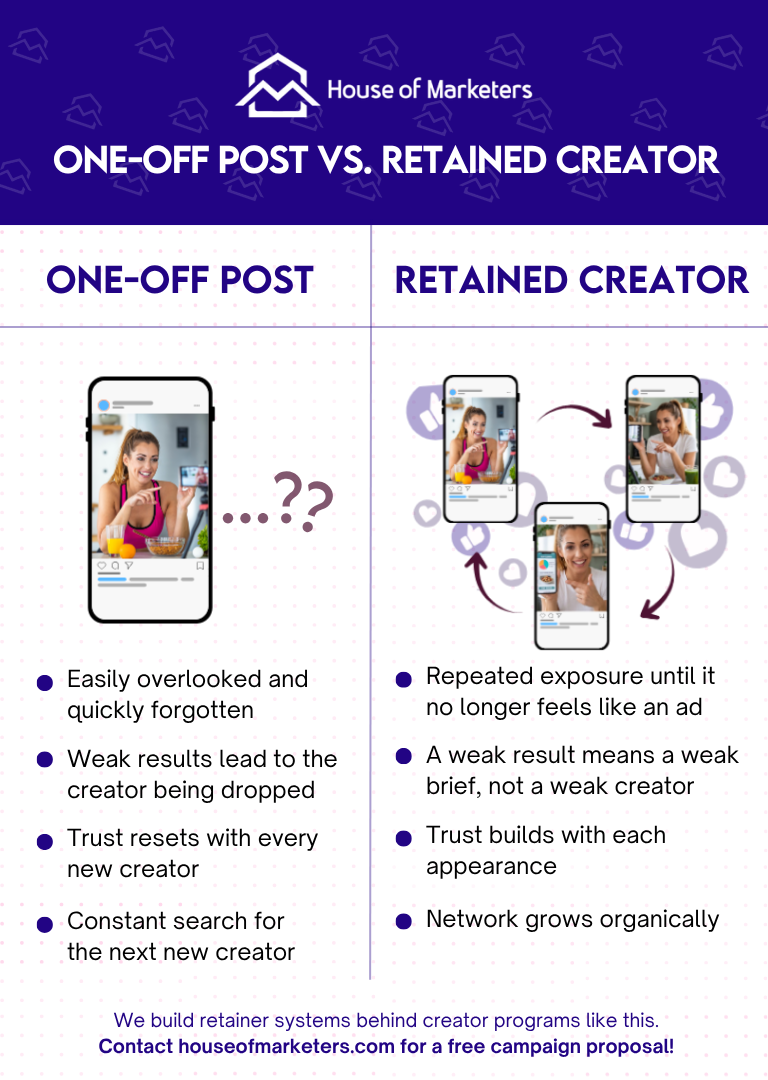
The logic behind retainers over one-off posts is repetition.
A single sponsored post is easy to scroll past. But when your favourite creator uses the same app and talks about it week after week, it starts to feel less like an ad and more like the thing everyone in that niche is already using.
Lesson 5: Fix the Brief Before Blaming the Creator
A creator who didn’t convert wasn’t treated as a bad hire. Instead, that data was treated as evidence the brief or the fit was wrong in the first place, and the fix was on Cal AI’s end, not a strike against the creator.
Want to learn how to write a good influencer marketing brief? check out our guide on writing an Influencer Marketing Brief Template.
Cal AI this particular mindset on not blaming the creators is what let a retained network scale without turning into constant relationship damage control; i.e., cutting someone loose became a data-driven adjustment rather than a verdict on anyone’s competence.
Contact for Free Campaign Proposal
Lesson 6: Layering Paid Media Boosting on Top of Organic Trust
Once Cal AI’s organic reach had built real trust in the niche, they turned to paid ads. But they made a deliberately unconventional choice for their CTA for these ads. Instead of selling the subscription, they sold the free trial.
Once the funnel was already converting reliably, they also added an affiliate marketing layer. A point note here is that turning on affiliates before you actually know your marketing & user is a fast way to fund fraud and junk installs, not growth. You need to know what a customer is worth before you start paying strangers to bring you customers.
And all three marketing layers- boosting, affiliate, and influencer marketing worked in tandem. By the time someone saw a paid ad or clicked an affiliate link, there’s a good chance they’d already seen Cal AI once or twice organically, through a creator they already followed.
The ad wasn’t introducing the app, it was closing a decision that had already started.
What Other AI Brands Can Learn From Cal AI
None of these marketing tips are exclusive to a calorie counting product. The underlying principles transfer to any AI-powered consumer app. Here’s what any AI brand can take from it.
Choose an Influencer Niche With Low CPMs and an Existing Content Format
Cal AI worked because fitness creators were cheap to reach and the content format already existed. Check for that same setup before betting on influencers. A crowded, expensive niche with no natural content angle won’t behave the same way.
Build an Influencer Program, Not a One-Off Campaign
The screening criteria, the same-call signing, the renewal scores, the no-blame churn — none of that is a growth hack. It’s a system. That’s the actual gap between “we tried influencers and it didn’t work” and a $30M engine.
Sequence Influencers, Paid Ads, and Affiliate — Don’t Run Them Together
Cal AI ran trust first, paid second, affiliate last. Each layer building on proof from the one before it. Launch all three at once and you typically get weak results across all three.
Plan for Attribution to Get Harder as You Scale
With five creators, it’s obvious which post drove which spike in installs. With five hundred, that link disappears. Because there are too many posts overlapping, its harder to trace any one video back to a result. Cal AI didn’t solve this with better tracking software. It leaned on comment sections instead, reading audience intent directly since the install data itself couldn’t be trusted at that volume.
The House of Marketer Take
Most AI brands have their strategy backwards. They pour months into the product, then treat go-to-market as an afterthought. They send uncustomised influencer DMs at scale, miss the intricacies https://houseofmarketers.com/influencer-marketing-agencies-ai-brands/needed for a highly scaled influencer campaign and hope that the product is good enough to carry itself.
Cal AI’s story is proof that’s the wrong order.
If you are an AI brand that wants to use influencer marketing to skyrocket your AI brand’s success, contact House of Marketers. We help you with ad hoc creator outreach with real screening, fast onboarding, and a defined creative strategy process.
Contact for Free Campaign Proposal
Read more: Influencer Marketing Agencies AI Brands