




Parents are one of the hardest audiences to win, because every baby product affects a child’s well-being and they cannot afford a bad purchase. That is why they trust social proof over promises, and trust it most when it comes from other parents. Marketing baby products to new parents comes down to trust, so build it before you ask for the sale. A brand can say its product is safe, but your product and marketing need to show it.
Most new parents have done a lot of homework before they ever see your product. Babylist’s Future of Family report, a 2022 survey of about 7,000 US parents and their families, found that 51% spend at least 25 hours researching products before the birth, and 83% rely on informal help from extended family. So if you are launching a new baby product and asking yourself, “How do I market baby products to new parents?”, you are in the right place.
10 Real Strategies for Marketing Baby Products to New Parents
Each of the ten strategies below comes with a real brand example, including campaigns House of Marketers ran as a parenting influencer marketing agency.
1. Segment Your Audience by Baby’s Age to Match the Question Parents Are Asking
The questions a parent asks change quickly as the baby grows, so a single message for “new parents” will rarely land. A parent at 34 weeks is usually searching for what they actually need for a newborn, while a parent with a four-month-old is searching for ways to get the baby to nap. These two people are at different stages with different worries, and one ad cannot speak to both of them.
To reach new parents, split your audience by baby’s age and answer the question each group is asking right now. Most baby brands can work with four stages. Here is how a baby monitor brand could approach them:
- Preparing: Parents want to know what is essential, so checklists and starter kits work well. A monitor brand could publish a guide on whether a monitor is needed before the birth.
- Early weeks: Parents want to know that the product is safe and easy to use. A short setup video and clear reassurance will help more than a list of features.
- Emerging routines: Parents want to know what actually works, and at this stage they listen to other parents more than they listen to brands. Content from a parent who has used the monitor through a few weeks of nights is the most convincing thing you can show.
- Mobility and toddler: Parents want to know what comes next, so this is the time for upgrade paths and bundles. A monitor brand could offer a toddler camera or a trade-in for the first monitor.
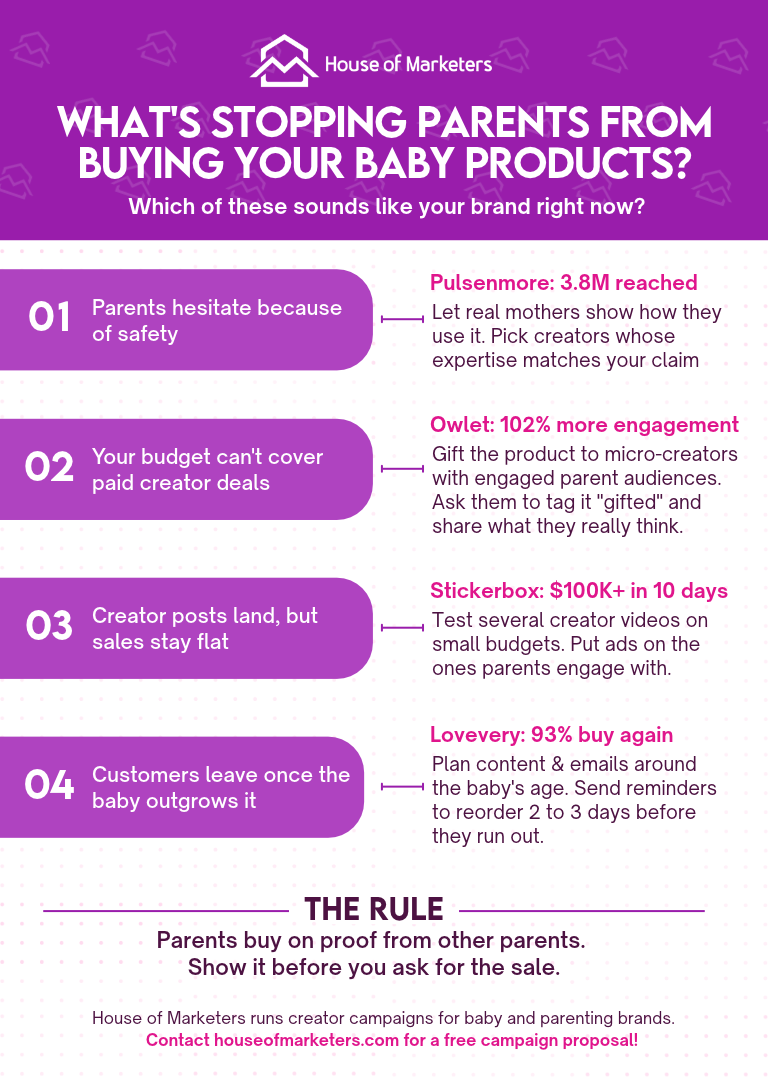
Lovevery builds this stage map into the product itself. Its Play Kits subscription delivers age-matched activities for the child plus guidance for the parent. Reach Capital, one of Lovevery’s investors, reported more than 350,000 kit subscribers in 2023 and says 93% of customers make a second purchase. Each stage gives the parent a reason to stay and a clear next step. A brand without a subscription can get a similar effect with email flows and content built around the baby’s age.
2. Partner With Micro-Influencers to Borrow Trust From Close-Knit Communities
To borrow trust from a close-knit community, partner with micro-influencers, creators with smaller but highly engaged followings. Their audiences treat a product recommendation like advice from a friend.
That trust builds over time. Followers often know the creator’s baby by name and have watched the family grow on camera.
The engagement numbers back this up. Dash Social’s influencer benchmarks put average engagement at 2.4% for micro-influencers (10,000 to 100,000 followers), against 1.6% for macro-influencers. In the baby niche, that gap matters because parents ask questions in the comments, and creators who answer them build stronger audiences.
Joie is an international baby gear brand, launched in 2011, that makes car seats, strollers, and travel systems. Look at how @safeintheseat introduced it to US parents. Michelle is a certified child passenger safety technician, so her audience already treats her as the authority on car seats. Her partnership post drew 3,196 likes and 1,923 comments, helped along by a giveaway.
The lesson: pick creators whose expertise matches the claim you need to make. A car seat needs a safety voice. A sleep product needs a sleep voice. Mamas & Papas applied the same logic when it named two sleep consultants as its resident sleep experts.
3. Educate Before You Sell to Reduce Decision Fatigue
Educating parents before you sell reduces decision fatigue, because clear guides narrow their choices and answer questions before they are asked. Publish checklists, comparisons, and setup videos first, then ask for the sale.
Parents do not want more choices. They want fewer, better-explained options. Educational content cuts through the noise because it answers the question before the parent has to ask it. Owlet’s Liz Teran told Chief Marketer the brand aims to reach parents while they read guides such as Wirecutter’s best baby monitors list, with the right message ready.
Useful educational formats for baby products include:
- Essential vs optional checklists.
- Comparison guides based on use cases, not only features.
- Age, size and stage explainers.
- Material, care and maintenance guides.
- How-to videos and setup instructions.
- Questions to ask before buying.
- Post-purchase troubleshooting and routine support.
Put this into practice:
- Publish a “what you actually need” guide for each stage.
- Group products by milestone and offer starter bundles.
- Record a short setup video for every product that needs assembly.
- Write comparison pages that include your own limits. Honesty earns the next click.
Then hand these assets to your creators. A creator who can point to a clear guide has an easier time making a credible recommendation.
4. Build Long-Term Creator Relationships to Earn Lasting Trust
To earn lasting trust, sign creators for a season or a year instead of a single post. Audiences see the product used over time, which builds a track record no one-off sponsored post can.
One sponsored post tells parents a brand paid for attention. A year of posts tells them the creator actually uses the product.
Parenting bloggers have an advantage here. Their audiences watch them move through pregnancy, the newborn weeks, weaning, and the toddler years. A product that appears across those stages gains a track record, and that record builds trust no single post can.
Mommy’s Bliss, a baby wellness brand, shows what long-term creator work can build. It ran seasonal campaigns with 35+ creators, each matched to what parents needed at the time, such as teething or cough and cold. According to influencer agency The Shelf, the campaigns earned 35M+ impressions across 2021 to 2024.
To run this approach well:
- Sign creators for a season or a year, not a single post.
- Rotate products as the child grows, so the creator’s content follows the family’s real needs.
- Give each creator room to share honest feedback. Parents spot scripted praise quickly.
5. Seed Products Early to Fill Your Pipeline With Authentic Content
Product seeding means sending free products to creators in the hope they post about them, with no contract requiring a post. It costs less than paid partnerships and produces content that reads as genuine.
Influencer seeding works like a product trial run by real parents. You send the product to creators whose audiences match your buyer, they test it in daily life, and they share it if it earns a mention. Because nobody scripted the post, followers read it as a genuine recommendation.
Owlet Baby Care shows how far seeding can stretch a small budget. The brand chose creators with engaged communities over big followings and built a pipeline of pregnancy and infancy-stage parents, since babies outgrow the monitor and customers turn over quickly. When its paid influencer budget shrank in 2023, it leaned into product seeding, and its Aspire case study reported 39% more content reach, 59% more impressions, and 102% more engagement within a few months.
Keep the ad disclosure visible. Parents forgive product gifting. They do not forgive hidden ads.
Honesty is what parents are checking for. They already question every claim, so a creator who says “gifted” up front earns belief. A single undisclosed gift does the opposite, because followers start doubting everything else that creator has posted.
In the US, disclosure is also the law. The FTC treats free products as a material connection, so ask every creator to add a visible “gifted” tag in the caption or on screen. Then invite them to say what they really think, drawbacks included. A creator who names one small flaw sounds more credible than one who praises everything.
6. Use Cause Partnerships to Create Value Beyond the Product
Cause-based partnerships work when a baby brand backs a charity or story that connects to its product’s purpose. Parents remember the brands that support them through the hard parts of parenthood. And that emotional connection compounds over time.
Tommee Tippee, a UK-based baby feeding product brand, partnered with the creative platform A View From a Bridge and the Maternal Mental Health Alliance to share Laura’s story about antenatal depression. The post gave the audience real support information and drew 8,113 likes and 184 comments. The post leads with the story and the support available, and the brand earns goodwill by backing it.
Use this approach with care. Pick a cause that connects to your product’s purpose, let the charity partner lead on accuracy, and measure it with sentiment and reach rather than direct sales.
7. Lead With Mother-Led Storytelling to Turn Safety Doubts Into Trust
Mother-led storytelling turns safety doubts into trust by letting a real mother explain how she uses the product. Parents who worry about safety listen to another mother’s experience before they listen to a brand.
Use this strategy for baby and pregnancy products that trigger hesitation. Parents worry about safety first and features second. Your content has to answer that worry in a real person’s voice.
House of Marketers faced this directly with Pulsenmore. Pulsenmore is a medtech brand whose at-home prenatal ultrasound device lets expecting mothers perform guided scans at home. The brand entered eight markets with low brand awareness, audience hesitation about safety, and fast ad fatigue on TikTok.
Our team built an awareness campaign across TikTok, Meta, and Instagram with local creators, and we tested which formats built the community. Mother-led storytelling resonated strongest. The results:
- 11,551 new followers across three platforms at $0.93 per follower
- 3.8 million people reached
- 5.7 million total video views
- 166,404 engaged video views at a cost of under $0.01 each
8. Capture Ready-to-Buy Parents With Search, Product Pages, and Registries
To capture parents who are ready to buy, show up in search, make your product page answer every question, and get onto baby registries. Together, they turn the interest creators build into a sale.
Work through them in this order.
Step 1: Show Up When Parents Search
Make sure you show up in search when parents already know what they want.
- Run text ads that match what parents type into Google, and product listing ads that show your item with its photo and price.
- Write plain, factual product titles. Skip claims you cannot prove, such as “safe” or “non-toxic.”
Step 2: Make Your Product Page Answer Every Question
A parent who clicks through is still deciding, so the page has to do the persuading. Your product page should cover:
- Who the product is for
- What is included in the product they buy
- What it is compatible with, such as the stroller, car seat, or crib a parent already owns, and the ages and sizes it fits
- What it is made of, how fast it arrives, and how easy it is to return
- Cited evidence behind every claim, which matters most
Then write pages around the questions parents ask at each age, and answer them directly. Pages written this way also give AI search tools clear passages to pull from.
Step 3: Get Onto the Baby Registry
A baby registry is a wish list where expecting parents save the products they want, so family and friends can buy them as gifts. In Babylist’s 2022 survey, 20% of parents started their registry as soon as they knew they were expecting, and 39% started in the second trimester, so plan for it early.
Partnering with the registry platform itself can open the door. Shipt turned to Babylist for its engaged audience of new parents and placed a 90-day trial code in the free sample boxes Babylist sends to registry users.
9. Turn Creator Content Into Paid Ads to Scale What Already Works
To scale what already works, turn your best creator videos into paid ads once you know which ones parents save, share, and comment on. Your ad spend then backs content that has already proven itself. So use paid amplification to put that winning creative in front of more new parents.
Stickerbox proved this strategy. Stickerbox is a voice-activated device that turns prompts into printable stickers as a screen-free creative tool for kids. It had no audience and no sales history. House of Marketers tested 25+ creative assets across TikTok, Instagram, and Facebook, then scaled the winners with full-funnel paid media and structured retargeting. We focused on content centered on education, demonstration, and relatability, aimed at US parents and gift buyers.
The outcome:
- $100,000+ revenue in the first 10 days
- $300,000+ revenue within 90 days
- 6X blended return on ad spend
- 3M+ video views, and four sell-outs in the first three months
To copy this approach:
- Secure paid-usage rights in every creator agreement.
- Test several creator videos with small budgets first.
- Scale only the formats that parents save, share, and comment on.
- Use retargeting to answer objections, such as safety, sizing, or returns.
10. Track Repeat Buyers and Keep Your Claims Honest to Protect Loyalty
To keep baby product customers loyal, track which parents buy again as their child grows, and only make claims you can prove. Both protect the trust that brings parents back for the next purchase.
That is because baby customers have a built-in expiry date. A child outgrows the product, so you need to know which parents come back when their baby needs the next size or product.
Pampers shows what this looks like in practice. The brand was losing customers each time a baby moved up a diaper size, so it built the Pampers Club app around those transition points. By tracking the stages of a new family, Pampers predicts and encourages the next purchase. Iris, the agency behind the program, reports a 40-point increase in size-band retention.
Judge your results by what groups of parents do over time, not by the last ad they clicked. So start by tracking:
- What it costs to win a customer
- How much each customer spends over time
- How many buy again, how many add a bundle
- How many are still buying at 30, 90, 180, and 365 days.
Also time your emails around the parent’s routine. Send a reorder reminder two to three days before they are likely to run out, and ask for a review 7 to 14 days after delivery.
Tracking shows you which parents come back. Trust is what brings them back, and parents lose it quickly when a brand scares them, overstates what a product does, or handles their child’s data carelessly. So protect that trust with how you speak in your marketing:
- Avoid fear-based creative. It may lift short-term clicks but damages long-term loyalty.
- Approve claims before launch. At House of Marketers, clients supply approved claims and limits, we write them into the creator brief, and the team reviews each piece before it goes live.
- Respect privacy rules. Do not build ad audiences from child-directed activity or children’s data, since Google does not allow personalised ads for users under 18 and prohibits uploading customer data from child-directed content, and check with legal counsel where it applies.
A parent who feels respected once will often buy again, and recommend you to the next new parent they meet.
Checklist for Marketing Baby Products to New Parents
Use this list when you plan a launch. Each point maps to one of the ten strategies above:
Baby Product Marketing Checklist
Putting it all together is where most brands stall. They get the first creator post right, then lose momentum when it is time to connect creators, search, registries and follow-up emails. If you want a clear view of where your current parenting influencer strategy leaves results behind, that is exactly what we help brands work through at House of Marketers.
Contact for Free Campaign Proposal
Frequently Asked Questions
How do I market baby products to new parents?
To market baby products to new parents, build trust before you sell. Split your audience by baby’s age, publish guides that answer their questions, and partner with parenting creators whose followers already trust them. Then capture ready-to-buy parents with search, clear product pages, baby registries, and follow-up emails.
What is the best channel for marketing baby products to new parents?
No single channel wins. Creator content on Instagram and TikTok helps parents discover and compare products, while search and baby registries capture parents who are ready to buy. Most successful baby brands combine both, so start where your buyers already research and add the other.
Do micro-influencers work better than large creators for baby products?
Micro-influencers usually earn higher engagement and closer community trust, which suits a category built on peer advice. Larger creators still add reach, so many baby campaigns blend both.
Why do baby brands market to parents instead of babies?
Babies cannot choose or buy anything, so parents make the purchase decision. Co-parents, grandparents, and gift givers also shop, so include them in your targeting.
What is product seeding for baby brands?
Product seeding means sending free products to parenting creators with no scripted post required. The creator tests the product in daily life and shares it if it earns a mention. It costs less than paid partnerships and produces content that reads as a genuine recommendation, as long as the gift is clearly disclosed.
Should baby brands market to dads too?
Yes. In a 2026 PulseAI survey of 600 fathers in India, 92% said they take part in household purchase decisions, but only 17% felt brands market to them directly. Products that involve setup or spec comparison, such as car seats and monitors, suit dad-focused how-to videos and dad creators.