



The brands that are creating the best-performing content types on TikTok have stopped asking “what’s trending this week?” and started asking “which formats does this platform actually reward?”
This guide breaks down the top-performing content types on TikTok, how other brands are using them in their content, and explains how TikTok decides what counts as trending in 2026.
We take a scalpel to TikTok’s best-performing content types and formats so you can replicate these formats for your brand.
Let’s get started.
Top-performing content types on TikTok for Brands in 2026
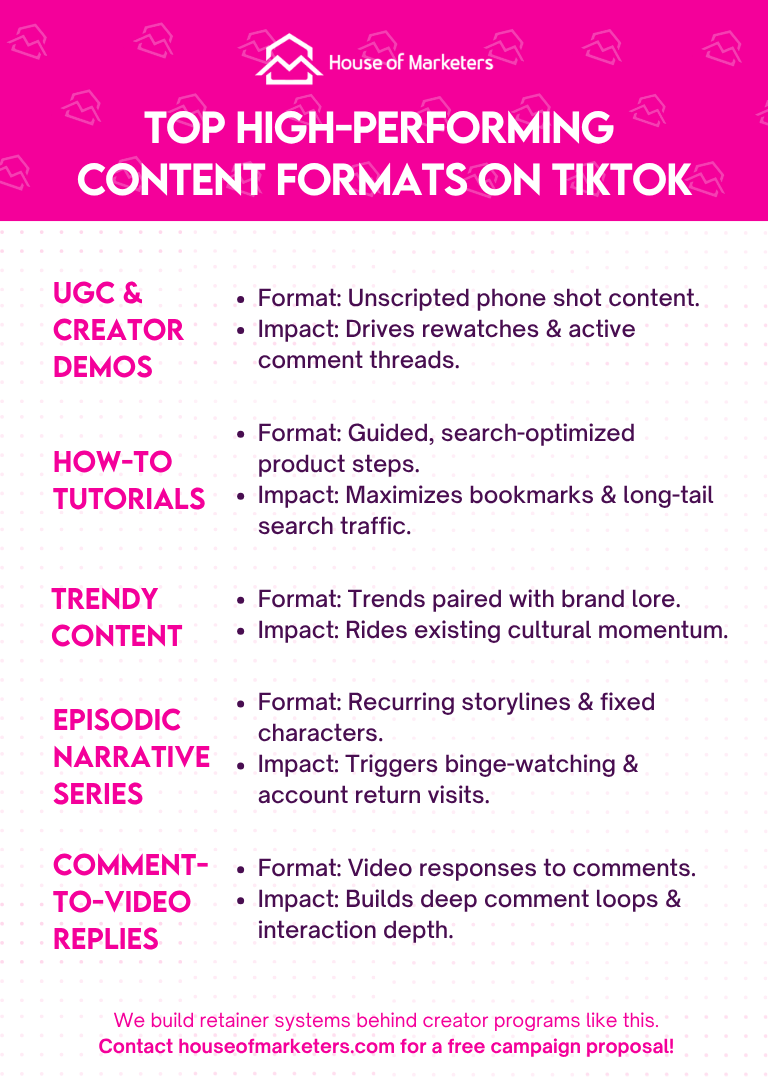
As a TikTok Marketing Agency, we have noticed that some content formats keep showing up at the top of TikTok’s For You Feed again and again.
Each one does one of three things:
- Gets rewatched and saved hundreds of times.
- Gets the kind of contextual comments that TikTok rewards.
- Builds a library of content that keeps surfacing in search months later.
Let’s take a look at how each one works and how other brands are using them.
Contact for Free Campaign Proposal
1. UGC and Influencer Content
UGC campaigns and TikTok influencer campaign content are powerful ways of getting rewarded by TikTok. Especially when it’s shot in one take on a phone. It’s naturally rewatchable and built for comments.
This is because 76% of consumers say they want brands showing up with more authentic content; UGC-based ads get roughly four times the click-through rate of average branded content, and 84% of consumers say they’re more likely to trust a brand’s marketing when it features user-generated content.
None of that is a coincidence: audiences have gotten fluent at spotting a script, and TikTok’s own 2026 trends forecast says plainly that audiences are trading polish for real process and real people. UGC is the format built for exactly that trade.
Take Rare Beauty, for example. Its Soft Pinch Liquid Blush became one of the brand’s best-known products through creator-led demos alone: unscripted videos of a single dot of pigment blended out on camera, with no scripted messaging behind them. The format was so easy to replicate across skin tones that it spread organically on TikTok and made the product go viral.
Staples employee Kaeden (@blivxx) turned her lunch-break TikToks about working at Staples into a viral moment with no brief or brand kit involved. The trend has since pulled in 14 million+ videos from other creators.
Staples Influencer Marketing Case Study
@blivxxYall wanted to meet the printers♬ original sound – Oblivion
So basically, content shot in a style that feels like catching up with a friend is what works best on TikTok.
2. Educational and how-to content.
A creator walking through how a product actually works is one of the most saved and shared content types on the platform. This content gets saved the most, and saved content is one of TikTok’s strongest ranking signals. Because someone bookmarking a tutorial is telling the algorithm they intend to come back to it, often right before they buy.
This content format is also compoundable. Every how-to video adds to a searchable library that keeps surfacing weeks or months after publication. This is exactly the kind of long-tail discovery TikTok’s search algorithm rewards.
House of Marketers ran education-first TikTok campaigns for K-beauty brands, generating 200M+ views. d’Alba’s ingredient-explainer content alone pulled 100M+ video views, a 9% engagement rate, and 150% sales growth.
Read more about the d’Abla Marketing Case Study here.
4. TikTok Trends & Challenges With a Brand-Specific Spin
Brands that get this right do a product tie-in, add a piece of brand lore, or make a joke only they could make, rather than recreating the trend beat-for-beat.
This works because of how TikTok surfaces trends in the first place.
Trending audio, hashtags, and challenge formats are still an explicit ranking signal. But audiences increasingly discover brands through unexpected adjacent moments rather than direct searches.
A brand that inserts itself naturally into a trend or challenge that’s already moving gets carried by an audience that was never looking for it in the first place, arriving with curiosity instead of scepticism.
Duolingo did this best when it made its own bit onto the Squid Game hype cycle rather than just posting about the show. Its “Pink Guard” video put Duo the owl and a Duolingo user inside the show’s world instead of just referencing it from the sidelines.
The video pulled 46M+ views and a 15% engagement rate, well above what a normal Duolingo post earns.
@duolingo in my pink guard era 💖🦉 #squidgame2 ♬ original sound – Duolingo
Embed: TikTok
5. Episodic and Series Content
Episodic content is built around a single goal: getting someone to come back. A numbered series with a recurring character or storyline turns a brand’s TikTok account into something with a plot, and plots have audiences that check back in.
TikTok’s algorithm loves episodic content. Because viewers who follow a series generate exactly the kind of rewatch, search, and repeat-visit behaviour that TikTok loves.
It also is an infinite content idea glitch since it’s a storyline you never run out of ideas. Once a format and a cast are established, new episodes become a production pipeline instead of a fresh creative brief every time.
The format also lowers the guard audiences put up against brand content. Episode 23 of a series someone has followed for months reads as content they chose to watch, even when the account posting it is, unmistakably, a company.
Shelby’s Shawarma built its entire TikTok presence around a recurring character, Yasser the Shawarma Man, and running bits like the “No Ketchup on Shawarma” rule that plays out episode after episode. Viewers know the beat before it happens, comment on insider jokes, and treat new videos like the next scene in a show rather than a one-off post.
This content format turned a small food trailer in Ontario into a global fanbase that recognizes a Shelby’s video within seconds.
@shelbyscanada Think twice my friend 🥫🩴 @Griizly ♬ original sound – Shelby’s Canada
Embed: TikTok
6. Comment-to-Video Answers
Comment-to-video answers take a single comment and turn it into the premise for a full video reply.
TikTok is a platform that is urging brands to treat comments as a creative surface, not a support inbox. The format works for a structural reason as much as a creative one.
Comments now outweigh likes in TikTok’s ranking signals, and a video built around answering one comment tends to pull in a second wave of comments underneath it.
That reply-to-a-reply loop is exactly the kind of comment depth TikTok’s algorithm treats as a strong signal, and it’s hard to manufacture with a scripted ad.
It also does something for brand voice that few other formats can: it proves, in public, that a real person is reading what the audience writes. A brand that visibly responds to a specific, oddly-worded comment with a full sketch is telling its audience that showing up in the comments is worth the effort, and per TikTok’s own guidance, that’s exactly the behaviour it wants to reward.
Starface, a $90 million skincare brand, turned a comment daring it to “make them work and I’ll buy them” into a full response video that pulled 40,000+ views.
@starface Replying to @Hailey ♬ original sound – Starface World
Embed: TikTok
How TikTok Decides What’s Trending in 2026
Every video that goes up on TikTok is tested before it’s trusted.
When a new video is published, the algorithm doesn’t push it to a creator’s full following. Instead, it shows the video to a small sample audience and watches how that group behaves.
If the video holds attention, it moves to a bigger pool. If it doesn’t, it stops there.
What “holds attention” means has gotten stricter. Watch time and completion rate are still the single heaviest ranking signal, but the bar has moved: a video now needs to hold close to more than half the average completion to be treated as genuinely working.
Rewatches count too, which is part of why short, loop-able videos still punch above their weight: a 10-second clip someone watches twice registers as 200% watch time.
Beyond watch time, the signal hierarchy for 2026 looks roughly like this:
- Shares: weighted around three times more heavily than a like, because sharing to a DM or another platform is a stronger intent signal than a passive tap
- Saves: a strong purchase-intent, “come back to this” signal, and a big part of why educational content performs
- Comments: now outweigh likes in the ranking, and a genuine, multi-word comment or question counts for more than a one-word reaction or an emoji
- Completion rate and rewatches: the core engagement layer beneath everything else
- Video information: captions, on-screen text, audio, and hashtags, which increasingly double as search-ranking signals too
TikTok is functioning as a search engine as much as a feed now. The platform’s own 2026 Next trend report calls this shift Curiosity Detours, describing how people arrive with one search intent and get pulled into unexpected, algorithmically-surfaced discovery journeys.
The report frames its overarching 2026 theme as Irreplaceable Instinct, built on three signals:
- Reali-Tea (a pullback from polish toward unfiltered, real process and people),
- Curiosity Detours (search-driven discovery over linear feeds),
- Emotional ROI (audiences demanding a clear “why to buy” before they purchase).
TikTok is explicit that comments themselves are now part of the creative canvas. The report describes a “comment react stack” trend and tells brands to treat comments, reacts, and memes as material to design content around, not just a feedback channel to moderate.
Source: TikTok Next 2026 Trend Report
The algorithm no longer separates “engagement” from “content.” What gets watched, saved, replied to, and searched for is what gets amplified, and that’s exactly why the formats above are outperforming everything else brands are trying right now.
House of Marketers Insights on Creating Best-Performing Content on TikTok
As a TikTok marketing agency, we’ve run enough of these campaigns that we have noticed some patterns.
Build for the format’s mechanics, not for the moment.
A UGC video works because it’s rewatchable and unscripted, not because it’s a UGC video. An episodic series works because it gives someone a reason to check the next post, not because episodes are trendy. Understand the content mechanics instead of following the formats only.
Say the thing you want to be found for in the content
Say it out loud, in the video, and again in the on-screen text. TikTok’s search layer reads your audio and your captions, not just your hashtags. A brilliant how-to video that never says “how to fix cakey concealer” anywhere in it won’t surface when someone searches that exact phrase, and that search traffic is where the long-term views come from, not the first 24 hours.
Treat your best-performing organic post as a brief, not a finish line.
Whichever format gets the strongest saves or comment depth this month is the one to repeat on a schedule, not the one to admire once and move on from. One viral post is luck. Ten posts built on the same working mechanic is a system, and systems are what actually compound.
Final Thoughts
Following these formats might get you a single viral post once. But that is half the battle. Because what you need is a repeatable system that keeps that viral post working after the spike fades.
Knowing which format to use is the easy part. The plateau most brands hit is turning one of these into a system that runs on a schedule, gets briefed properly, and gets amplified once it proves itself organically. That’s almost always a strategy problem, not a creative one.
If you want a clear view of which of these formats would actually move the needle for your brand on TikTok, that’s exactly what we help brands work through at House of Marketers. Get in touch for a free campaign proposal.