

In just four months, an AI language-learning app took its annual recurring revenue from $1M to $12M. The reason? Just a single UGC reel of a guy making deliberate, ridiculous mistakes in English while talking to an AI language teacher avatar.
That kind of explosive traction is exactly what every AI product founder is chasing right now, and exactly what almost none of them get.
Because the AI product category is exploding, and a growing market means growing noise. And most AI products still launch with no audience, no demand baseline, and a product that needs explaining before anyone is ready to buy it.
This guide breaks down five real AI product launch marketing campaigns, including,
- What each brand does.
- How they used Influencer marketing and UGC.
- Why the campaign worked.
- A ready-made checklist for YOU so you can apply the same mechanics to your own launch.
Let’s get started!
What is a Good AI product launch strategy?
Influencer marketing, of course! Because while your product may be breaking down barriers in the AI sphere, it still needs some human credibility behind it to win user trust.
Creators provide that credibility when they demonstrate what your product does and vouch for it to audiences who already trust them. Influencer marketing closes the gap by turning broad AI curiosity into trust in your specific product by showcasing its use in action.
This demonstration and user trust is the reason influencer marketing outperforms almost every other marketing channel for AI brands. Want to launch an AI product? Do these three things:
- AI products need demonstration, not description.
A static ad can’t show what a tour guidance AI app or an AI English tutor actually does. A creator filming a real use case can, in just 15 seconds.
- AI products need trust fast.
New tech triggers skepticism. A recommendation from a creator someone already follows shortens that gap. That’s because 69% of consumers say they’re more likely to trust a recommendation from a friend, family member, or influencer than messaging that comes directly from a brand.
- AI products live on the same platforms creators dominate.
The behaviour that drives AI curiosity, i.e., scrolling, watching, sharing, happens on TikTok, Instagram, and YouTube. Exactly the platforms where creator content wins.
Influencer marketing ROI for an AI product launch: Stats
Influencer marketing is the highest-ROI channel available for an AI product launch strategy and the numbers back this up. The influencer marketing industry is projected to reach over $47.8 billion by 2027. AND it is a marketing niche with one of the highest rates of conversions. That’s because Influencer marketing returns an average of $5.78 for every $1 spent. 86% of consumers have made an influencer-driven purchase in the past year.
And it’s not just for brand awareness but instead it drives real measurable results too. 83% of marketers say sponsored influencer content generates more conversions than branded organic posts.
For AI brands specifically, cost-efficiency matters even more, because winning the category means producing a lot of content to find what lands. Helpfully, average influencer CPM has dropped 53% year-over-year, making high-volume creator strategies more affordable than ever.
Read more: Influencer Marketing in 2026: Key Stats That Matter
Ready to launch your AI product influencer campaign?
Get a free proposal from House of Marketers
Influencer Marketing for AI Products: 5 Real Campaign Successes
Now all this may sound good in theory, but there are 5 AI product brands that are winning with influencer marketing. Let’s take a look and see how you can borrow their strategy.
1. Stickerbox: Turning a Brand-New Category Into $300K in 90 Days
Stickerbox is a voice-activated creative device that uses generative AI to turn spoken prompts into printable stickers. It’s screen-free, KidSAFE COPPA-certified, and aimed squarely at parents and families in the US who want interactive, creativity-led play. They were looking for an influencer marketing agency that specializes in AI products, and they found our AI influencer agency.
Sticker Box’s influencer marketing campaign
Stickerbox partnered with us, House of Marketers to launch into an entirely new product category. A new category comes with caveats like,
- No audience
- No demand baseline
- Concepts that needed explaining before they sell.
House of Marketers’ approach combined education, demonstration, and relatability, testing 25+ creative assets across TikTok, Instagram, and Facebook to quickly find what resonated with the audience.
View this post on Instagram
Top-performing creatives were then scaled through a full-funnel paid media boosting strategy with structured retargeting and real-time optimisation.
But for the most part, UGC did the heavy lifting. Creators showed real parents and kids speaking a prompt and watching a physical sticker print out the “aha” moment that no description could deliver.
Stickerbox’s AI Influencer Marketing generated $100,000+ in revenue in the first 10 days, $300,000+ within 90 days, a sustained 6X blended ROAS, 3M+ video views, and the product selling out four times in its first three months. Demand consistently exceeded inventory.
Why it worked, the checklist to follow
- Show the “aha” moment on camera. For any AI product, the single most valuable asset is a creator capturing the instant the product does its magic.
- Test wide before you scale. 25+ assets meant winners were found by data, not guesswork.
- Only scale proven creatives with paid. Organic content finds the hook; paid amplification turns it into revenue.
- Lead with the use case, not the tech. “Screen-free creativity for kids” sells; “generative AI sticker device” doesn’t.
2. Praktika: One UGC Format That 12X’d Revenue in matter of months
Praktika is an AI language-learning app built around conversational avatars that let users practise speaking with a patient, always-available AI tutor. It targets self-conscious language learners, helping people who freeze up practising a new language with a real human.
Praktika’s AI Influencer Marketing Campaign
Praktika’s breakout came from a deceptively simple UGC format. It featured a user talking to Praktika’s AI avatar while intentionally making absurd mistakes in English. It was funny, relatable, and most importantly, it demonstrated the product’s core value (a judgment-free space to be bad at a language). All while being an entertaining piece of content. When the format took off, the team doubled down and amplified the winning videos with paid ads.
One video alone pulled 6.7M views on TikTok. Annual Recurring Revenue (ARR) jumped from $1M to $12M in a 4 month, then climbed past $20M ARR with 2M+ monthly active users across 100+ countries.
@praktika.app My English not good… #english #englishteacher #englishonline #ingles #inglesfacil ♬ original sound – Speaking English Praktika – praktika.app
Why it worked, the checklist to follow:
- Find the format, not just the creator. The repeatable idea (mistakes + AI avatar) was the asset. A format can be replicated across markets; a single creator can’t.
- Make the demo the entertainment. The product value and the joke were the same thing; that’s what makes UGC unskippable.
- Amplify winners with paid immediately. Organic virality is fragile; paid makes it durable.
- Design content that seeds word-of-mouth. When 60% of growth is referral, the content did more than convert — it made people want to share.
Read more: How to Choose the Right Metrics for Social Media Campaign Success
3. Cluely: The Industrial UGC Playbook That Hit ~$5M ARR in Three Months
The app Cluely itself is not a controversial AI assistant. Yet its controversial marketing strategy grew it into a viral phenomenon. Cluely targeted young, online, and drawn-to-polarising-content users and built its entire go-to-market strategy for launching AI-powered products around that.
View this post on Instagram
Cluely’s AI Influencer Marketing Campaign
Cluely reportedly ran a “creator army,” hiring 700+ creators producing 200+ videos per day, paying roughly $20–40 per video plus bonuses for viral hits.
The strategy was pure statistical probability: make 100 videos, one goes viral; repost the winner across 100 accounts, and 20–30 more take off.
But volume alone doesn’t keep an audience coming back, characters & stories do. Cluely’s sharpest move was building a recurring, Office-style episodic series that turns its product story into serialized comedy. Their breakout character is Ling Long, a recurring character in an Office-style workplace comedy series.
View this post on Instagram
He’s the reason viewers return: an episodic reel series trains the audience to expect the next installment, and the character’s chaos keeps watch-through and engagement high. Episodes regularly pull millions of views, with one hitting roughly 1.9M views and 234K likes. Another one got 4.3M views with a 13% engagement rate.
Why it worked, the checklist to follow
- Volume beats perfection. More content = more chances at the algorithm lottery. AI brands should plan for hundreds of assets, not a handful.
- Pay for performance, not vanity metrics. Per-video pay plus viral bonuses aligns creators with engagement, not follower counts.
- A word of caution: controversy scales reach but carries real brand risk. Use polarisation deliberately, and only if it fits your brand’s tolerance. The growth engine depended on momentum mattering more than truth, which is exactly how the ARR overstatement happened.
Read more: Ultimate 5-Step Social Media Influencer Marketing Strategy
4. Gauthmath: High-Volume Micro-Influencer Scale in Education
Gauthmath is an AI-powered homework and study-help app, aimed at students. Built to help them with their school work in a productive manner.
Gauthmath’s AI Influencer Marketing Campaign
Gauth ran a high-volume UGC engine: a small roster of micro-influencers operating dozens of brand-new TikTok accounts, each posting several videos a week, adding up to 200+ videos weekly.
The content used real use cases, “day in the life” and “study with me” formats that show the product solving an actual problem in context. Strong hooks meant that even if only a small percentage of clips broke out, those winners reached millions.
@nathanstudiess When you chose happiness over responsibility use gauth 😭😭🙏 #study #studytok #highschool #college #studyhacks #studywithme ♬ Ladyfingers by Herb Alpert and The Tijuana Brass – Mieze Katz
In Q3 2025, Gauth held the #1 US education-app download spot for six consecutive days, due to its influencer marketing campaign.
Why it worked, the checklist to follow:
- Micro-influencers deliver higher trust per dollar. On TikTok, nano-influencers average around 10.3% engagement, versus 1-2% at the celebrity and mega tier. Nearly three-quarters of brands now favour micro and mid-tier creators over macro and celebrity partnerships, for exactly this reason: stronger engagement at lower cost. For a volume play like Gauth’s, that maths compounds. Ten small creators running many accounts buy more genuine engagement per dollar than one big name ever could, and each account is another lottery ticket in the algorithm.
- Show the product in real context. “Study with me,” “day in the life,” and exam-stress formats work because they demonstrate the product solving a real problem without feeling like an ad. A student filming their actual late-night homework session, then reaching for Gauth, reads as a habit worth copying rather than a pitch. That native fit is what lets the content survive on a feed where anything that looks like an ad gets scrolled past.
- Engineer the hook. On TikTok, the first two seconds decide whether a clip reaches millions or dies at a few thousand, which is why Gauth’s videos open on a relatable tension (“me looking at the ‘this won’t be on the exam’ question on the exam”) before the app ever appears. When only a small percentage of clips are meant to break out, the hook is the single biggest lever on which ones do. Test many, keep the openers that stop the scroll, and cut the rest fast.
Micro vs Macro Influencers: Which Delivers Higher ROI
5. GuideGeek: Long-Form Ambassador Storytelling
GuideGeek is an AI travel assistant that answers travel questions and builds itineraries for free over WhatsApp, Instagram, and Facebook Messenger. It targets travellers who want real-time, trustworthy travel planning.
GuideGeek’s AI Influencer Marketing Campaign
GuideGeek backed travel influencers like chef Michael Motamedi and his family around the world, all with GuideGeeks AI’s choosing where to go and what to do at every stop. The campaign worked well enough that the planned six-month trip was extended to a full year, and it earned coverage in Forbes and Skift along the way.
The story wrote itself because the road-tested product publicly built credibility that fed directly into partnerships.
Why it worked, the checklist to follow
- Match the format to the product. A travel AI is best proved over a journey, not a 15-second clip. Let the format serve the use case.
- Long-term ambassadors build durable trust. This aligns with the data: 71% of influencers offer discounts for longer-term partnerships, and creators actively prefer them.
- Let real, messy proof do the selling. Surprise recommendations and genuine “will this work?” moments are more convincing than polished claims.
- Convert creator credibility into B2B momentum. Ambassador road-testing became the proof point that won brand and DMO partnerships.
Your go-to-market strategy for launching AI-powered products
Here’s the crux of all that these brands have in common and what you can follow with your eyes closed:
- Demonstration is non-negotiable. Every winner showed the product doing the thing.
- Volume finds the hook; paid scales it. Stickerbox, Praktika, and Cluely all tested wide, then amplified proven winners with paid media boosting.
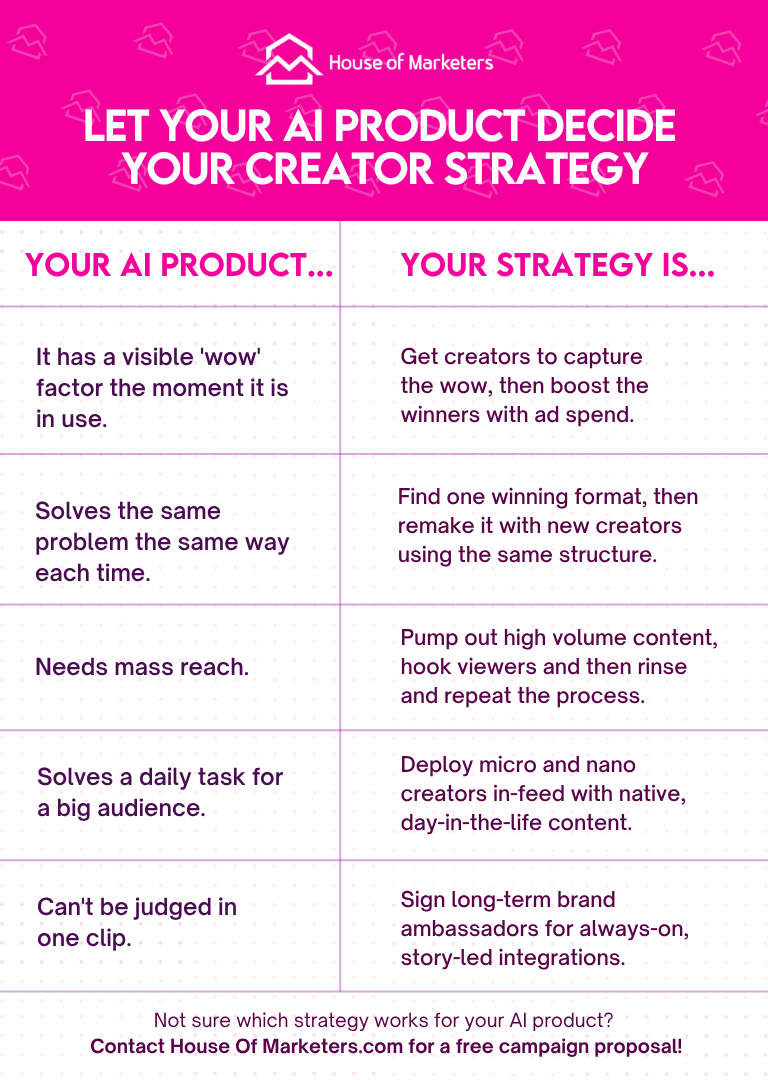
- Match creator type to product type. Micro-influencers for high-volume trust (Gauth), a repeatable format for viral reach (Praktika), long-form ambassadors for considered products (GuideGeek).
- The format is the asset. A replicable content idea outlasts and out-scales any single creator or post.
Final Thoughts: The Winning AI Products Launch Strategies Are the Ones Being Demonstrated
The AI category is growing faster than any consumer technology in history, but that growth is exactly why a new product can’t win on features alone.
The brands breaking through aren’t the ones with the most novel model; they’re the ones getting their product shown, trusted, and shared by creators before competitors get a chance to explain themselves.
Most AI brands get the first half right: they find creators and ship a few posts. The plateau hits at the transition from scattered organic content to a systematic, format-driven, paid-amplified engine.
That gap is almost always a strategy problem, not a budget one.
That’s exactly what we help AI product brands work through at House of Marketers, as an Influencer Marketing Growth Partner for Ambitious AI SaaS Companies that has scaled brands like Stickerbox from a cold launch to $300,000+ in 90 days.
If you want a clear view of where your influencer strategy or UGC campaigns are leaving results behind, that’s the conversation to have.