



Overview
- Meta’s Holiday Insights Report shows social media now rivals search engines for gift discovery
- Influencers drive purchase decisions, and 94% of social shoppers turn to influencers for shopping recommendations.
- AI tools and business messaging are now part of how shoppers decide what to buy.
- House of Marketers‘ key takeaways and what we’d do with them in your holiday campaigns.
Meta’s Holiday Insights Report just made the life of any holiday campaign marketer easier. If you’re planning your holiday campaigns, knowing where shoppers find gift ideas and what makes them buy shapes almost every other decision. And Meta’s comprehensive report suggests that 37% of shoppers lean on social media and the creators on it to plan their holiday shopping.
Below, we break down the key takeaways and what we’d actually do with them, based on how we already build social search into our creator campaigns.
What is Meta’s Holiday Shopping Insights Report?
Meta’s Holiday Insights Report is a Meta-commissioned online survey of 14,473 festive shoppers, conducted by Ipsos in November 2025, across 18 countries in North America, Latin America, Europe, and Asia-Pacific.
Key Takeaways from Meta’s Holiday Insights Report
Here is a summary of the 7 most useful takeaways from Meta’s Holiday Insights Report, which can help you plan holiday campaigns using the current stats and consumer data.
Social media rivals search engines for gift discovery
Social media has become one of the main places festive shoppers look for gift ideas. Across all 18 markets, 37% of festive shoppers use social media for gift discovery and inspiration, close to search engines at 41% and well ahead of TV advertising at 27%. The share rises to 44% in Latin America and 50% in Asia-Pacific.
Social search creates demand that search engines then capture
People use traditional search for questions they already know to ask. While social media is where they find products they didn’t know existed, i.e., through an unboxing, a creator review, or seeing something used in real life.
That’s the same conclusion we reached when Meta published its earlier research on social search: social creates the demand that search later captures. Gift shopping may be the clearest example all year. Most gift buyers start without a product in mind. A query like “gifts for a dad who cycles” is better answered by a creator showing five options in 30 seconds than by a page of blue links.
As our Co-Founder Inigo Rivero put it when we explained what social search is:
“Social search has changed how discovery works. People no longer find answers through neutral results pages. They find them through creators demonstrating solutions in public.”
Social shoppers spend more and buy across more categories
Shoppers who discover gifts on social media are worth more than the average holiday shopper. Meta calls them “social shoppers”, and compared with the average festive shopper they:
- plan to spend more (49% expect to increase spending year on year, vs 36% overall)
- shop across more product categories (5.4 vs 4.3)
- are more likely to buy gifts for themselves (83% vs 67%)
They also give more weight to product quality, brand reputation and online reviews, and to how products are marketed and presented.
Keeping this in mind, Meta’s advice is to invest in seeding product discovery as well as focusing on conversions in your holiday campaigns. Show reviews and endorsements directly in ad creative, and use consistent creative systems and shoppable catalogues to make buying across categories easier.
Source: Meta
Social media sends shoppers into physical stores
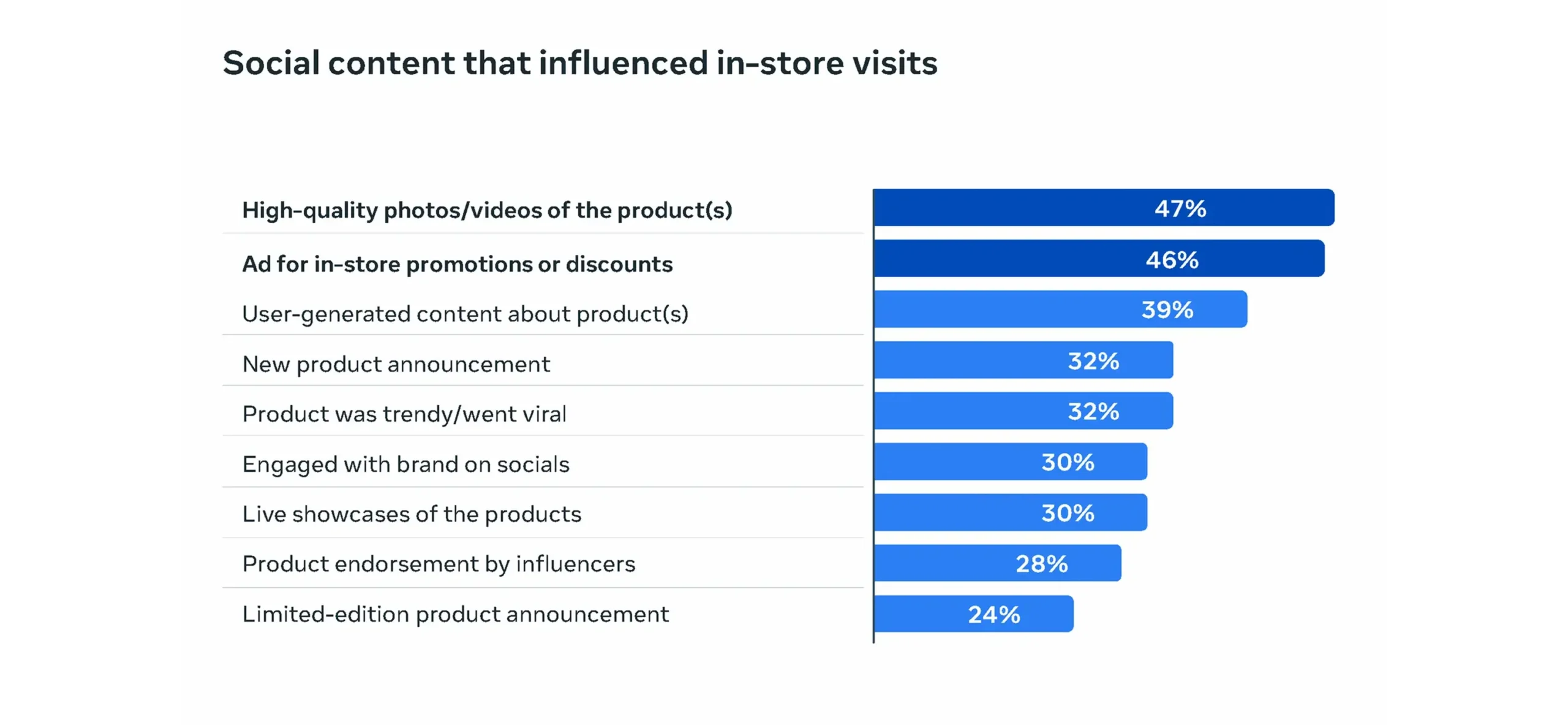
Social media drives in-store sales as well as in-app ones. 85% of social shoppers have bought something in store after seeing it on social media, and 29% do so often. Separately, 78% of festive shoppers who use Facebook, Instagram or WhatsApp have bought products directly in those apps.
The content most likely to send someone into a shop is:
high-quality product photography and video (47%)
ads for in-store promotions (46%)
user-generated content (39%).
Shoppers use social media to check three things: quality (46%), whether a product lives up to expectations (42%), and look at specific features (31%). By the time they walk in, they’ve largely decided.
Source: Meta
Shoppers use creators as researchers and deal finders, not mood boards
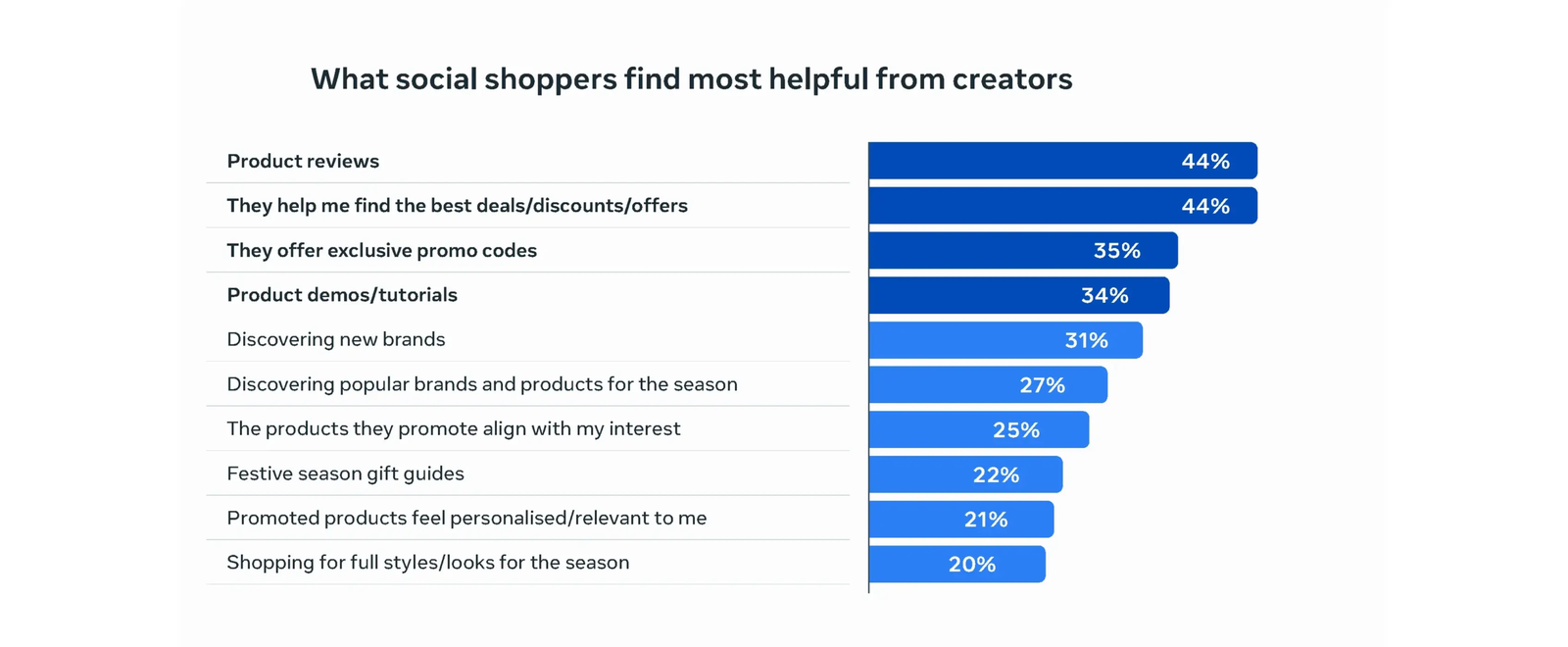
Shoppers want creators to help them decide, not just to inspire them. 94% of social shoppers look to creators for festive shopping guidance, and 57% say creator content is likely to influence what they actually buy.
The creator content they find most helpful is product reviews (44%), help finding the best deals (44%), exclusive promo codes (35%) and product demos (34%). Lifestyle inspiration plays a secondary role. In social search terms, reviews and demos are the answers people are searching for.
Nearly one in four shoppers already use AI for festive shopping.
Shoppers turn to AI when festive shopping feels most overwhelming: coming up with gift ideas, comparing products across categories, working through reviews and choosing for people whose tastes they don’t fully know. 59% say they wish they spent less time finding the right product.
Business messaging has become a checkout channel, not just customer service
Messaging a brand on social media is now part of how people buy, not just how they get help. They message to discover products (33%), add to basket (27%) and pay (26%). Customer service, which most brands build their messaging around, ranks only fifth.
House of Marketers Insight
Social search is now where festive shopping starts. Shoppers scrolling in late November aren’t looking for a mood board. They’re searching for an answer: what to buy, whether it’s worth it, and where to get the best price. The brands that win the season will be the ones whose creator content shows up as that answer.
That changes how creator content should be briefed and used:
- Make creator content findable, not just watchable. Brief creators to say the search phrase out loud and repeat it in captions and on-screen text (“best gifts for new mums under £50”). Social platforms read all three, and festive queries are some of the most specific searches people make all year.
- Brief for usefulness, not aesthetics. Ask for reviews, demos, comparisons and a code. Be strict about what the product does and leave creators free in how they say it.
- Put creator proof into paid amplification. Social shoppers weigh reviews and reputation more heavily, and user-generated content is the third-biggest driver of store visits. Running creator content as partnership ads puts that proof in the ad itself.
- Use more creators, covering more use cases. Social shoppers buy across more categories and buy for themselves. A wider roster covering different price points and gift recipients matches more searches than one hero creator.
Conclusion
The consumer behaviour Meta’s study points to isn’t specific to one platform. As a TikTok marketing agency, we see the same pattern: a creator’s honest demo often does more than a brand’s own ad. The AI trend points the same way: as we found in our look at influencer marketing for AI search visibility, AI tools often link to social content, so creator content that answers festive questions can surface in AI recommendations as well.
As Inigo put it: “We are already running campaigns where Social Search is built into the brief, the creator selection, and the reporting. It is not a future concept for us. It is how campaigns are being executed right now.”
For brands with budgets already set, there’s still room to act before the season closes: promo-code content for Cyber Monday, search-led review content for last-minute gifting, and a test plan for January sales. For everyone else, this is the baseline for 2027 planning.
Planning creator content for the final festive push, or getting ahead on 2027? House of Marketers runs influencer campaigns across TikTok, Instagram, and YouTube with a network of 250,000+ creators. Get in touch with our team to plan your next campaign.