



Only 28% of Consumers Trust AI Influencers. Here’s Where Influencer Marketing Is Heading

Since 2024, headlines have warned that AI is coming for the influencers. This year, AI-generated influencers became hard to ignore, and the question is back: will they make real creators obsolete in influencer marketing?
As an influencer marketing agency, we get asked if AI-generated influencers will devalue human creators. Our answer is a definite no.
AI has made it really easy to produce endless videos, faces, and voices and that’s the problem. When anyone can make content at that scale, what becomes valuable is the one thing AI can’t produce: a real person that an audience trusts.
That is what brands have always paid creators for, and we are seeing that real creators are gaining more value today because:
- Audiences are rejecting virtual influencers and other AI-generated influencer content.
- Platforms are changing their rules to favor content made by real people.
- People turn to AI for answers, but to trust those answers, they turn to human creators.
We explore all the reasons, so brands can see what is changing and what to do about it while there is still time to get ahead. But first.
What are Virtual Influencers and AI Influencers
A virtual influencer is a fictional social media character, usually CGI or animated. A team designs it and controls what it posts, like a real creator would.
An AI influencer is a newer type where generative AI does much of the work. The AI helps create the character and writes or generates its posts and replies, so less of it is designed by hand.
The two terms overlap. Many AI influencers are also virtual, but not all virtual influencers use AI.
Virtual influencers like Lil Miquela and Shudu have been around for a while and have built followings BECAUSE everyone knew they were digital. The fakeness was part of the appeal.
Even then, many audiences pushed back and never fully accepted them. They worked as a novelty for some brands, not as a replacement for real creators. A digital character can’t try a product or share a real experience, so it was never going to suit every brand.
What has changed is that AI-generated influencers now look and sound like real people, and many sometimes don’t explicitly say they are AI. Audiences are not comfortable with that, and rightfully so.
Source: Guardian
Lisa Barber, editor of Which? Tech told the Guardian that 70% of people could not correctly identify all the real and fake videos shown in a deepfake investigation.
Lisa said companies “must be transparent when content has been created using AI.” And that, “it is concerning that consumers are not able to trust the content they are seeing online. Companies must be transparent when content has been created using AI, particularly if AI-generated influencers are appearing in the content.”
If an influencer’s value is trust, a synthetic person gives audiences nothing to trust.
Do Audiences Trust AI-Generated Influencers?
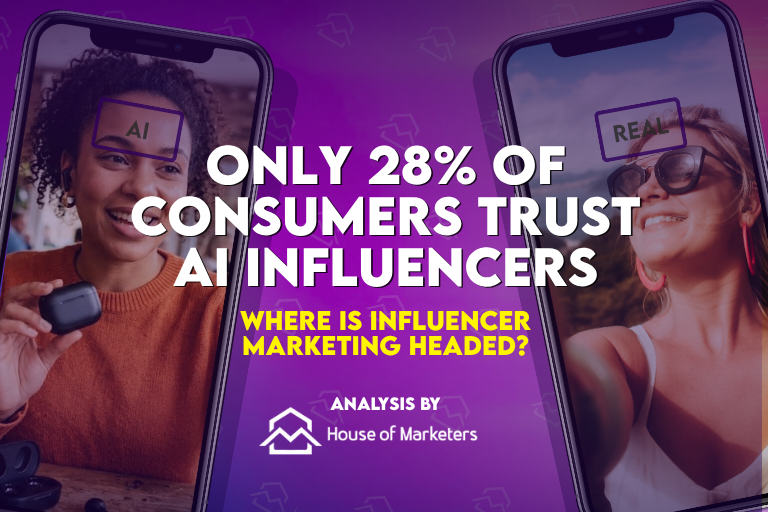
Mostly no. Meltwater and YouGov found that only 28% of consumers think generative AI is acceptable in influencer marketing.
If you think about it, trust is what makes a creator’s recommendation work. People believe a real creator’s recommendation when they see that the creator has tried the product, has been honest before, and would pay a price for being wrong, aka loss of trust.
AI can copy how trust looks by generating a friendly face, a relaxed tone, and a confident review. But an AI-generated influencer has not used the product it is vouching for, nor does it have anything to lose if the advice is bad.
AI-generated content is flooding the feeds but that influx of more content has not translated into better results. A TikTok and WARC survey of 400 marketers found that 88% said AI increased how much creative assets they produce, but only 45% said it significantly improved quality.
In other words, content is now easy to produce, but belief still has to be earned..
Users are Punishing Undisclosed AI Content
When brands hide their use of AI influencer content, it makes things worse. Meltwater’s research says 59% of users said their trust in a brand would drop if its AI use wasn’t disclosed, and 86% said disclosure matters. So the risk isn’t using AI. It’s being caught using it without disclosure.
SheerLuxe, a women’s leading fashion and beauty publisher, recently faced backlash for creating four AI influencers designed to offer beauty and styling advice.
Just reading the comments is enough to understand what the audience thought of this campaign.
That brings us to the second factor: social media platforms are changing their rules in light of AI-generated content and it’s not good news.
Social Media Platforms Favor Human-Made Content
So in recent months, several platforms have changed their rules on AI influencers and AI-generated content.
That’s because AI content is low trust and the more the audiences are skeptical of what they are seeing, the worse it is for social media platforms. Social media’s whole business depends on audiences trusting what they see. If feeds fill with low-quality AI content, people stop watching, and advertisers follow.
Here are all the rules social media has released recently to combat mistrust caused by AI content.
- Instagram replaced its “AI creator” label with a clearer “AI-generated profile” label. Profiles showing AI-generated people that don’t use it get less reach and lose recommendation eligibility.
- Snapchat has made it so only videos made by real people can be recommended on Spotlight. Creators can still use Snapchat’s AI tools to edit, but fully AI-generated videos are no longer rewarded on Snapchat.
- YouTube updated its monetisation rules to penalise generic or template-based videos, distressing content, and AI personas. Discussing sensitive topics like health and finance in the formats mentioned before can’t earn ad revenue on YouTube anymore. The aim is to stop content farming, not to ban AI.
- X set up its Original Content Rewards Program. It pays for posts that show your own voice, perspective, or expertise, and it excludes reuploads.
TikTok has labeled over 3 billion videos as AI-generated, removed more than 86 million fake accounts in the first three months of the year, and published an AI literacy guide that teaches users how to spot synthetic content.
But that doesn’t mean AI has no place.
Instagram’s rules, for example, leave creators who use AI for editing, captions, or graphics alone. What gets penalized is a fake person presented as real. A brand that builds a campaign on an AI persona is betting audiences won’t find out, at the same moment platforms are building the tools to make sure they do.
Together, these rules decide who gets seen and who gets paid. They move reach and money toward real people with an original voice, and they put a cost on synthetic personas.
That is the biggest shift among this year’s influencer marketing trends. A real creator never has to worry about being labeled, filtered, or demonetized for being fake. An AI persona does.
This brings us to the third factor: The rise of AEO and trust.
How AEO (Answer Engine Optimization) increases reliance on Human Creator Content
Answer Engine Optimization (AEO) is the practice of making your content easy for AI tools to find and cite when they answer questions.
AEO tools tend to favor sources that show real human input, such as first-hand experience, honest opinions, and personal results. That is exactly what creator content has. So when people turn to AI for answers, the sources AI draws on often come from creators.
AI answers, and shoppers both lead back to creators
Google now shows AI-written summaries (AI Overviews and AI Mode) at the top of results. SE Ranking studied 100,000 keywords and found social platform links in 67.66% of AI Overviews and 32.39% of AI Mode answers.
Those links point to where real people share what they have tried. But AI answers are not the only place people look for that experience. Many skip the AI answer and search social platforms directly.
Read more about social search: what is social search
People search on social media to hear from real people.
Adobe Express surveyed more than 800 US consumers and found that 49% now use TikTok as a search engine, up nearly 20% since 2024. What they look for is tutorials, product reviews, personal stories and influencer recommendations. In each case they want someone who has done or tried the thing. AI can write an answer, but it can’t say it tried the product last week.
Read more about social search: what is social search
Shoppers use creators to check what AI tells them.
Shoppers who trust AI recommendations are six times more likely to also trust creators. And 83% of consumers say they “trust but verify” what chatbots recommend. So the path now often runs like this: AI suggests a product, the shopper checks a real person’s review, then buys.
Creators sit at both ends of that path. AI tools cite their content, and shoppers use it to confirm AI’s answers. AI isn’t replacing the creator in the buying journey. It is just giving creator content a bigger job.
Ready to launch your next influencer campaign?
Get a free proposal from House of Marketers
House of Marketers Insights: The future of Influencer Marketing for brands
The future of influencer marketing isn’t humans against AI. It’s humans doing the part that needs trust, and AI doing the work behind them.
To put that split into practice, brands should follow these four steps to stay ahead of the curve.
- Don’t build campaigns on AI personas. Audiences reject them, and platforms are limiting their reach. A real creator doesn’t carry that risk.
- Disclose AI use clearly. Write a simple internal standard and check past creator content against it.
- Use AI behind the scenes and keep the person human. AI is useful for edits, variations, and translations. The face, the voice, and the opinion should stay with the creator. This is how we read the Warc data: find what a community cares about, let creators turn it into content, then use AI to scale it.
- Brief creators on the questions people search, and keep working with the ones who perform. Tutorials, honest reviews, and personal stories are what people look for. Even captions count, because Instagram now treats them as a discovery signal. Creator content is also cost-efficient. Our UGC Creative guide puts creator content at 45% better conversion than brand-produced video on TikTok Shop.
Final thoughts
AI will keep making content cheaper, and that is exactly why trusted human voices matter more. Many brands can find creators and brief posts well enough. The harder part is building a creator program that holds up as the rules change and shows up where people search. That is a strategy problem, not a budget one, and it is what we help brands work through as an influencer marketing agency. Contact House of Marketers for a free campaign proposal!
Contact for Free Campaign Proposal