

If you sell a consumer product, you have probably tried to compete with bigger brands on a small budget and watched your ads do very little for sales. OLIPOP was in the same spot. It cut back paid social, handed its awareness to TikTok creators, and grew into a soda brand that passed $400 million in revenue in 2024. In this case study, we break down OLIPOP’s marketing strategy and what you can copy from it.
As a TikTok marketing agency, House of Marketers has broken OLIPOP’s playbook into steps a smaller brand can follow. We cover:
- Where OLIPOP started and why its early paid social ads did not work
- Why it moved to TikTok in 2021 and handed its account to creators instead of an agency
- How it briefs creators, joins trends and works with micro-influencers
- How its seeding and affiliate program works, and how it measures results
- A three-phase checklist (planning, before launch and after launch) you can use at a much smaller scale
What Is OLIPOP? The Prebiotic Soda Brand’s Origin Story
OLIPOP is a prebiotic soda brand, meaning a soda made with added plant fiber and marketed for gut health. It was built by two founders, Ben Goodwin and David Lester. Ben Goodwin spent about four years testing formulas in a makeshift backyard lab until he partnered with David Lester on their first brand, Obi, a probiotic soda. Obi never gained the traction they hoped for, and they sold it in 2016. The roughly $100,000 from that sale became the starting capital for OLIPOP.
Goodwin finished the prebiotic formula in 2018, and the first cans reached 40 stores in Northern California in early 2019. First-year gross revenue was $852,000, according to CNBC.
This was a small, self-funded soda brand with no real ad budget, in a category dominated by Coca-Cola and PepsiCo. Growth had to come from somewhere other than outspending anyone, and the team did not find it right away.
Why OLIPOP’s Early Paid Social Ads Didn’t Work
OLIPOP’s early paid social ads did not move revenue enough to justify the spend. By 2021, it had cut its Facebook ad budget in half, as growth marketer Steven Vigilante explained on the DTC Podcast.
This is a common mistake. Paid media amplifies ad creatives, so if you have not yet found creative that works, more spend only shows a weak idea to more people. Spending on paid media before you know whether the ad creative or hook (the opening seconds meant to stop someone scrolling) works is not an ideal place to start.
After that disappointing experience, OLIPOP gave influencer marketing a shot. It started with Instagram creator partnerships built on scripted talking points and discount codes to drive website sales. That decision to pivot strategies changed the trajectory of OLIPOP’s business.
The scripted Instagram posts were only a first test. In September 2021, Vigilante moved OLIPOP’s focus to TikTok, and that is where its creator-led marketing really began.
How OLIPOP Built a TikTok Presence With Creators
OLIPOP handed its TikTok account to creators after an agency gained it only about 1,000 followers between September 2021 and January 2022, Vigilante told Ad Age. For a brand at that stage, a familiar face talking to camera builds trust faster than polished ad graphics.
OLIPOP put creator Sara Crane on a full-time retainer as the face of the account, with creator Diana Rondi working part-time alongside her. (A retainer is a fixed, ongoing fee rather than a payment per post.) Both appeared on camera in most posts, doing trending-sound lip-syncs, skits, recipes and flavor announcements. Together, they grew the account from 1,000 to 34,000 followers in six months.
That growth did more for OLIPOP than anything it had tried before, so the brand began working with creators beyond its own account.
OLIPOP’s TikTok Influencer Marketing Strategy, Step by Step
OLIPOP’s TikTok influencer marketing strategy rests on five habits. It briefs creators with a short questionnaire and one goal, joins trends that creators start, and spreads its budget across many small creators. It also runs a seeding and affiliate program, and it judges TikTok by reach and search rather than clicks.
Ready to launch your next influencer campaign?
Get a free proposal from House of Marketers
How OLIPOP Briefs Creators
The brief itself is short: one clear campaign goal, with the creative left to the creator.
OLIPOP recruited through questionnaires and matched each creator to a campaign goal, so the brief started from what the creator already made instead of what the brand wanted to say.
After the match, OLIPOP gave creators artistic freedom over the post, so the hook, format, and tone came from the person who knows what their audience will actually watch.
How OLIPOP Joins Trends While Staying on Brand
OLIPOP joined trendy moments that other creators started. When the “sleepy girl mocktail” took off, fans were buying out OLIPOP’s Lemon Lime flavor to make it. An average of 1,500 Instagram story posts a week tagged the brand, many showing a can poured over ice in a wine glass. The team joined the trend while it was live and treated the people posting as a signal of who to work with next. That is how it found creator Gracie Norton, whose mocktail video first caught the brand’s attention and later became a paid campaign.
The same instinct worked on a bigger stage. When the Barbie movie dominated summer 2023, OLIPOP placed itself inside it. Strawberry Vanilla OLIPOP showed up as product placement in the “Barbie World” music video by Nicki Minaj and Ice Spice. Marketing Brew reports the placement drew more than 150 million views. It also led somewhere: Mattel reached out about a Barbie x OLIPOP Peaches & Cream flavor for Barbie’s 65th anniversary.
How OLIPOP Uses Micro-Influencers to Stay Visible
OLIPOP leaned on micro-influencers, creators with smaller but more engaged followings, to build presence at scale. Early on, the brand spread its budget across about 10 smaller influencers instead of one big-name deal. It also gifted product widely and watched who posted about it unprompted, because an unprompted post is the signal that someone actually likes the product.
As Steven Vigilante, now OLIPOP’s director of strategic partnerships, told Entrepreneur:
“Some of our best partnerships started with a free sample and a conversation.”
Recent data shows the same long-tail pattern, with many small creators instead of a few big names. Modash’s analysis of about 4,800 OLIPOP-sponsored posts from October 2025 to September 2026 covered roughly 3,000 creators. TikTok accounted for 57.2% of posts, Instagram 31.6% and YouTube 11.2%. On TikTok, 41.5% of partnerships were with creators averaging under 1,000 views per post. Thousands of creators, each adding a post, many of them small, turn into a constant presence.
How OLIPOP Runs Its Influencer Seeding and Affiliate Program
Influencer seeding is the strategic distribution of products to a carefully selected group of relevant creators, usually at scale, to generate awareness, organic advocacy, and potential content. OLIPOP turned the gifting habit from its early days into a formal creator program. Every approved creator gets a $36 sample pack and earns at least 10% commission on the sales they drive. This is an affiliate model, where creators are paid a share of the sales they generate. Nearly 1,900 creators have joined, and the program grew from 4% of total company sales in 2021 to 12% in 2024.
The setup was simple. Creators need at least 10,000 followers on one platform, with exceptions for health professionals, and 82 registered dietitians are in the program. Everyone who joins gets the variety-can sample pack, and their followers get a custom code worth 15% off, mainly to introduce a shopper to the brand. Creators have freedom, with no strict approval or posting requirements. It is also run lean: its agency partner GravityFed collects gifting requests in Google Sheets, and applications are reviewed by hand.
How OLIPOP Measures TikTok Influencer Marketing Results
OLIPOP judges TikTok on views and cost per thousand views (CPM), not last-click sales. Steven Vigilante has said its TikTok content drew 1.3 billion views at a $0.61 CPM, a company-reported figure rather than an audited one. Creator content has a measurement problem: a person watches a video on TikTok and buys a can weeks later in a store, so a click-through rate tells you almost nothing. On Darkroom’s Social Studies podcast, Vigilante described TikTok views as a driver of Google searches and retail sales instead.
The more telling signal was search. CNBC reported Google searches for OLIPOP spiking as views of #guttok, TikTok’s hashtag for gut health content, passed 700 million between December 2022 and January 2023. By the time of that report, the brand had grown from 40 stores to more than 23,000.
That demand showed up on shelves. By 2025, Fortune reported that OLIPOP was sold in about 50,000 retailers and had passed $400 million in revenue in 2024.
Influencer Marketing Lessons Brands Can Take From OLIPOP
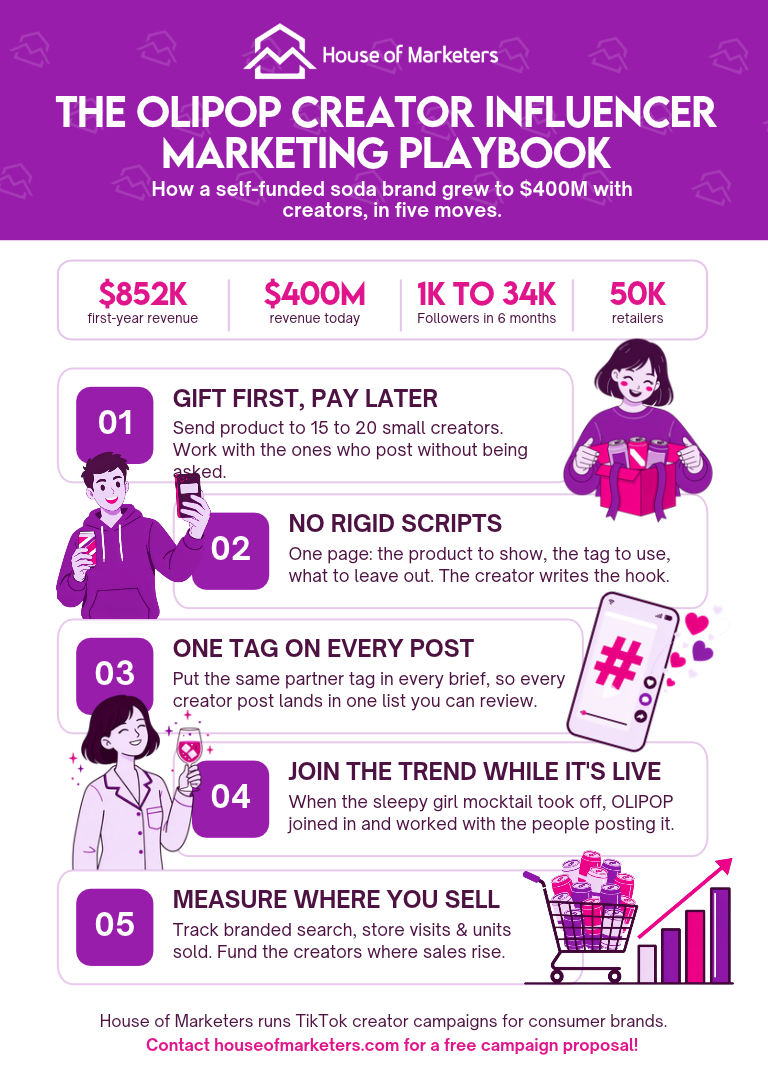
Brands can copy three things from OLIPOP. Send product to a handful of small creators and watch who posts unprompted. Brief a placement instead of a script. Measure with search and store data that matches how you sell. These moves work at a much smaller scale than OLIPOP’s. Here they are as a checklist in three phases: planning, before launch, and after launch.
Planning: Choose Creators and Write the Brief
- Choose creators by what they already post, not by follower count. Start with a list of 15 to 20 creators whose regular content already has a natural spot for your product, the way a meal or snack video does for a can of soda. Check that their audience shops where you sell. Then send each one a short questionnaire: what do you usually make, and what would you want to try with this product? Match every creator to one clear goal, such as awareness, a new flavor or a retail launch. Like OLIPOP, start by spreading your budget across about 10 smaller creators instead of one big name, so you get ten chances to find what works.
- Brief the placement, not the script. Keep the brief to one page: the product to show, the one thing that must be true (clearly visible, tagged correctly), and what to leave out, such as hard-sell lines. If you run an affiliate program like OLIPOP’s, the creator’s discount code goes at the end, never in the hook. Leave the hook, the script, and the format to the creator. They know what their audience will actually watch, and a post that sounds like an ad gets scrolled past. If you find yourself writing lines for the creator to say, cut them and write the goal instead.
Before Launch: Set the Tag, the Payment Model and a Baseline
- Agree the payment and one partner tag before anyone films. Settle in writing whether each creator gets a flat fee, free product or a commission like OLIPOP’s affiliates, and put the same tag in every brief. OLIPOP posts with its #OLIPOPPartner tag outperformed posts with the generic #OLIPOP tag, and the tag is also what lets you pull every creator post into one list later and compare them.
- Write down your starting numbers. Because TikTok views rarely turn into clicks, pick three signals you can track: branded search volume, visits to your store locator or “where to buy” page, and sales velocity, meaning units per store per week at your top retailers. Record today’s number for each with the date, so you can tell later what the creators changed. Also set the CPM you are willing to pay, using OLIPOP’s figure above as a rough benchmark rather than a target.
After Launch: Track What Moves, Then Back It
- Line up post dates against search and sell-through. Note the day each batch of posts goes live, then check weekly whether branded search rises in the same weeks. Then ask your retailers for weekly sell-through. If one store or region got more creator posts than another, compare its velocity before and after the posts. Expect a lag, since the sale happens after the video.
- Back what works and review monthly. Compare creators by CPM, not follower count, and keep funding the creators and formats where search and velocity rise. Boost the posts that perform, and pause the ones where only views go up. Watch for trends too. If a creator starts a trend around your product, send them product and join in while it is live.
For more on running creator programs, read what influencer seeding is and how to run it, and the TikTok influencer marketing guide.
Final Thoughts
OLIPOP shows what happens when a brand treats creators as the main awareness channel rather than an add-on. A challenger soda brand used TikTok creators to build demand at scale and let retail do the selling.
Most brands get the first step right: send product and brief a few posts. Growth stalls when it is time to run it as a system, with tiered creators, commissions, measurement tied to how the product actually sells, and paid amplification on what works. That last piece matters because the same paid spend that failed OLIPOP early on makes far more sense once you know which creative lands. As a TikTok influencer agency, House of Marketers helps brands close that gap.
Contact for Free Campaign Proposal
FAQs: OLIPOP Marketing Strategy
What is OLIPOP’s marketing strategy?
OLIPOP’s marketing strategy treats TikTok creators as its main awareness channel. It briefs creators on one goal and leaves the creative to them, joins trends its fans start, and spreads its budget across many small creators. It then judges results by views, branded search and retail sales rather than last-click conversions.
Why did OLIPOP move from paid ads to TikTok creators?
Its early paid social ads were not moving revenue enough to justify the spend, so it cut its Facebook budget and moved its focus to TikTok in 2021. Creator content cost less to make, felt native to the feed, and reached younger shoppers who were already watching gut-health content on TikTok.
Who runs OLIPOP’s TikTok account?
OLIPOP built its TikTok account with creators rather than an agency. Sara Crane joined on a full-time retainer as the face of the account, with Diana Rondi working alongside her part-time. Both appear on camera in most videos, from lip-syncs and skits to recipes and flavor launches.
How does OLIPOP’s creator affiliate program work?
Approved creators receive a variety-pack sample and earn commission on the sales they drive through a personal discount code. Most need at least 10,000 followers on one platform, with exceptions for health professionals such as registered dietitians. Creators choose what to post, with no strict approval process.
How does OLIPOP measure influencer marketing results?
OLIPOP tracks TikTok by views and cost per thousand views instead of clicks, because most of its sales happen in stores, often weeks after someone watches a video. It looks for the effect in branded Google searches and retail sales instead.
Can a small brand copy OLIPOP’s influencer strategy?
Yes, at a smaller scale. Send product to 15 to 20 creators whose content already suits it, brief one goal instead of a script, and record your branded search and sales numbers before launch. Then put more budget behind the creators whose posts move those numbers.