


Influencer seeding (also known as product seeding) is a marketing activity that involves strategically sending products to creators for free, with the objective of getting them to post about your product, despite not having any contractual obligations in place with the creators.
Many brands are concerned with the lack of control and guarantees of content being produced. But yet, this strategic approach is exactly what’s working for some of the biggest global companies right now.
It’s not suitable for every company, especially if your product is of high value, but for most product-focused brands, it’s an excellent way of driving awareness, engagement and sales.
The Influencer Seeding Craze
Product seeding is one of the most increasingly popular strategies in recent years, offering brands authentic reviews that typically lead to higher engagement and potential sales. And as an influencer seeding agency, we’ve run enough seeding campaigns and influencer seeding strategies to know what separates the ones that generate real results from the ones that don’t.
In this article, we will break down all the ways you can learn to replicate our learned wisdom for your brand.
Let’s get into it!
What is Influencer Seeding?
Influencer seeding is the practice of brands sending free products to creators, without there being any contractual obligation to post about them. Instead of a formal campaign brief or payment agreement, brands reach out with a genuine, personalised message explaining why they think the creator would enjoy the product and offering to send it as a gift.
A typical outreach message might sound something like:
“Hi! We came across your content and absolutely love your style. We think you’d genuinely enjoy our product, and we would love to send you one to try, completely free. There’s no expectation to post. If you end up loving it and decide to share it with your audience, we’d be thrilled, but there’s absolutely no pressure. Let us know if you’re interested!”
This no-pressure approach helps brands build authentic relationships with creators and can result in more genuine recommendations and higher-quality user-generated content than heavily scripted sponsored posts.
So why seed instead of just running a standard influencer campaign where payment is exchanged? Because the two do different jobs.
A paid creator endorsement buys you a professional collaboration. But seeding buys you a true fan that will most likely remain loyal to your brand. You put it in the hands of people whose audience already trusts them, and the creators who genuinely like your product will post about it, in their own words, on their own terms. That’s what makes the endorsement land in an even more genuine way.
The mistake most brands make is treating influencer seeding as a cheaper version of a paid creator partnership. It isn’t. It’s a different mechanism entirely.
Ready to launch your next influencer campaign?
Get a free proposal from House of Marketers
Why is Influencer Seeding Important?
Influencer seeding has become a useful and effective approach in modern influencer marketing strategy. It’s because,
- Paid partnerships can be expensive, depending on the industry niche
- Audiences are getting better at spotting sponsored content
- Larger creators are increasingly protective of what they put their name to
We’re not saying paid partnerships should be abandoned as they have their place, but we’ve watched this play out repeatedly: audiences scroll straight past the ‘paid partnership’ tag because they’re desensitised to promotional content. Seeding sidesteps that entirely – it’s a big part of why our COSRX influencer seeding campaign worked so well.
There’s also a timing factor. Social search is changing how people discover products. A growing share of buyers now type a product name into TikTok or Instagram before they ever reach Google. What they find there is creator content. If the only results are your own branded posts, that’s a weaker first impression than a dozen genuine creators using your product in their everyday lives.
Seeding is one of the few strategies that builds that organic search footprint deliberately. Every seeded post that mentions your name becomes a small piece of social proof sitting exactly where your next customer is already looking.
What is the Difference Between Influencer Seeding & Influencer Gifting
Think of it like this. Gifting is the action; seeding is the marketing strategy. A seeding campaign normally involves gifting products, but not every influencer gift forms part of a structured seeding campaign.
Influencer seeding is the strategic distribution of products to a carefully selected group of relevant creators, usually at scale, to generate awareness, organic advocacy and potential content.
Influencer gifting is the broader act of giving a complimentary product to an influencer. It may be used for relationship-building, appreciation, product trials or as part of a seeding campaign.
Influencer gifting and influencer seeding are often used interchangeably, and neither necessarily requires the creator to post. However, influencer gifting broadly refers to giving a creator a complimentary product, while influencer seeding is a more targeted strategy in which brands distribute products to selected creators to encourage organic discovery, advocacy and potential coverage. In both cases, content is not guaranteed unless this has been separately agreed with the creator.
There’s no posting requirement for both; and the goal is to find out who genuinely connects with your product and attempt to get creators to post about it.
For both strategies, brands may provide guidelines covering tone, format, and message, so the content stays on-brand and predictable. Trackable links and discount codes can also help in measuring performance and deciding whether a creator is worth a paid partnership down the line. However, this not often the case, and the creator is more likely to request payment, so you have to be careful with how you approach this.
The clearest way to think about the progression is this:
- Influencer Gifting: The act of sending products to influencers for free, with the hope of them posting, despite no obligation in place.
- Influencer Seeding: Targeted influencer gifting at scale, in the form of a fully-fledged product distribution strategy to encourage high volumes of organic creator coverage.
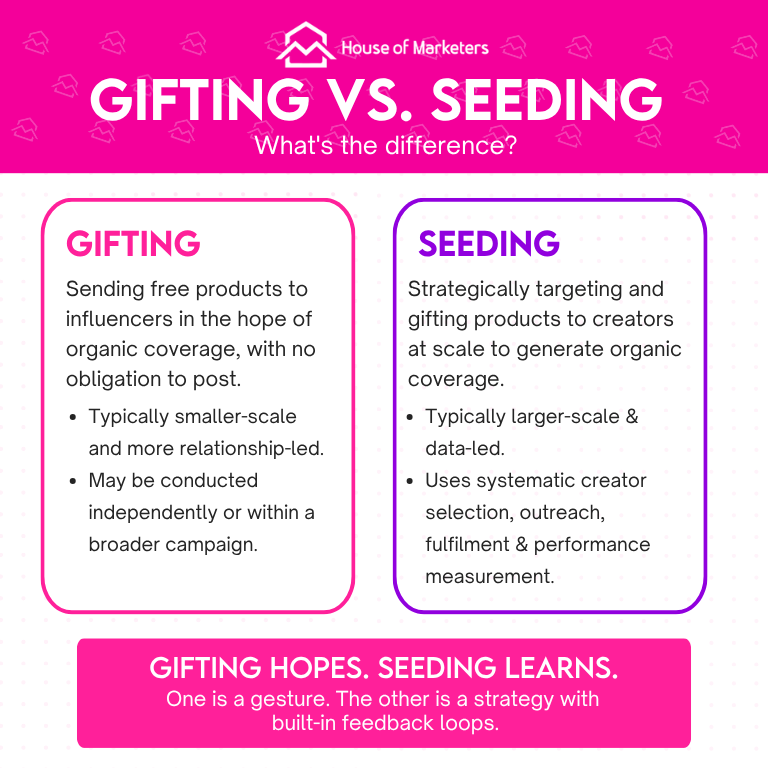
Why Influencer Gifting and Seeding Does Actually Cost.
“I’m gifting so it’s free” – that statement is far from the truth, and here’s why.
There’s hidden costs in influencer gifting. Yes you’re not paying the creators to post. But the real cost is if a low percentage of the creators actually decide to post your product. Maybe they don’t like it, or weren’t engaged enough with you to post. Maybe the creators even just threw away your product. You have to really spend your time strategically selecting the right creators and ensuring they remain engaged. Your investment includes time, i.e., research, outreach, tracking, and the follow-up. All this is not easy to manage and keep track of, and that is why most companies utilise a dedicated influencer gifting agency.
Need suggestions on who to partner with? Check out our ranked list of the best influencer gifting agencies.
Best Influencer Gifting Agencies.
Which Influencers are Best for Influencer Seeding Campaigns?
Influencer seeding works best with micro-influencers in the 5,000 to 50,000 follower range.
Micro-influencers have smaller but more highly engaged audiences because of their small audience size. Their strengths lie in the fact that their audience trusts them on particular topics or just really enjoy their content. Audiences are often much more likely to have met a micro-influencer as well because their follower communities tend to start from their home city.
Micro-influencers are also significantly more likely to respond to personalised outreach than larger creators, who are often managed by agencies and are inboxed constantly. Accessibility is part of the value. A direct, genuine message to a 25,000-follower creator in your niche will land very differently to the same message sent to someone with a million followers and a full-time management team filtering their DMs.
There’s also an algorithmic dynamic at play. Platforms prioritise content that performs well within a community before pushing it wider. A micro-influencer posting authentically to an engaged niche audience often gets better organic distribution than a macro-influencer posting to a passive one.
There is an economic benefit to this strategy, too. You can seed twenty micro-influencers for the cost of a single macro partnership, and if even half of them post, you’ve generated ten pieces of genuine, unscripted content that you can learn from, repurpose, and build on.
It’s exactly why, when COSRX came to us to expand across the US, UK, and Europe, we didn’t go straight to big creators. We ran monthly gifting waves to a carefully selected mix of micro and nano-influencers across multiple markets. The result was a 2x sales increase and a 15% TikTok Shop uplift. Driven by consistent, authentic content across a whole tier of creators who genuinely cared about the product.
How to Build an Influencer Gifting and Product Seeding Campaign
1. Define your goals and choose the right creators
Before anything goes in a box, get clear on what you’re actually trying to achieve.
- Is it brand awareness?
- Are you curating a list of UGC you can run as paid ads?
- Shortlisting of creators for a formal influencer marketing partnership down the line?
Each of those goals points to a different kind of creator, so naming the goal first saves you a lot of heartache from sending your product to the wrong people.
A few questions worth answering before you start:
- Which product are you sending, and why that one?
- What kind of content would you love this creator to make? (even if you’re not going to ask for it)
- Which platforms matter most for your audience right now?
- Are you building a long-term roster, or testing reception for a specific launch?
Once you know the goal, finding creators gets easier.
The best influencer seeding targets are people already talking about your category who simply haven’t discovered you yet. Here’s what you should do,
- Search your niche on TikTok and Instagram.
- See who’s tagging brands like yours.
- Pay attention to who your existing customers already follow.
- And weigh engagement over reach every time.
A creator with 30,000 followers and a 6% engagement rate can be far more valuable for seeding than one with 90,000 followers and 0.8%. The smaller, more engaged audience would typically trust the recommendation more. That said, engagement is just one of countless factors to weigh when deciding which creators to work with.
2. Personalise your outreach
How you reach out to an influencer has a huge effect on whether or not you will get a good response on your influencer gifting campaign.
So thoughtful outreach is your best insurance.
View this post on Instagram
Worth knowing: gifted products count as payment under ASA (UK) and FTC (US) rules, so creators should label gifted posts with #ad. A single line in your outreach asking them to do so keeps everyone compliant.
What NOT to do in influencer outreach strategy:
Copy-paste DM blasts are the fastest way to get ignored, and with AI making generic outreach even more common, creators can spot one in under three seconds.
You have to understand that they probably get dozens of messages a week. Yours has to read as if it came from an actual person who actually watched their work.
Good outreach is short, specific, and human. It references something real, i.e, a post you genuinely enjoyed, a reason you thought of them in particular.
Resist the urge to open with a PDF, a page of brand guidelines, and a list of required hashtags. That’s a one-way ticket to being ignored.
Be upfront about the content expectation from the start. Creators appreciate knowing what’s being asked – a clear, simple ask is not off-putting.
Keep the task light, keep the guidelines minimal, and let the product do the rest.
Creators who choose to post do so because they like the product, and that honesty is exactly what makes the content land.
3. Invest in a Good Seeding Kit
What is a seeding kit?
A seeding kit is the curated package a brand sends to a creator as part of an influencer seeding campaign. It typically includes the product itself and a short personal note. It is usually designed to make the unboxing worth filming.
A strong seeding kit usually contains:
- The hero product: lead with your best, not the sample you’re trying to clear.
- Branded, tactile packaging: layers and detail that make the unboxing itself content.
- A handwritten note: a few lines thanking the creator personally.
- A small unexpected extra: a usage tip or bonus that shows a real person thought about this specific recipient.
The better the kit, the higher your organic post rate because you’ve handed the creator their opening shot before they even know what the product is.
This is where a lot of brands underinvest, and it shows on camera.
Think of the package as your brief. Everything you’d want a creator to understand about your brand, and to feel about it, should come through the physical experience of opening the box. You’re not just sending a product; you’re sending them a reason to film YOUR product.
View this post on Instagram
4. Nurture without pressuring
Once the package is on its way, the instinct to chase is completely normal. Question about whether it has arrived, have they tried it, are they going to post? All are very real and expected.
However, we recommend resisting that instinct.
Just follow the creator. Engage with their content for real. If you want to check in after a week or two, keep it light: “Hope the [product] arrived safely — would love to know what you think.” Nothing more.
And if a creator doesn’t post, it may feel like wasted spend, but it tells you valuable information too. It might mean the product wasn’t right for their content, their audience, or their aesthetic. That’s one more thing you’ve learned about the product fit before you’ve spent another penny. A quiet no is a free lesson in who not to invest in next time.
The creators who post without being asked are the ones to double down on. Their unprompted content is the most credible thing your brand can put in front of an audience, precisely because nobody told them to make it.
5. Track your influencer seeding / influencer gifting strategy
If you want to know what’s working and which creators are worth a real partnership, you have to track it. In a seeding campaign, tracking is less important, but gifting campaigns are marked by tracking metrics.
Keep an eye on these metrics:
- Post rate. How many creators who received products actually posted, and in what format, i.e, a video, a reel, a story?
- Organic reach. How many people genuinely saw the content?
- Earned media value (EMV). The estimated value of the organic coverage you generated, useful for putting a number on the programme.
- Saves and shares. Stronger purchase-intent signals than likes or comments.
- Content usage rights. If you want to repurpose a seeded post as a paid ad, you’ll need permission. Sort this out early so a great post doesn’t go to waste.
Done consistently, this data cuts your guesswork in half.
An influencer gifting strategy that’s tracked well benefits your brand twofold. Once with a strong piece of content, and second, it helps to build your influencer campaign roster.
6. Use paid media boosting for the best assets your influencer gifting strategy creates
A great UGC post shouldn’t just live and die on the creator’s feed. With usage rights in hand, the strongest content has the potential to become paid media. Running paid media boosting puts proven, authentic creative in front of a far bigger audience, and it almost always outperforms studio-shot content because it doesn’t look like an ad.
On TikTok, the cleanest way to do this is through Spark Ads, which let you boost the creator’s original post from their own handle rather than re-uploading it as branded content. The post keeps its organic comments, likes, and credibility, and the creator’s name stays front and centre, which is precisely why it converts. On Instagram, partnership ads work the same way.
A sensible rule of thumb: don’t boost everything. Let seeded content run organically for a week or two, see which posts pull genuine saves, shares, and comment activity, and put spend behind the top two or three. You’re paying to amplify proof, not to manufacture it.
What Type of Content Can You Expect from an Influencer Seeding & Gifting Campaign?
The most common content formats you might see are:
Unboxing Videos
These are among the highest-performing video formats on TikTok and Reels. Viewers are genuinely curious about what’s inside and how a creator reacts to receiving it. These perform well because the hook is built in, i.e., something is about to be revealed.
View this post on Instagram
Product Reviews & Product Hauls
These are more considered content, often longer. Common in beauty, food, and tech niches. Audiences treat it differently from sponsored content and are much more receptive to advice that doesn’t come attached with a transaction.
The creator shows everything they’ve received, often alongside other products. Less depth per product, but high engagement through comments and questions. Viewers ask where to buy, how to use it, and how it compares. That question-and-answer activity drives further organic distribution.
View this post on Instagram
Humour and Creative Review
When a creator is a beloved customer instead of a new user, you can sometimes find them expressing their love for the product using their creative flair. This is honestly the biggest compliment your brand could ever receive. Worthy of being framed, really.
Take creator @davidlarbi, who received a pair of socks from @peperharowsocks and responded with an 18-second poem. The video hit 201K views and 13.8K likes. Peper Harow didn’t write a brief for that. They just sent socks to someone who happened to be a poet.
This is the rarest outcome of a seeding programme and arguably the most valuable. You can’t manufacture it. The only way to earn it is to put your product in the hands of people who are already passionate about your category, and then get out of the way.
View this post on Instagram
Day-in-the-life/Routine Content
This is one of the most common formats in seeding. When a creator naturally works your product into a morning routine or weekly ritual video, it signals habitual use, which is far more persuasive than a dedicated review.
For Stickerbox, a teacher’s UGC served a dual purpose. It answered a question and also validated the product.
Repost and Duet Chains
This happens when one creator’s seeded post inspires another creator to respond, compare, or build on it. This is entirely organic and impossible to manufacture, but it’s worth knowing it exists, because it means a single seed can generate multiple pieces of content you never planned for.
The conditions for it are simple, even if the outcome isn’t guaranteed: seed multiple creators within the same niche at roughly the same time. When a few of them post within the same window, their audiences overlap, the algorithm clusters the content, and one creator’s take becomes another’s prompt. This is part of why wave-based seeding — sending to batches of creators in your category rather than dripping out one parcel a month — tends to produce more compounding moments than the same number of sends spread thin across unrelated niches.
Ready to launch your next influencer campaign?
Get a free proposal from House of Marketers
Benefits of Influencer Seeding
Here’s what the benefits of influencer seeding actually mean in practice.
Influencer seeding content feels less like an ad, because it isn’t actually paid for
Seeded content comes with genuine reactions, filmed in someone’s real environment, in their own words. Audiences have become remarkably good at detecting the difference, and they respond to it accordingly.
You find out who actually converts before you allot marketing spend
Most brands build paid partnerships on gut feel and follower counts. Seeding lets you run a low-cost performance test first. The creator who posts organically and drives real comment activity or code redemptions has just solved your influencer marketing ROI problem.
Influencer seeding builds relationships
A creator who received your product with no strings attached and chose to post about it anyway starts from a completely different place than one who was contracted to. When you eventually bring them into a paid programme, they already know the product, their audience already trusts their opinion on it, and the content shows it.
When Should Influencer Seeding Lead to a Paid Partnership?
Seeding is how you find the creators worth paying. Once a creator has posted organically and their audience responded well, you now have proof of what’s working.
The signals worth acting on are specific. A creator who has posted about you more than once without being asked. Comment sections full of purchase-intent questions rather than generic praise. A discount code that’s actually been redeemed. Any one of these is a stronger predictor of paid campaign performance than follower count or media kit metrics, because it’s based on how their audience actually behaved with your product, not how it might.
At that stage, the conversation about paid collaboration is easy. You’re not cold-pitching someone. You’re saying, “We already did this, and it worked. Would you want to do it again with more support behind it?”
If you need help planning an influencer seeding strategy/product seeding strategy, then check out our guide on that, too.
Ready to work with an Influencer Gifting or Influencer Seeding Agency?
Running a seeding programme properly takes time and a lot of attention to many moving parts, like creator research, outreach, tracking, follow-ups, etc. When it’s resourced well, it’s one of the highest-ROI tactics in an influencer marketing strategy.
If you’d rather work with a team that runs influencer seeding campaigns for brands every day, House of Marketers can help. As a specialist influencer seeding agency and influencer gifting agency, we manage the full process end-to-end so you get the results without the operational overhead.
Contact button
Need more recommendations for the Best Influencer Seeding Agencies? Check out our ranked list here
Best Influencer Seeding Agencies
Frequently Asked Questions
What is influencer seeding?
Influencer seeding is when a brand sends free products to lots of carefully chosen creators, hoping they like them and share them with their followers. They don’t have to post, but some choose to. The objective of the campaign is to get a high percentage of them to do so.
What is the difference between influencer seeding and influencer gifting?
Influencer gifting is the act of sending free products to creators in the hope that they post, with no obligation to do so. Influencer seeding is a structured, strategically targeted gifting programme, typically conducted at scale to generate higher volumes of organic creator coverage. In short: gifting is the activity; seeding is the strategy.
What does ‘post rate’ mean?
Post rate is the percentage of influencers who receive a gifted product and then choose to post about it. For example, if 100 influencers receive a product and 85 post, the post rate is 85%, and you deserve a pat on the back.
Does influencer seeding guarantee content?
No. Without a contract, posting is entirely at the creator’s discretion. Content produced without obligation is naturally more authentic but it’s never guaranteed. This is a part of the reason why brands seek established influencer seeding agencies. Thoughtful outreach and strong product significantly improve post rates.
How much does an influencer seeding campaign cost?
Costs vary depending on the number of creators, product value, packaging and agency costs. As a general benchmark, you can seed twenty micro-influencers for roughly the equivalent cost of a single macro-influencer paid partnership. The cost per piece of content generated from a well-run seeding programme is typically lower than almost any other content production method.
What is a good post rate for an influencer seeding campaign?
A well-run seeding programme with thoughtful creator selection and personalised outreach typically achieves a post rate of 50–100%. Meaning if you seed 30 creators, you can realistically expect 15 to 30 organic pieces of content.
How do you measure the success of influencer seeding?
Key metrics include post rate, earned media value (EMV), saves and shares, and organic reach. Saves and comment activity are stronger purchase-intent signals than likes.
When should influencer seeding lead to a paid partnership?
Look for creators who posted without being asked, whose audience engaged meaningfully through comments and saves rather than just likes, and who drove measurable traffic or sales. If a creator has posted about your brand more than once organically, that’s a strong signal they’re ready for a paid relationship.
What types of brands benefit most from influencer seeding?
Influencer seeding works particularly well for consumer products with a strong visual or sensory quality, i.e, beauty, food and drink, fashion, lifestyle, and wellness brands. It also works well for new product launches where you want genuine feedback and early buzz before committing to paid campaigns.
Is influencer seeding the same as product seeding?
Yes, influencer seeding and product seeding are the same practice, and the terms are used interchangeably. Both refer to sending products to creators with no formal posting obligation.