

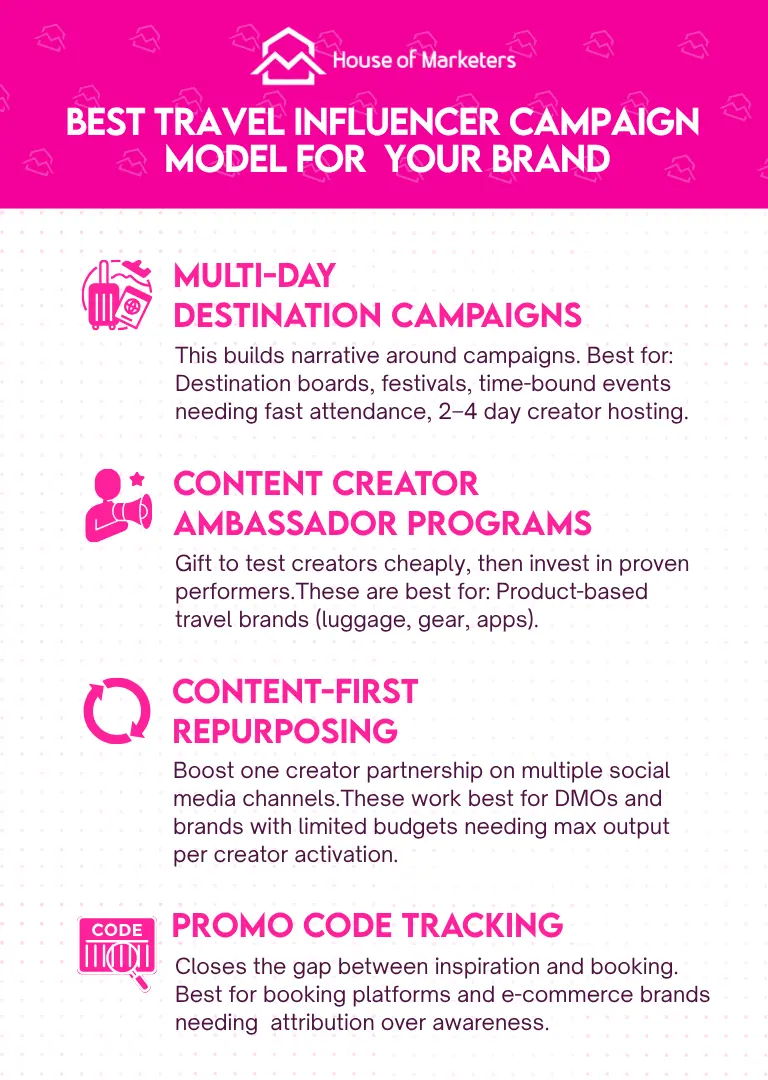
Travel brands drive measurable bookings with influencer marketing by moving past one-off sponsored posts toward four proven models: multi-day destination campaigns, tiered ambassador programs, content-first repurposing, and affiliate storefronts with trackable attribution. The brands that profit from travel influencer marketing aren’t chasing views, they are tying creator content to arrivals, length of stay, and booking revenue to measure ROI.
The thing is, travellers don’t plan trips from brochures anymore. They plan them from creator Reels in their feed. Research indicates 39% of consumers say influencer content shapes where they travel, and 57% say creators influence their booking decisions — which means creator content isn’t a side channel in the funnel, it’s the booking journey itself.
These statistics prove that creator content isn’t a side channel in the marketing funnel anymore; it’s the booking journey itself.
But most travel brands are investing in influencer marketing the old way. They confuse follower count with engagement. Their stakeholders expect one-off partnerships to carry the whole campaign’s KPI weight. And worst of all, there’s no clarity on how to measure if a creator’s post caused an actual booking.
This guide breaks down how real travel brands use influencer partnerships to drive measurable bookings. We analyse four proven frameworks with real case studies, along with the campaign metrics measurement system that separates a viral moment from a profitable campaign.
Travel Brands’ Influencer Marketing Frameworks That Delivered Measurable Results
Let’s analyse the influencer marketing strategy of 4 travel brands that derived measurable results from their campaigns. We deconstruct their case, strategy, and execution. Let’s get into it.
1. Meghalaya Tourism’s Hype Campaigns for Cherry Blossom Shillong Festival using Micro-Influencers
Source: meghalayatourism
The Case
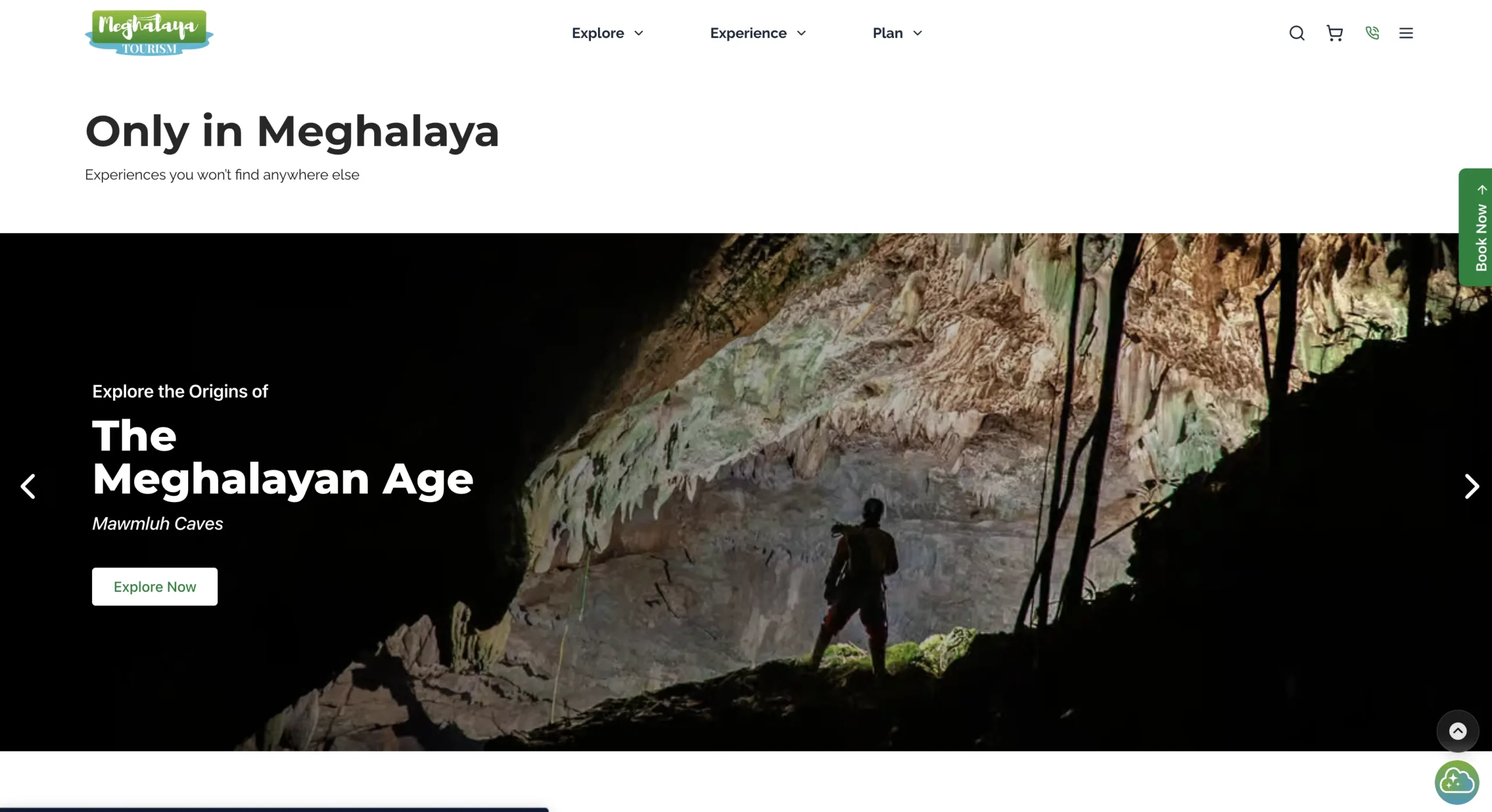
Meghalaya Tourism is a destination board in northeast India. In 2025, they had an incredible music festival coming up, but they needed to drive attendance fast. Instead of a single sponsored post from a celebrity, they partnered with multiple high-profile Indian and international travel influencers for multi-day content captures during the festival itself.
What happened
The influencers didn’t just post a single moment. They created authentic, ongoing stories—setting, journey, experiences, culture, food. The campaign delivered a footfall increase of 40% compared to previous editions, totaling 150,000+ visitors during the festival period. The campaign also won two gold awards at the WOW Awards Asia 2025.
View this post on Instagram
Why it works
Multi-day campaigns eliminate the biggest weakness of one-off influencer posts.
A single post plants the seed of inspiration in the viewer. BUT! Multiple posts create a narrative around that experience that inspires “want” & excitement.
This is the strategy that gets your viewer asking, “Should I book here?” These are questions a brochure alone can never answer.
How to Implement it for your Travel Brand
- Host creators for 2–4 days (covers travel + immersion time)
- Brief for daily content across Stories, Reels, and long-form video
- Let creators choose their narrative angle (don’t script execution)
- Repurpose content across your owned channels and paid ads using paid media boosting
- Measure: Visitor arrivals linked to campaign date + average length of stay
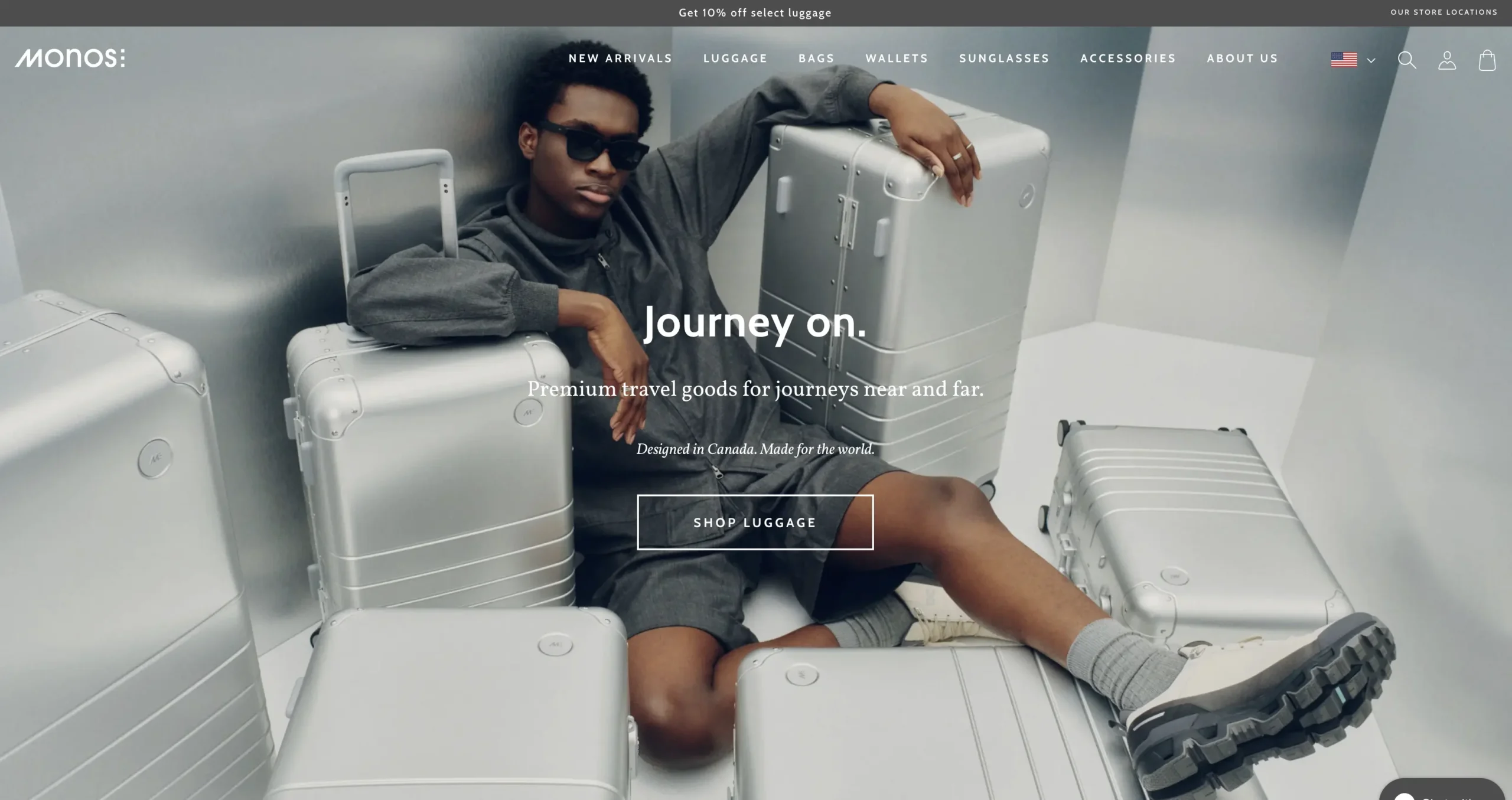
2. Monos’s Long-Term Ambassador Programs
Source: Monos’s
The case
Monos, a luxury luggage brand, wanted to find a way to expand influencer partnerships without losing their authenticity.
To achieve this, they used a tiered system. Instead of treating all influencer collaborations as one-off deals, Monos built three distinct tracks.
Always-on gifting
Products flow to macro-influencers at a consistent pace. Costs stay low (product + shipping), and these creators generate high-quality content that can be repurposed into paid ads.
UGC engine
A second always-on program targets nano and micro-influencers, asking them to create user-generated content with Monos products. This is volume-focused. Hundreds of creators, dozens of pieces of content, and low individual cost.
@monostravel We take quality testing very seriously at Monos HQ. #luggagedurability #checkinluggage ♬ original sound – Monos Travel
Ambassador program
Monos cherry-picks top performers from the UGC pool and invites them into long-term paid partnerships. These ambassadors get cash on top of product, benefit from deeper creative direction, and help Monos achieve measurable business goals.
@aliciaamaclaren A quick guide for those struggling to figure out which Monos luggage is right for you! ✨ #monospartner @Monos #ad #monostravel #luggagecomparison ♬ original sound – Alicia Maclaren
Why it works
This structure is a funnel.
- The top of the funnel (always-on gifting) generates constant organic content.
- The middle (UGC) tests hundreds of potential creators cheaply.
- The bottom (ambassadors) rewards proven performers and builds genuine relationships.
How to Implement it for your Travel Brand
- Start with open influencer seeding campaigns (product only, no cash)
- Track metrics for performance like engagement rate, authentic audience response, content quality
- Invite top 5–10% of UGC creators into paid ambassador tier (6–12 month contracts)
- Use ambassadors for campaign leadership + owned-channel content
- Measure: Content quality improvement + booking lift in ambassador posts vs. gifted posts
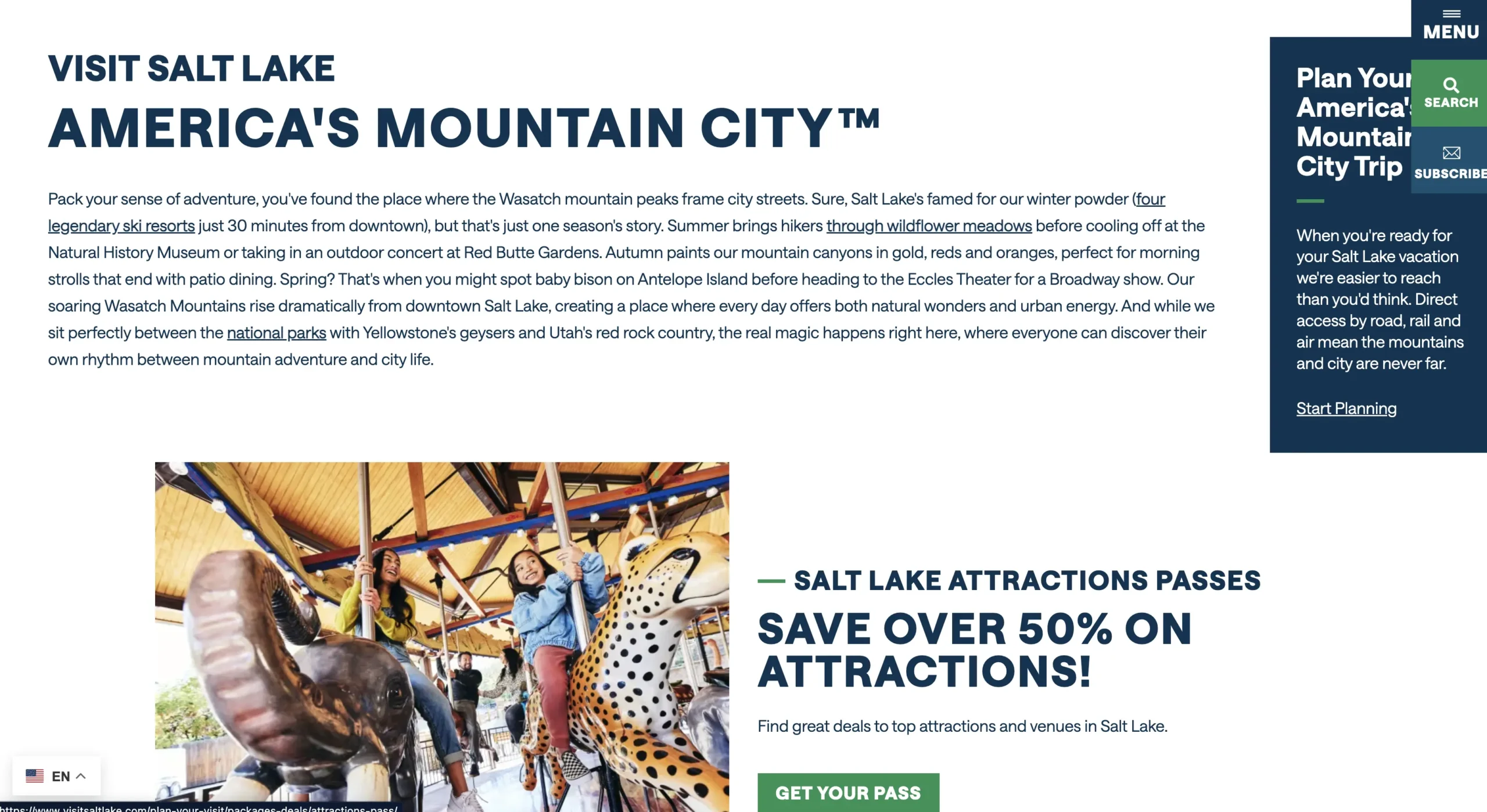
3. Salt Lake Content-First Repurposing
Source: Visit Salt Lake
The case
Visit Salt Lake is a destination marketing organization. They ran a multi-creator campaign and produced 80+ pieces of creator-generated travel content. Instead of treating each piece as a one-time social post, they built a content library designed for reuse.
What happened
A single creator photo from a hiking trip became:
- An Instagram Reel (organic reach)
- A paid Meta ad ($500+ spent amplifying it)
- A hero image in an email campaign
- Social proof on the Visit Salt Lake website
- A testimonial quote in a sales deck
That one creator partnership was amortized across six different marketing channels. The ROI per activation multiplied as well.
Why it works
Content-first strategy uses the logic that every piece of creator content should work across owned channels, paid ads, email, and organic social.
This increases the surface area for the brand to get more traction on the same piece of content.
How to Implement it for your Travel Brand
- Budget for extended content usage rights (not just social posting rights)
- Request photo sets, not just individual images
- Capture behind-the-scenes + finished content
- Build a content library with tagging (destination, activity, season, audience demographic)
- Repurpose: organic social → paid ads → email → owned website
- Measure: Cost per piece ÷ number of channels used = true ROI per creation
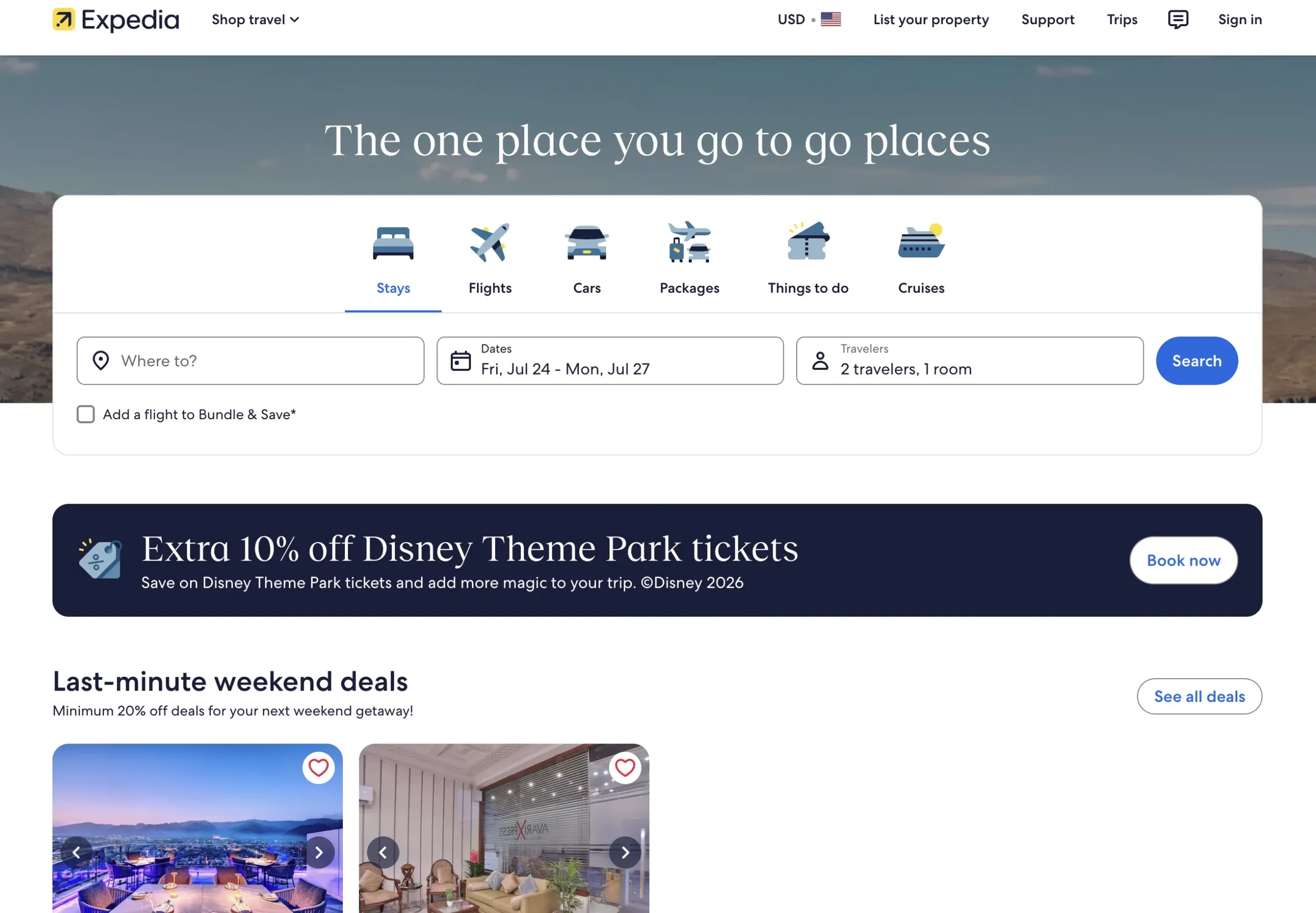
4. Expedia’s Affiliate & Promo Code Tracking
Source: Expedia
The case
Expedia is a booking platform and they launched a new strategy in 2025 introducing influencer Expedia Travel Shops. Instead of asking influencers to promote Expedia through traditional posts, Expedia gave creators curated storefronts where they could recommend specific destinations, hotels, and experiences. The CTA was that travelers could book directly from the influencer’s storefront.
View this post on Instagram
What happened
Travelers stopped at the inspiration stage and moved directly to booking. Influencers got paid not just for content creation but for performance. Expedia could track every recommendation back to a booking.
Why it works
This is the highest-intention model. It removes friction between “I want to go there” and “I’m booking.” It also ties creator compensation directly to results, which realigns incentives. Creators are motivated to recommend bookable destinations and experiences, not just aspirational ones.
How to Implement it for your Travel Brand
- Create branded affiliate links or promo codes for each creator
- Use UTM parameters to track source (creator name, campaign, platform)
- Integrate with your CRM to capture booking source
- Pay commission on bookings (not just clicks) or base fee + performance bonus
- Measure: Attribution report showing which creators drove highest booking volume + revenue per creator
How to Track Multi-Touch Attribution in Travel Influencer Campaigns
Almost all influencer campaigns suffer from the “how to measure success” dilemma. Did the influencer drive bookings? Which bookings? How much revenue?
For years, travel boards and hospitality brands couldn’t answer those questions. No proof that the influencer campaign actually moved the needle.
In 2026, the best travel brands finally solved this. Here’s how.
The Multi-Touch Attribution Model
A traveler’s journey to booking is rarely one click. It looks like this:
- Sees creator’s Reel about mountain hiking (January)
- Saves the post
- Returns to the post three weeks later, clicks creator’s link
- Lands on your destination page
- Leaves to research (Google search, competitor comparison, etc.)
- Opens your email about “early spring hiking season” (you’re retargeting)
- Clicks the link, browses hotels
- Books a week later
Without multi-touch attribution, credit goes entirely to email (last touch). With Multi touch attribution, you see the full chain: creator was the inspiration catalyst. Email was the conversion trigger. Both mattered to achieve the desired outcome.
How to set up Multi-Touch Attribution in Travel Influencer Campaigns:
- Add UTM parameters to every creator link. A UTM link looks like a link like this “?utm_source=creator&utm_medium=instagram&utm_campaign=jane_hiking&utm_content=mountain_reel”
- Use unique promo codes for each creator i.e, “JANE20”
- Integrate your booking system with your CRM (Salesforce, HubSpot, Pipedrive)
- Set attribution model in Google Analytics to “position-based” (40% first touch, 40% last touch, 20% middle) or “time-decay”
- Measure: Creator-attributed revenue, conversion rate by creator, customer lifetime value by creator source
The Best KPIs to measure in Travel Influencer Campaigns
Measure your influencer marketing against these KPIs:
In-destination arrivals linked to digital campaigns.
The only metric that ultimately counts: did the content put people in the destination? Track it through creator promo codes redeemed on-site and booking data cross-referenced against arrival dates. 400 tracked arrivals beats 4 million views every time.
Average length of stay for digitally influenced visitors.
A three-night booking is worth triple a one-night booking. Segment influenced bookings by promo code and compare their average stay to your baseline. Creators whose audiences book longer trips are reaching high-value travellers — often where micro-creators outperform.
Conversion rate from campaign traffic to booking.
The percentage of campaign visitors who actually book. A high click-through with a low booking rate signals a broken handoff. The problem could be anything from a slow landing page, pricing mismatch, or even marketing to the wrong audience.
Track conversion rate per creator; it separates creators who entertain from creators who sell.
House of Marketers Recommendation for Travel Brands who want to Find their Audience in 2026:
Social Search is rewriting how travellers find you. Social Search indicates that travellers aren’t starting on Google anymore. They’re searching inside the feed.
According to Adobe Express‘s recent research surveying over 800 US consumers, nearly half of US consumers (49%) now use TikTok as a search engine, and TikTok search adoption has grown by nearly 20% since 2024.
For a travel brand, this is where the “whats the best time to visit X,” or “hidden gems in Y” queries are being asked.
Gen Z leads social search adoption at 25%, followed by millennials at 17%. These are the people planning trips for the next decade.
As House of Marketers CEO, Inigo Rivero recently commented on the power of Social Search:
“Social search has changed how discovery works. Audiences are much less likely to search for your brand on Google. They’re now identifying their latest destination on platforms like TikTok. Algorithm’s and search results within social media is personalised based on user behaviour and engagement habits.”
For travel, personalisation-by-behaviour is the whole game. A traveller who has watched more hiking videos than another person is likely to be served more hiking destinations via organic posts and paid ads.
The creator who owns that niche shows up exactly when intent peaks, which is precisely why micro-creator specialisation (covered above) compounds inside social search rather than fighting against it.
Short-Form Video Dominates Travel Bookings
The most important finding for travel marketers is what people search for.
Tutorials dominate TikTok search content at 61%, followed by product reviews (45%), personal stories (41%), and influencer recommendations (33%).
This is basically a checklist for a destination creator’s entire content library.
- A “what to pack for Patagonia” tutorial,
- An honest resort review, a solo-travel story,
- A “you have to stay here” recommendation.
Platform Strategy for Influencer Marketing For Travel Brands
TikTok: Trend-driven, trend-aware audiences, cultural relevance. Creators who understand trends and can hook attention in the first second. Destination fit: adventure, digital nomad, Gen Z-targeted.
Instagram: Aspirational visuals, curated feeds, discovery via Explore. Creators with strong aesthetic consistency. Destination fit: luxury, wellness, high-aesthetic categories (overwater bungalows, infinity pools, sunset locations).
YouTube Shorts: Slightly longer storytelling (up to 60 seconds), deeper narrative. Destination fit: multi-day itineraries, decision-making transparency (“I wish I’d known”), experience walkthroughs.
Strategy: Don’t force all creators onto all platforms. Match creator style to platform. A visual luxury creator belongs on Instagram. A storyteller belongs on YouTube. A trends-native creator belongs on TikTok.
Final Thoughts
Most travel brands get the content creation piece right. But the gap between great content and profitable campaigns is exactly what separates a viral moment from a sustainable strategy.
At House of Marketers, we help brands design and execute influencer marketing strategies built for this shift. From creator selection to content structuring and paid media boosting, our focus is on long-term performance in environments where authenticity and relevance drive results. So Contact House of Marketers for a free campaign proposal today!
Contact for Free Campaign Proposal
Read more: